
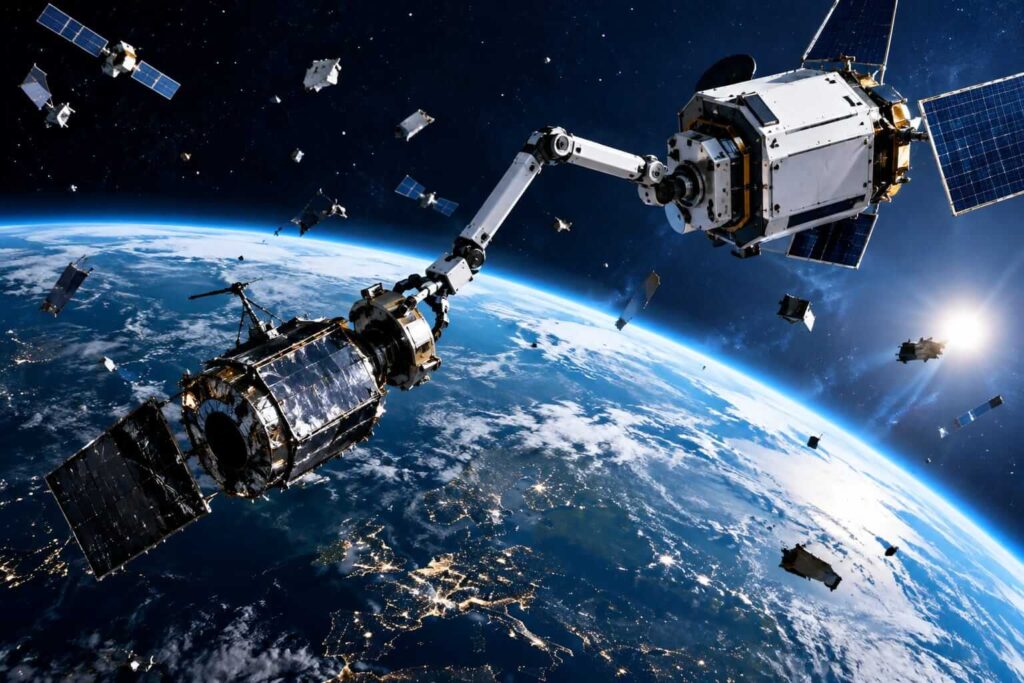
Space Debris: How Scientists Plan to Clean Up Earth’s Orbit
Introduction
Space debris is becoming one of the biggest challenges facing the future of space exploration. Thousands of inactive satellites, spent rocket stages, fragments and other human-made objects are moving around Earth at extremely high speeds. Even a small piece of debris can damage or destroy an operational spacecraft during a collision.
As satellite launches increase, especially with large constellations providing internet, navigation and Earth-observation services, keeping Earth’s orbital environment safe is becoming more important. Scientists and space agencies are therefore developing new ways to prevent additional debris and remove some of the most dangerous objects already in orbit.
From robotic spacecraft and robotic arms to controlled re-entry and new satellite designs, the future of space debris cleanup could look very different from today’s approach.
Table of Contents
1. Why Space Debris Matters
2. What Is Space Debris?
3. Why Is Earth’s Orbit Getting Crowded?
4. How Space Debris Can Threaten Satellites
5. How Scientists Plan to Clean Up Space Debris
6. Robotic Spacecraft and Active Debris Removal
7. The Role of ClearSpace-1
8. Preventing New Space Debris
9. Benefits of Cleaning Earth’s Orbit
10. Challenges Scientists Must Solve
11. Practical Checklist
12. FAQ
13. Conclusion
Why Space Debris Matters
Earth’s orbit is becoming an increasingly valuable environment.
Satellites support everyday services that many people rarely think about. Weather forecasting, GPS and navigation, communications, television, internet connectivity, disaster monitoring and scientific research all depend on spacecraft operating safely above Earth.
However, satellites are not the only objects orbiting the planet.
Old spacecraft, discarded rocket stages, fragments from explosions and collision-generated pieces can remain in orbit for years or even decades.
The European Space Agency’s 2026 Space Environment Report warns that insufficient end-of-life disposal is contributing to increasing collision risks. ESA also reports that more than three intact satellites or rocket bodies reenter Earth’s atmosphere on average each day, while around ten new payloads are launched daily.
This creates an important challenge: space must remain usable for future generations
What Is Space Debris?
https://www.nasa.gov/headquarters/library/find/bibliographies/space-debris/
Space debris, also called orbital debris or space junk, refers to human-made objects in space that no longer serve a useful purpose.
These objects can include:
- Defunct satellites
- Spent rocket stages
- Broken spacecraft components
- Fragments created by collisions
- Pieces released during satellite operations
- Small metal or composite fragments
- Objects left behind after spacecraft break apart
The important point is that size does not always determine danger.
A tiny fragment travelling at orbital velocity can carry enough energy to damage sensitive spacecraft.
For example, a small piece of metal may look harmless when held in your hand. In orbit, however, it can become a high-speed projectile.
This is why tracking, collision avoidance and debris mitigation are critical parts of modern space operations.
Why Is Earth’s Orbit Getting Crowded?
https://futurescienceai.com/blog/space-astronomy/life-on-other-planets-science-explained/
The number of satellites around Earth has grown rapidly.
Commercial communications networks, Earth-observation satellites, scientific missions and navigation systems are all increasing demand for orbital space.
At the same time, older objects do not simply disappear when their missions end.
Some satellites can naturally lose altitude because of atmospheric drag and eventually burn up during re-entry. Others can remain in orbit for much longer.
ESA estimates that the number of objects larger than 1 centimetre is already extremely large, with more than 1.2 million objects estimated in orbit.
This creates a difficult situation.
Even if humanity stopped launching new spacecraft, existing objects could still collide and produce additional fragments.
That possibility is associated with the Kessler syndrome, a scenario in which collisions generate more debris, which then increases the chance of additional collisions. NASA describes this process as a potential runaway chain reaction
How Space Debris Can Threaten Satellites
The biggest concern is collision risk.
Imagine two objects travelling around Earth at several kilometres per second. They do not need to be enormous to cause serious damage when they collide.
A collision can:
1. Damage an operational satellite.
2. Destroy important spacecraft systems.
3. Create hundreds or thousands of fragments.
4. Increase the probability of additional collisions.
5. Make certain orbital regions more difficult to use.
This creates a difficult feedback loop.
More debris can create more collisions. More collisions can create even more debris.
Therefore, cleaning space is not simply about making orbit look less crowded. It is about reducing future collision risks.
How Space Debris Cleanup Could Work
Scientists are developing several complementary strategies rather than relying on one giant “space vacuum cleaner.”
The main approaches include:
- Active debris removal
- Controlled atmospheric re-entry
- Robotic capture
- End-of-life satellite disposal
- Design-for-removal technology
- Collision avoidance
- Better tracking and space traffic coordination
- Preventing explosions and fragmentation
The most important concept is active debris removal, or ADR.
ESA defines active debris removal as sending a spacecraft to rendezvous with a piece of debris, capture it and then change its orbit so that the object can be safely disposed of.
Robotic Spacecraft and Active Debris Removal
One of the most promising ideas is to use a specialized spacecraft as a robotic “cleanup vehicle.”
The cleanup spacecraft would first locate and approach its target.
However, reaching the object is only the beginning.
Step 1: Find the target
Ground-based tracking systems monitor objects in orbit.
The cleanup mission needs accurate information about the target’s position, speed, orientation and orbit.
Step 2: Match the orbit
The servicing spacecraft must carefully adjust its own orbit until it can safely approach the target.
This is a complex process because both spacecraft are moving at extremely high speeds.
Step 3: Inspect the object
The cleanup spacecraft may use cameras, sensors and navigation systems to determine how the target is moving.
This is especially important if the satellite is tumbling.
Step 4: Capture the debris
Different missions could use different capture technologies.
Possible methods include:
- Robotic arms
- Nets
- Harpoons
- Gripping mechanisms
- Docking interfaces
- Specialized capture devices
The method depends heavily on the target.
Step 5: Change the orbit
After capture, the servicing spacecraft can change the combined system’s trajectory.
The goal may be to lower the object’s orbit until atmospheric drag causes it to reenter and burn up.
ESA explains that a chaser spacecraft may match the target’s orbit, capture it and then change the orbit of the combined system for safe disposal.
The Role of ClearSpace-1
One of the most important European efforts is ClearSpace-1.
The European Space Agency describes ClearSpace-1 as a mission designed to demonstrate the removal of an unprepared and uncooperative object from orbit.
The target is ESA’s PROBA-1 satellite, a spacecraft weighing approximately 95 kg. The mission is currently planned for launch in 2029.
The spacecraft will use four robotic arms to capture the target.
This is technically challenging because PROBA-1 was not originally designed to be captured by another spacecraft.
ESA’s 2026 program information says the mission is intended to demonstrate technologies including robotic capture, close-proximity guidance, navigation and control, and safe post-capture disposal.
The significance goes beyond one satellite.
If these technologies work reliably, future servicing vehicles could potentially be used to remove multiple dangerous objects.
Prevention Is Just as Important as Cleanup
Cleaning existing debris is only half of the solution.
If new debris continues to be created faster than old debris is removed, the problem will continue.
Therefore, space agencies and satellite operators are also focusing heavily on prevention.
Better end-of-life planning
Satellites should have a plan for what happens after their missions end.
Depending on the orbit and mission, this could involve controlled re-entry, moving to another orbit or another approved disposal strategy.
Design for removal
Future spacecraft can be designed so that another spacecraft can safely capture them.
ESA calls this approach Design for Removal, or D4R.
Potential features include visual markers, navigation aids, capture interfaces and other technologies that make future servicing easier.
Avoiding accidental fragmentation
Satellite operators also need to reduce the chance of explosions and breakups.
This means managing fuel, batteries and other stored energy sources properly at the end of a mission.
NASA maintains specific orbital debris mitigation requirements for spacecraft and launch vehicles.
Benefits of Cleaning Earth’s Orbit
Cleaning orbital space could provide several long-term benefits.
1. Safer satellites
Reducing large debris objects can lower collision risks for operational spacecraft.
2. More reliable space services
Communications, weather forecasting, navigation and Earth observation depend on functioning satellites.
3. Safer space exploration
Future lunar and deep-space missions will depend on reliable access through Earth’s orbital environment.
4. Support for commercial space
Private companies are increasingly developing satellites and space-based services.
A cleaner orbital environment could make long-term commercial activity more sustainable.
5. Protection for future generations
Space is becoming an important infrastructure environment.
Keeping it usable today can help prevent future generations from inheriting an increasingly hazardous orbital environment.
Challenges Scientists Must Solve
Space debris cleanup sounds straightforward until engineers consider the real conditions.
The target may be tumbling
An inactive satellite may rotate unpredictably.
A servicing spacecraft must approach it without causing another collision.
Debris is moving extremely fast
Orbital objects travel at enormous speeds.
A small navigation error can become a serious problem.
Every mission is expensive
Launching a spacecraft, operating it and performing complex rendezvous operations requires significant resources.
For cleanup to become routine, costs must eventually become more manageable.
Not every object can be removed
There are millions of debris objects.
Scientists therefore need to identify which objects pose the greatest long-term risk.
ESA notes that removing selected large objects can help control the growth of debris populations in important orbital regions.
International cooperation is essential
Satellites and debris do not respect national borders.
An object launched by one country can threaten spacecraft operated by another.
Therefore, long-term orbital sustainability requires cooperation between governments, space agencies and private companies.
Practical Checklist: How to Keep Earth’s Orbit Safer
For future satellite missions, responsible operators should consider:
- Plan spacecraft disposal before launch.
- Track the satellite throughout its operational life.
- Monitor potential conjunctions.
- Reduce the possibility of explosions after mission completion.
- Follow recognized orbital debris mitigation standards.
- Consider design-for-removal features.
- Develop reliable end-of-life procedures.
- Support responsible space traffic management.
- Consider active debris removal for high-risk objects.
- Share relevant orbital information with appropriate authorities.
NASA’s current orbital debris requirements provide technical processes for limiting the creation of debris during space missions.
CTA: Explore the Future of Space Technology
Space debris is not only an environmental challenge in orbit. It is a technology challenge that will influence the future of satellites, robotics, artificial intelligence and space exploration.
At Future Science AI, we explore the technologies shaping tomorrow—from artificial intelligence and robotics to quantum computing, clean energy and space exploration.
Stay connected with Future Science AI for practical insights into the science and technologies transforming our future.
FAQ
1. What is space debris?
Space debris is human-made material left in Earth’s orbit that no longer serves a useful purpose. It includes inactive satellites, spent rocket stages and fragments created by spacecraft breakups or collisions.
2. Why is space debris dangerous?
Space debris can travel at extremely high speeds. Even relatively small objects can damage operational spacecraft during a collision, potentially creating additional debris.
3. How will scientists remove space debris?
Scientists are developing active debris removal missions using spacecraft equipped with technologies such as robotic arms, capture mechanisms, navigation systems and controlled orbital maneuvers.
4. What is ClearSpace-1?
ClearSpace-1 is an ESA-supported active debris removal mission designed to demonstrate the capture and removal of ESA’s PROBA-1 satellite. ESA currently lists its planned launch for 2029.
5. Can space debris be completely removed?
Completely removing every piece of debris is not currently realistic. Scientists are instead focusing on preventing new debris and removing selected large or particularly risky objects that can contribute significantly to future collision risks
Conclusion
Space debris is becoming a major challenge for the future of space exploration. As more satellites enter orbit, preventing collisions and safely disposing of old spacecraft will become increasingly important.
Scientists are responding with a combination of technologies. Robotic servicing spacecraft, active debris removal, controlled re-entry, improved tracking and design-for-removal systems could all play a role.
The goal is not simply to remove everything from orbit. Instead, the long-term strategy is to prevent new debris while selectively removing objects that create significant risks.
ESA’s latest environmental assessment emphasizes that prevention alone may no longer be enough and that active debris removal will be an important part of stabilizing the orbital environment.
The future of space depends on keeping Earth’s orbital highways usable.
If scientists, governments and private space companies can combine responsible mission design with advanced robotics and debris-removal technologies, humanity can continue expanding into space without turning Earth’s orbit into an increasingly dangerous environment.