
Quantum Simulation: How Quantum Computers Could Transform Drug Discovery
Introduction
Quantum simulation could become one of the most important applications of quantum computing because chemistry itself operates according to quantum mechanics. By using quantum computers to model molecules and their electronic behavior, researchers hope to understand chemical reactions and drug-target interactions with greater accuracy than some conventional approaches can provide.
Drug discovery is already heavily dependent on computational science. Researchers use computers to screen compounds, predict molecular structures, study protein interactions, and identify promising drug candidates before laboratory testing. However, biological molecules can be extremely complicated, and accurately modeling their behavior can demand enormous computational resources.
That is where quantum simulation enters the picture.
Instead of replacing traditional computers, future quantum systems are more likely to work alongside classical computers, artificial intelligence, GPUs, and high-performance computing systems. Recent research is already exploring hybrid quantum-classical workflows for molecular and protein simulations.
So, could quantum simulation genuinely transform pharmaceutical research? The answer is potentially yes — but important technical challenges still need to be solved.
Table of Contents
1. Why Quantum Simulation Matters for Drug Discovery
2. What Is Quantum Simulation?
3. How Quantum Computers Could Simulate Molecules
4. Quantum Simulation in Drug Discovery
5. Key Benefits of Quantum Simulation
6. Quantum Simulation vs Traditional Computing
7. A Step-by-Step Quantum Drug Discovery Workflow
8. Current Challenges and Limitations
9. Common Mistakes to Avoid
10. Practical Checklist.
11. Frequently Asked Questions
12. Conclusion
Why Quantum Simulation Matters for Drug Discovery
Developing a new medicine is a long and complicated process. Scientists must identify biological targets, discover potential compounds, test how those compounds interact with targets, evaluate safety, and eventually move successful candidates through clinical development.
Computational tools can reduce the number of molecules that need to be synthesized and tested in laboratories. Nevertheless, accurately predicting molecular behavior remains difficult.
One reason is the enormous chemical space available to researchers. The number of theoretically possible drug-like molecules is often described as being extraordinarily large, making exhaustive experimental testing impossible.
Quantum computing is attracting attention because molecules are governed by quantum mechanical effects. In principle, quantum computers may offer a more natural way to represent and calculate certain molecular properties.
This does not mean every pharmaceutical problem will suddenly become faster. Instead, the greatest opportunity may come from carefully selected chemistry problems where classical approximations struggle.
What Is Quantum Simulation?
Quantum simulation is the use of quantum computing techniques to reproduce or study the behavior of quantum systems.
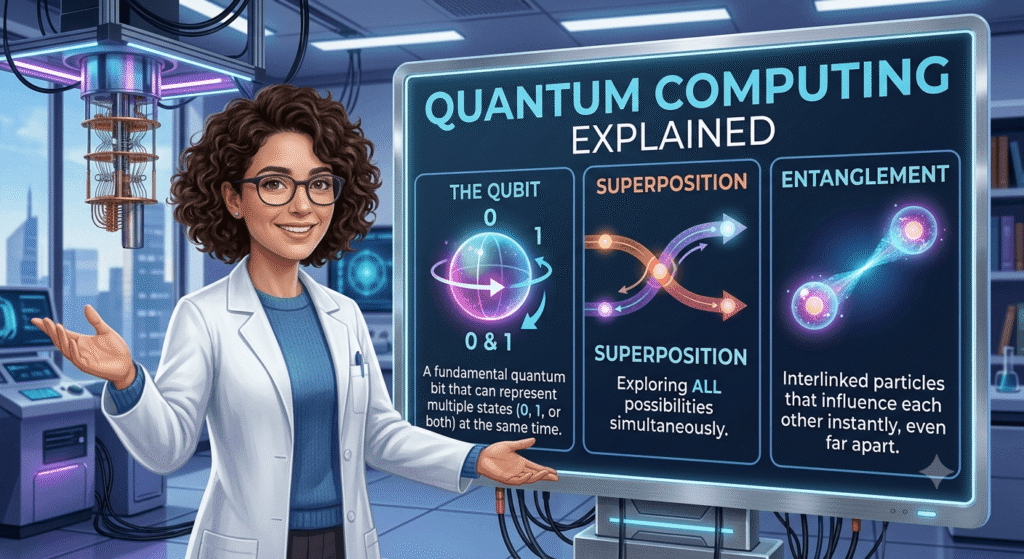
A conventional computer stores information using bits represented as 0s and 1s. A quantum computer uses qubits, which can exist in quantum states involving combinations of 0 and 1.
Through quantum phenomena such as superposition and entanglement, quantum algorithms can process information in ways that differ fundamentally from classical algorithms.
Why Molecules Are a Natural Target ?
Atoms and molecules are quantum systems. Their electrons occupy quantum states, and these states influence how molecules bond, react, absorb energy, react with other molecules, and interact with biological targets.
For example, understanding the electronic structure of a molecule can help researchers estimate its stability and chemical behavior.
Classical quantum chemistry already provides powerful methods such as density functional theory and other electronic-structure techniques. However, increasing molecular complexity can make highly accurate calculations computationally demanding.
Quantum computers are being investigated as another computational approach for these problems.
How Quantum Computers Could Simulate Molecules?
The basic idea is to translate information about a molecule into a mathematical representation that a quantum computer can process.
Researchers can represent molecular orbitals and electronic states using qubits. Quantum algorithms then manipulate these states to estimate properties such as molecular energies.
Two important approaches frequently discussed in quantum chemistry are Variational Quantum Eigensolver (VQE) and Quantum Phase Estimation (QPE).
Variational Quantum Eigensolver
VQE is a hybrid quantum-classical approach.
A quantum processor prepares a trial quantum state, while a classical computer adjusts parameters in an attempt to find a lower-energy state.
The process can be repeated:
1. Prepare a quantum state.
2. Measure relevant properties.
3. Send results to a classical optimizer.
4. Adjust the quantum circuit.
5. Repeat until the calculation reaches an acceptable solution.
This hybrid approach is particularly interesting for current quantum hardware because classical and quantum resources can share the workload.
Quantum Phase Estimation
Quantum Phase Estimation takes a different approach and is associated with high-precision estimation of quantum system properties.
It is particularly important in discussions about future fault-tolerant quantum computers because accurate molecular energy calculations could become possible for increasingly complex systems.
However, large-scale practical implementations require quantum hardware with much better error correction and reliability than today’s systems generally provide.
Quantum Simulation in Drug Discovery
The biggest opportunity is not simply “faster chemistry.” It is better information about molecules.
1. Understanding Drug-Target Interactions
A drug must interact with a biological target in a useful way.
Quantum simulation could eventually provide more detailed information about electronic interactions between a drug molecule and its target.
This could help researchers investigate:
- Binding behavior
- Molecular energies
- Reaction mechanisms
- Electronic structures
- Chemical stability
- Covalent interactions
Researchers are already investigating hybrid quantum-classical methods for realistic drug-design problems, including covalent interactions and molecular energy calculations.
2. Improving Molecular Design
Imagine researchers have thousands of possible compounds.
Instead of synthesizing every candidate, computational models can help prioritize the most promising molecules.
Quantum-enhanced calculations could eventually provide additional molecular information that classical drug-design tools can use to rank candidates.
The result could be a workflow where:
AI generates molecules → classical systems screen them → quantum simulation studies difficult molecular properties → researchers select the strongest candidates.
This hybrid model could be particularly powerful.
3. Exploring Difficult Chemical Reactions
Some drug-development processes involve complicated chemical reactions.
Quantum computers could potentially model reaction pathways and electronic changes more directly, helping researchers understand why a particular reaction succeeds or fails.
Better reaction modeling could support medicinal chemistry, pharmaceutical manufacturing, and the development of new therapeutic compounds.
4. Studying Complex Biological Molecules
One of the most exciting developments is the increasing scale of quantum-classical molecular simulations.
In 2026, researchers from Cleveland Clinic, RIKEN, and IBM reported a quantum-centric workflow that reached simulations involving more than 12,000 atoms, including protein-ligand systems.
This does not mean quantum computers can already simulate an entire human cell accurately.
Instead, it demonstrates how combining quantum processors with classical supercomputers may allow researchers to attack increasingly difficult molecular problems.
Quantum Simulation vs Traditional Computing
Classical computers remain extremely important in drug discovery.
Modern pharmaceutical research already uses:
- High-performance computing
- Molecular dynamics
- Density functional theory
- Machine learning
- AI-based molecular generation
- Cloud computing
- GPU acceleration
Quantum computing should therefore be viewed as an additional tool rather than an immediate replacement.
The most realistic future is likely to involve hybrid computing.
A classical computer may handle data processing and optimization. GPUs may perform large numerical workloads. AI may search chemical space. A quantum processor could tackle specific quantum-mechanical calculations.
IBM describes this type of architecture as quantum-centric supercomputing, where CPUs, GPUs, and quantum processing units work together.
A Step-by-Step Quantum Drug Discovery Workflow
A future quantum-assisted drug discovery process could look like this:
Step 1 — Identify a Biological Target
Researchers first identify a protein, enzyme, receptor, or other biological target associated with a disease.
Step 2 — Generate Candidate Molecules
AI and conventional computational chemistry tools can generate or identify potential compounds.
Step 3 — Perform Classical Screening
Large numbers of candidates can be screened using established computational methods.
Weak candidates are removed.
Step 4 — Select Difficult Problems
Researchers can identify molecular calculations where greater accuracy could make a meaningful difference.
Step 5 — Run Quantum Simulation
Selected molecular systems are mapped onto quantum circuits and analyzed using appropriate quantum algorithms.
Step 6 — Combine the Results
Quantum results can be integrated with classical simulations, AI models, and experimental data.
Step 7 — Laboratory Validation
Finally, promising candidates must still be synthesized and experimentally tested.
This last step is critical. A quantum simulation is not a replacement for biological experiments or clinical trials.
Common Mistakes to Avoid
Mistake 1 — Assuming Quantum Computers Are Already Replacing Supercomputers
They are not.
Current quantum hardware has limitations involving noise, errors, circuit depth, scalability, and algorithm implementation.
Mistake 2 — Believing Quantum Computing Automatically Means Faster Computing
Quantum advantage is problem-specific.
A quantum computer will not automatically outperform a classical computer for every calculation.
Mistake 3 — Ignoring Classical Chemistry
Decades of research have produced highly effective computational chemistry techniques.
Quantum computing needs to demonstrate meaningful advantages against these strong classical baselines.
Mistake 4 — Expecting Immediate New Medicines
Drug discovery remains a long scientific process.
Even if quantum simulation identifies a promising compound, researchers still need laboratory validation, preclinical testing, clinical trials, regulatory review, and manufacturing.
Mistake 5 — Treating Quantum Claims as Guaranteed Results
The field is developing quickly, but many proposed pharmaceutical applications remain research projects rather than routine industrial tools.
Nature Physics researchers have emphasized that quantum computers are still far from being everyday tools in pharmaceutical drug design and that significant technical progress remains necessary.
Practical Checklist for Understanding Quantum Drug Discovery
Before evaluating a quantum drug-discovery project, ask:
- What specific molecular problem is being solved?
- Is the problem genuinely difficult for classical methods?
- What quantum algorithm is being used?
- How many qubits are required?
- How are errors handled?
- What classical baseline is being compared?
- Does the method work on realistic molecular systems?
- Can the results be experimentally validated?
- Can the workflow scale?
- Does the approach provide useful information to medicinal chemists?
This checklist can help businesses and researchers separate realistic opportunities from exaggerated claims.
Frequently Asked Questions About Quantum Simulation
https://futurescienceai.com/blog/quantum-technology/biggest-challenges-in-quantum-computing-guide/
Q1: What is quantum simulation in drug discovery?
Quantum simulation uses quantum computers to model molecular and chemical behavior. In drug discovery, it could help researchers study electronic structures, molecular energies, reactions, and drug-target interactions.
Q2: Can quantum computers discover new drugs?
Potentially, but quantum computers do not independently discover medicines. They could become one component of a broader drug-discovery workflow involving AI, classical computing, laboratory experiments, and clinical research.
Q3: Why are molecules difficult to simulate?
Molecules contain interacting electrons and nuclei governed by quantum mechanics. As molecular systems become more complicated, obtaining highly accurate simulations can require substantial computational resources.
Q4: Will quantum computing replace AI in drug discovery?
No. Quantum computing and AI are more likely to complement each other. AI can search and generate potential molecules, while quantum simulation may provide detailed calculations for selected chemical problems.
Q5: When will quantum simulation transform pharmaceutical research?
The timing is uncertain. Researchers are already demonstrating increasingly sophisticated quantum-classical chemistry simulations, but large-scale, fault-tolerant quantum computing is still developing. Practical pharmaceutical advantage will depend on hardware, algorithms, error correction, and comparisons with improving classical methods.
Take the Next Step Into the Future of Science
Quantum computing is moving from an abstract research concept toward increasingly practical experiments in chemistry and biology.
For pharmaceutical companies, researchers, technology leaders, and innovators, understanding this transition early can provide an important strategic advantage.
At Future Science AI, we explore emerging technologies that could shape the future of healthcare, artificial intelligence, science, and computing.
Want to understand how AI, quantum computing, and emerging technologies could affect your industry? Explore more Future Science AI research or contact us to discuss the technologies shaping tomorrow.
Conclusion
https://www.ddw-online.com/how-quantum-computing-is-revolutionising-drug-development-34423-202504/
Quantum simulation could transform drug discovery by giving scientists a new way to investigate the quantum behavior of molecules. Rather than replacing classical computers, quantum systems are likely to become part of hybrid workflows that combine quantum processors, supercomputers, GPUs, AI, and established computational chemistry.
The potential is significant. Better molecular simulations could help researchers understand drug-target interactions, investigate difficult chemical reactions, explore new compounds, and prioritize promising candidates.
However, the technology is still developing. Current quantum computers face major limitations, and practical quantum advantage must be demonstrated against increasingly powerful classical methods.
The most important point is that the future of quantum drug discovery will not be about quantum computers working alone. It will be about quantum simulation working together with AI, classical computing, chemistry, biology, and experimental science.
As quantum hardware and algorithms continue to improve, that combination could open new possibilities for discovering medicines and tackling some of the world’s most difficult diseases