Artificial Intelligence has already changed the way we live, work, and communicate. From virtual assistants and recommendation systems to self-driving technologies and advanced chatbots, AI is becoming a part of everyday life. However, most of today’s systems are designed for specific tasks. The next major milestone is Artificial General Intelligence, often called AGI.
Artificial General Intelligence represents a future form of AI capable of learning, reasoning, and solving problems across a wide range of domains at a level similar to or beyond human intelligence. While AGI does not yet exist, it remains one of the most important goals in computer science and AI research.
As technology advances rapidly, understanding Artificial General Intelligence has become essential for students, researchers, business leaders, and policymakers alike.
Table of Contents
- What Is Artificial General Intelligence?
- AGI vs Traditional AI
- How Artificial General Intelligence Works
- Current Developments in AGI Research
- Benefits of Artificial General Intelligence
- Challenges and Limitations
- Real-World Applications of AGI
- Expert Insights on AGI
- Future Impact of AGI
- Future Predictions
- Frequently Asked Questions
- Conclusion
What Is Artificial General Intelligence?
Artificial General Intelligence refers to a machine capable of performing any intellectual task that a human can perform.
Unlike today’s AI systems, which are trained for specific functions, AGI would be able to:
- Learn new skills independently
- Adapt to unfamiliar situations
- Apply knowledge across multiple fields
- Understand context and reasoning
- Solve complex problems without specialized programming
For example, a current AI model might excel at writing articles but struggle with scientific experimentation. An AGI system could potentially perform both tasks while continuously improving through experience.
This ability to transfer knowledge across domains is considered one of the defining characteristics of Artificial General Intelligence.
AGI vs Traditional AI
Narrow AI
Most modern AI systems are examples of Narrow AI.
Examples include:
- Voice assistants
- Image recognition systems
- Recommendation algorithms
- Language models
- Fraud detection systems
These tools are powerful but limited to specific tasks.
Artificial General Intelligence
AGI differs because it would possess:
- General reasoning abilities
- Cross-domain learning
- Human-like adaptability
- Autonomous decision-making
- Continuous self-improvement
Simply put, Narrow AI is specialized, while AGI aims to be universal.

How Artificial General Intelligence Works
Researchers have not yet developed a complete AGI system, but several technologies are expected to contribute.
Advanced Neural Networks
Modern deep learning systems form the foundation of many AI breakthroughs.
Future AGI systems may use significantly larger and more sophisticated neural architectures capable of reasoning beyond pattern recognition.
Reinforcement Learning
AGI may learn through interaction with environments.
Similar to how humans learn from experience, AGI systems could improve through trial and error.
Knowledge Integration
Human intelligence combines information from multiple sources.
AGI would need to integrate:
- Language understanding
- Visual perception
- Logical reasoning
- Memory systems
- Decision-making processes
Cognitive Architectures
Researchers are exploring cognitive models inspired by the human brain.
These architectures attempt to simulate:
- Attention
- Learning
- Planning
- Problem-solving
Creativity
Current Developments in AGI Research
The race toward Artificial General Intelligence is attracting major investment worldwide.
Leading AI organizations are researching:
- Large language models
- Multimodal systems
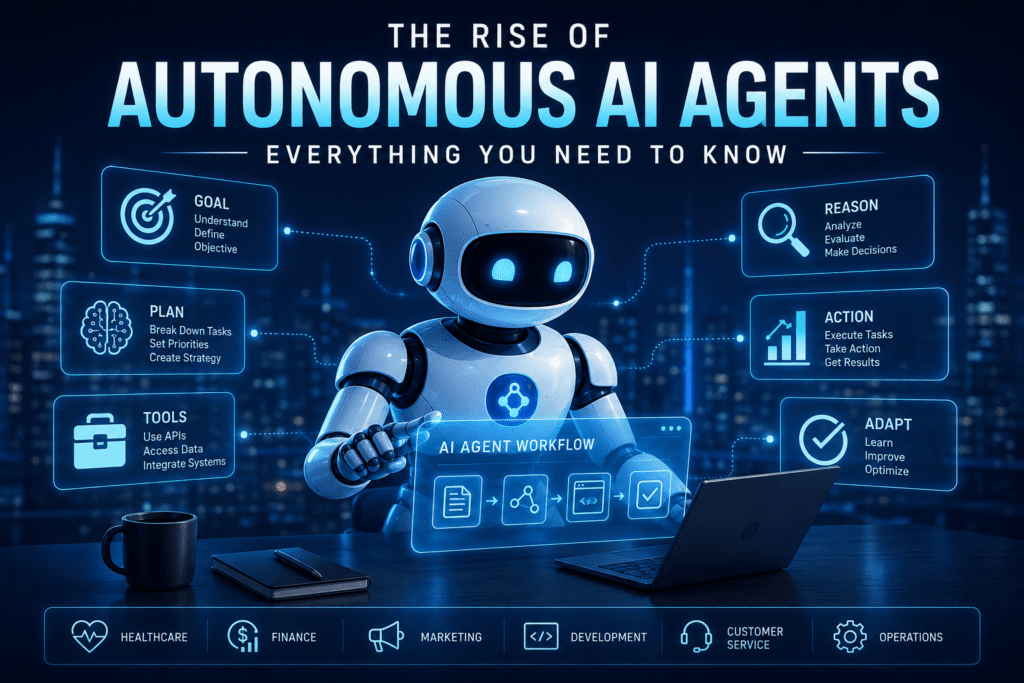
- Autonomous agents
- Reasoning engines
- Cognitive architectures
Recent AI systems have demonstrated impressive abilities in:
- Writing
- Coding
- Image generation
- Scientific analysis
- Mathematical reasoning
While these advances are significant, experts generally agree that true AGI has not yet been achieved.
Current systems remain highly dependent on training data and often lack genuine understanding and reasoning.
Benefits of Artificial General Intelligence
If developed safely, Artificial General Intelligence could produce enormous benefits.
Accelerating Scientific Discovery
AGI could analyze vast amounts of research data and generate new hypotheses.
Potential breakthroughs may occur in:
- Physics
- Biology
- Climate science
- Materials engineering
Revolutionizing Healthcare
Future AGI systems could assist in:
- Disease diagnosis
- Drug discovery
- Personalized medicine
- Surgical planning
This could improve healthcare outcomes worldwide.
Transforming Education
AGI-powered tutors could provide personalized learning experiences for every student.
Benefits may include:
- Adaptive lessons
- Real-time feedback
- Individual learning paths
Economic Growth
AGI could increase productivity across industries.
Businesses may benefit from:
- Improved decision-making
- Process automation
- Innovation acceleration
Challenges and Limitations
Despite its promise, Artificial General Intelligence presents significant challenges.
Technical Complexity
Human intelligence remains poorly understood.
Creating a machine with comparable cognitive abilities is one of the most difficult scientific challenges ever attempted.
Safety Concerns
Researchers emphasize the importance of AI alignment.
AGI systems must act according to human values and intentions.
Poorly aligned systems could produce harmful outcomes.
Ethical Questions
Important concerns include:
- Privacy
- Accountability
- Bias
- Transparency
- Human autonomy
Employment Disruption
AGI could automate many cognitive tasks currently performed by humans.
Governments and businesses may need strategies for workforce adaptation and reskilling.
Real-World Applications of AGI
Although AGI does not yet exist, experts envision applications across nearly every sector.
Healthcare
- Advanced diagnostics
- Medical research
- Treatment optimization
Scientific Research
- Discovery of new materials
- Climate modeling
- Space exploration
Business and Finance
- Strategic planning
- Market analysis
- Risk management
Engineering
- Autonomous design systems
- Infrastructure planning
- Robotics control
Education
- Personalized tutoring
- Curriculum development
- Lifelong learning support
Expert Insights on AGI
Many AI researchers consider AGI one of humanity’s most transformative technologies.
Experts frequently highlight two key priorities:
- Accelerating beneficial innovation
- Ensuring safe and responsible development
Several researchers argue that AGI could become as significant as electricity, the internet, or modern computing.
Others caution that safety research must progress alongside capability improvements.
The consensus is clear: preparation is essential.
Future Impact of AGI
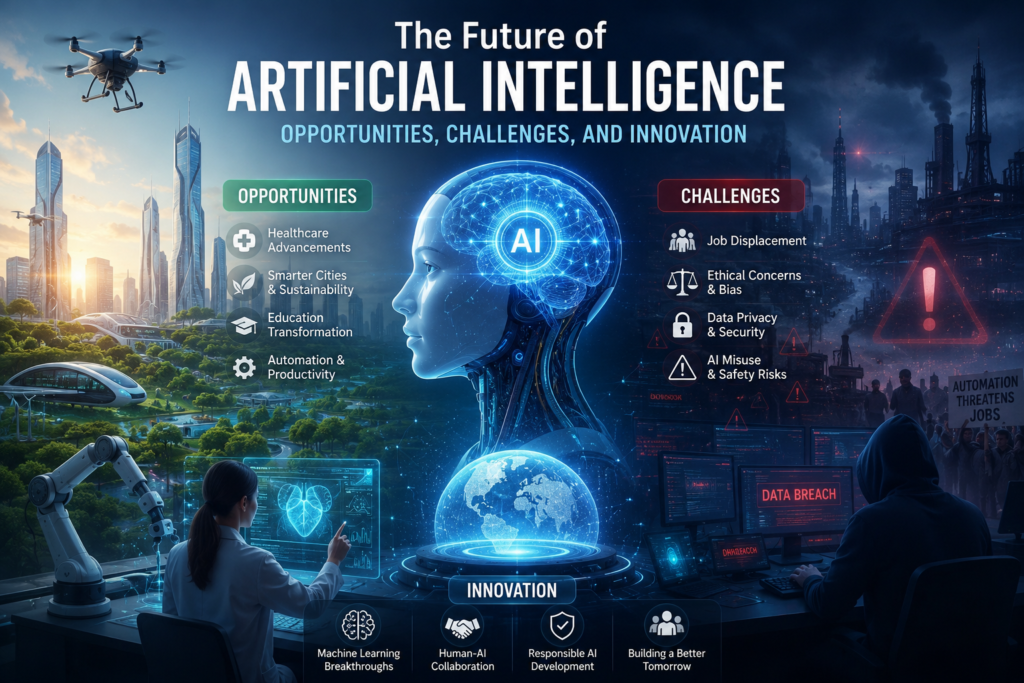
Artificial General Intelligence could reshape civilization in profound ways.
Potential impacts include:
- Faster scientific breakthroughs
- Increased global productivity
- Enhanced healthcare systems
- Advanced environmental solutions
- New economic opportunities
At the same time, society must address:
- Governance frameworks
- Ethical standards
- Security concerns
- International cooperation
The choices made today may influence how AGI affects future generations.
Future Predictions
While predictions vary, many experts expect continued progress toward increasingly capable AI systems during the coming decades.
Possible future milestones include:
Near-Term (Next 5 Years)
- More capable AI agents
- Improved reasoning models
- Better multimodal intelligence
Medium-Term (5–15 Years)
- Highly autonomous digital assistants
- Scientific research acceleration
- Advanced robotics integration
Long-Term
- Potential emergence of AGI
- Human-AI collaboration at unprecedented levels
- Major societal transformation
The exact timeline remains uncertain, but AGI research continues to accelerate worldwide.
Frequently Asked Questions (FAQ)
What is Artificial General Intelligence?
Artificial General Intelligence is a theoretical form of AI capable of performing any intellectual task that humans can perform.
Does AGI exist today?
No. Current AI systems are considered Narrow AI and remain specialized for specific tasks.
How is AGI different from AI?
Traditional AI focuses on specific tasks, while AGI would possess broad, adaptable intelligence across many domains.
Why is AGI important?
AGI could accelerate scientific discovery, improve healthcare, transform education, and drive economic growth.
What are the risks of AGI?
Potential risks include safety concerns, ethical challenges, misuse, and workforce disruption.
Can AGI think like humans?
Researchers aim to create systems with human-like reasoning abilities, but whether AGI will think exactly like humans remains uncertain.
When will AGI be achieved?
There is no scientific consensus on a timeline. Estimates range from years to several decades.
Will AGI replace humans?
Most experts envision AGI as a tool that augments human capabilities, although some jobs may be automated.
Conclusion
Artificial General Intelligence represents one of the most ambitious goals in modern science and technology. Unlike today’s specialized AI systems, AGI seeks to create machines capable of learning, reasoning, and adapting across virtually any domain.
The potential benefits are enormous, ranging from scientific breakthroughs and healthcare advances to personalized education and economic growth. However, significant technical, ethical, and safety challenges remain.
As research continues, Artificial General Intelligence will likely remain at the center of discussions about the future of humanity. Whether AGI arrives in ten years or several decades, its development could become one of the defining technological achievements of the 21st century.