The Rise of Autonomous AI Agents: Everything You Need to Know
Introduction
Artificial intelligence is entering a new phase, and autonomous AI agents are leading the transformation. Unlike traditional AI chatbots that simply answer questions, autonomous AI agents can understand goals, create plans, use software tools, make decisions, and complete complex tasks with minimal human input.
This shift is changing how businesses operate, how professionals work, and how consumers interact with technology. From managing customer support to automating research, software development, marketing, and business operations, AI agents are becoming digital teammates rather than simple assistants.
For business owners, marketers, developers, and technology enthusiasts, understanding autonomous AI agents is no longer optional. It is becoming a competitive advantage.
In this guide, you’ll learn what autonomous AI agents are, how they work, where they are being used today, and what organizations should consider before adopting them.
Table of Contents
- What Are Autonomous AI Agents?
- Why Autonomous AI Agents Matter
- How Autonomous AI Agents Work
- Key Technologies Behind AI Agents
- Real-World Applications
- Benefits for Businesses
- (Continued in Part 2)
- Best Practices
- Common Mistakes
- Practical Checklist
- FAQ
- Conclusion
What Are Autonomous AI Agents?
AutonomousAI agents are intelligent software systems designed to complete tasks independently by combining reasoning, planning, memory, and tool usage.
Instead of waiting for step-by-step instructions, these systems receive an objective and determine how to achieve it.
For example, imagine giving an AI the following request:
“Research the top five competitors in the cybersecurity market, summarize their strengths, create a comparison table, and prepare a presentation.“
A conventional chatbot may only explain how to perform these steps.
An autonomous AI agent can:
- Search for relevant information
- Compare multiple sources
- Organize findings
- Generate charts
- Create presentation slides
- Revise its work if needed
- Deliver the completed output
This ability to execute multi-step workflows makes autonomous AI agents significantly more powerful than earlier AI applications.
How Autonomous AI Agents Work
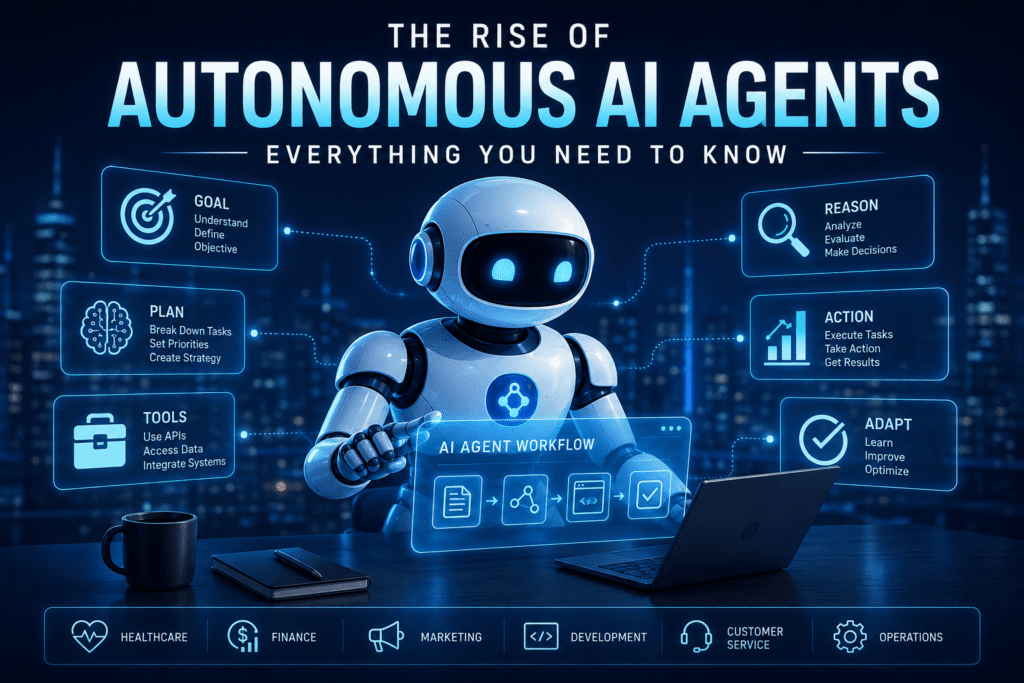
Although implementations vary, most autonomous AI agents follow a similar workflow.
1. Understanding the Goal
The process begins with a clear objective.
Examples include:
- Generate a weekly sales report.
- Schedule meetings.
- Analyze customer feedback.
- Monitor cybersecurity threats.
- Research investment opportunities.
The AI first interprets the user’s intent before deciding on an execution strategy.
2. Planning the Workflow
Rather than immediately producing an answer, the agent creates an internal plan.
This often includes:
- Breaking the problem into smaller tasks
- Identifying required tools
- Prioritizing actions
- Estimating dependencies
- Selecting data sources
Planning enables the AI to solve larger problems more effectively.
3. Using External Tools
One of the defining characteristics of autonomous AI agents is their ability to interact with external systems.
Depending on permissions, an AI agent may connect with:
- CRM software
- Email platforms
- Calendars
- Web browsers
- Cloud storage
- Business databases
- APIs
- Analytics dashboards
Instead of only generating content, the agent can perform meaningful actions within these systems.
4. Learning from Feedback
Many AI agents evaluate whether their results meet the intended objective.
If not, they can:
- Retry a task
- Refine search strategies
- Gather additional information
- Correct formatting
- Improve accuracy
This iterative process helps produce more reliable outcomes.
Key Technologies Behind Autonomous AI Agents
Several technological advances have made autonomous AI agents practical.
Large Language Models (LLMs)
Modern language models provide reasoning, language understanding, and content generation capabilities that allow AI agents to communicate naturally and interpret complex instructions.
Memory Systems
Unlike traditional chatbots that treat every interaction independently, advanced AI agents can retain relevant context during a workflow.
This allows them to:
- Remember project goals
- Track completed tasks
- Maintain consistency
- Personalize interactions
- Build upon previous actions
Tool Integration
AI becomes significantly more useful when it can interact with external applications.
Examples include:
- Reading spreadsheets
- Sending emails
- Searching databases
- Creating documents
- Updating CRM records
- Running business reports
Decision Engines
Modern AI agents evaluate multiple options before selecting the most suitable action.
Rather than relying on fixed rules, they combine reasoning with available information to adapt to changing situations.
Real-World Applications of Autonomous AI Agents
Autonomous AI agents are already delivering value across industries by automating workflows that once required significant human effort.
Healthcare
Healthcare organizations use AI agents to help summarize clinical documentation, support medical research, assist with administrative workflows, and streamline appointment management. These systems are designed to assist professionals rather than replace clinical judgment.
Finance
Financial institutions are exploring AI agents to:
- Detect unusual transaction patterns
- Assist with fraud monitoring
- Generate financial reports
- Analyze market data
- Improve customer service operations
Human oversight remains essential, especially for regulated decisions.
Marketing
Marketing teams are using AI agents to:
- Research competitors
- Build content calendars
- Analyze campaign performance
- Draft email sequences
- Segment audiences
- Recommend SEO improvements
Rather than replacing marketers, these tools help teams work faster and focus on strategy.
Software Development
Developers increasingly use AI agents to assist with:
- Writing code
- Reviewing pull requests
- Debugging applications
- Creating documentation
- Generating test cases
- Automating repetitive development tasks