AI-Powered Wearables: How Smart Devices Are Monitoring Human Health
Introduction
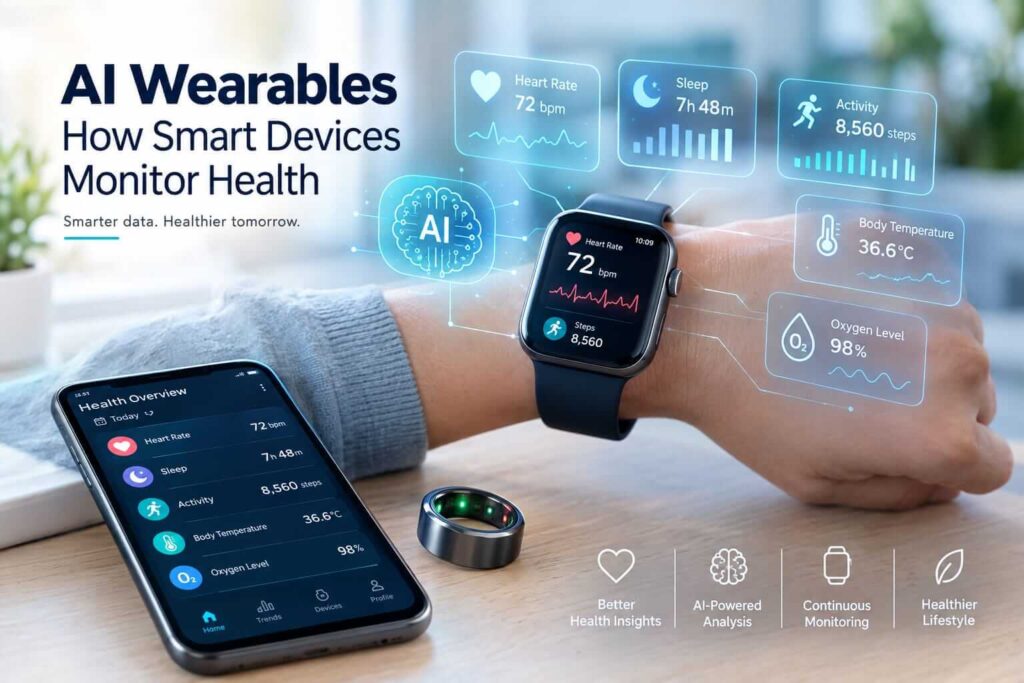
AI-powered wearables are changing the way people understand and monitor their health. Smartwatches, smart rings, fitness bands, patches, and other connected devices can collect information such as heart rate, movement, sleep patterns, temperature, and other physiological signals throughout the day.
Instead of relying only on occasional measurements at a clinic, wearable devices can provide a continuous stream of personal data. Artificial intelligence can then help identify patterns, estimate certain health metrics, and present information in a way that is easier for users to understand.
The technology is becoming increasingly important in digital health. The U.S. Food and Drug Administration recognizes wearable devices as part of the broader digital-health ecosystem, including technologies used for health monitoring outside traditional clinical settings.
However, there is an important distinction: a health-tracking device is not automatically a medical diagnostic device. Accuracy, validation, intended use, and regulatory authorization all matter.
So, how exactly do these devices work, and what could they mean for the future of healthcare?
Table of Contents
1. What Are AI-Powered Wearables?
2. Why AI Wearables Matter
3. How Wearable Health Monitoring Works
4. What Health Signals Can Wearables Track?
5. How AI Analyzes Health Data
6. Benefits of AI-Powered Wearables
7. Wearables in Remote Healthcare
8. Limitations and Privacy Concerns
9. Best Practices for Using Smart Health Devices
10. Common Mistakes to Avoid
11. Practical Wearable Health Checklist
12. The Future of AI-Powered Wearables
13. FAQ
14. Conclusion
What Are AI-Powered Wearables?
AI-powered wearables are connected devices that combine sensors, software, data processing, and artificial intelligence to monitor or interpret information related to the human body.
Common examples include:
· Smartwatches
· Smart rings
· Fitness trackers
· Continuous monitoring patches
· Chest straps
· Smart clothing
· Medical wearable sensors
· Some health-focused earbuds and other emerging devices
The basic idea is simple.
A sensor collects information. Software processes the signal. AI or machine-learning algorithms can then identify patterns or generate estimates, alerts, scores, or other insights.
For example, a smartwatch may continuously measure heart-related signals and movement. Its software can use these measurements to estimate activity levels or identify an unusual pattern that deserves attention.
Modern wearable research covers measurements including physical activity, sleep, heart rate, body temperature, blood pressure, oxygen saturation, and other physiological signals.
Why AI-Powered Wearables Matter
Traditional healthcare often provides a snapshot of a person’s health.
A patient may visit a doctor, have their blood pressure checked, complete a test, and then return home. That information can be valuable, but it does not necessarily show what happens between appointments.
Wearables offer another approach.
They can collect data during normal daily activities, including walking, sleeping, exercising, working, and resting.
From occasional measurements to continuous data
This shift is important because some health patterns may only become visible over time.
For instance, a single heart-rate measurement may tell you your heart rate at one particular moment. Repeated measurements can provide information about changes and trends.
That does not mean wearable data should replace professional medical assessment. Instead, it can potentially complement clinical information.
The FDA describes digital health technologies as tools that can help move healthcare beyond traditional clinical environments and improve understanding of patient behavior and physiology.
The World Health Organization has also examined how wearable technology could contribute to population-level monitoring of physical activity and sedentary behavior.
How Wearable Health Monitoring Works
The process usually involves several layers.
1. Sensors collect signals
Wearables contain small sensors designed to detect physical or physiological signals.
Depending on the device, these may include:
· Accelerometers
· Optical sensors
· Temperature sensors
· Electrical sensors
· Pressure sensors
· Motion sensors
· Other specialized biosensors
For example, optical sensors can use light-based measurements to estimate changes associated with blood flow.
1. Software processes the information
Raw sensor readings can contain noise caused by movement, positioning, environmental conditions, or other factors.
Software processes these signals before presenting useful information to the user.
1. AI identifies patterns
Machine-learning systems can analyze large amounts of information and look for patterns.
Instead of examining every individual reading manually, algorithms can consider changes across time.
1. The device presents an insight
The final output might appear as:
· A heart-rate measurement
· Sleep information
· Activity statistics
· A trend graph
· An alert
· A recovery or readiness score
· Another estimated health metric
This is where AI can make complex datasets easier for ordinary users to interpret.
What Health Signals Can Wearables Track?
The capabilities vary considerably between devices.
Heart rate
Heart-rate monitoring is one of the most established wearable applications.
Some smartwatches can also provide notifications for unusually high or low heart rates under specified conditions. Certain devices offer ECG-related features or irregular-rhythm notifications in supported markets.
Sleep
Many smartwatches and rings estimate sleep duration and different aspects of sleep behavior.
Researchers have extensively studied wearable devices for sleep monitoring, although accuracy varies by device and measurement method.
Physical activity
Accelerometers and other motion sensors can estimate:
· Steps
· Movement
· Activity duration
· Sedentary time
· Exercise patterns
Recent research shows that physical activity and sleep are among the most frequently studied smartwatch applications.
Blood oxygen and temperature
Some devices include sensors designed to estimate blood oxygen saturation or measure temperature-related signals.
However, users should always check the intended use and limitations of the specific product.
Emerging measurements
Researchers are also investigating wearable approaches for:
· Blood pressure
· Glucose monitoring
· Stress-related measurements
· Hydration
· Respiratory signals
· Disease monitoring
These areas are promising, but the evidence and regulatory status can differ significantly between technologies.
How AI Analyzes Health Data
The most interesting part of modern wearables is not simply collecting data.
It is what can happen after the data is collected.
Imagine a person wears a smartwatch for six months.
The device may accumulate thousands of individual measurements. Looking at every reading manually would be impractical.
AI can help organize that information.
Pattern recognition
Algorithms can examine changes over time rather than focusing on one isolated measurement.
For example, an algorithm might identify a consistent change in activity or sleep behavior.
Personalized insights
AI systems can potentially compare a person’s current measurements with their previous patterns.
This allows wearable platforms to move toward more personalized health information rather than simply displaying generic statistics.
Early alerts
Some wearable systems can generate alerts when measurements meet certain predefined conditions.
For example, Apple documents high- and low-heart-rate notifications and irregular rhythm notifications on supported Apple Watch models and regions.
Importantly, an alert is not necessarily a diagnosis.
A wearable may indicate that something deserves further attention, but a healthcare professional may need to determine what it actually means.
Benefits of AI-Powered Wearables
1. Continuous monitoring
The biggest advantage is continuity.
A wearable can collect information during ordinary daily life rather than only during a clinical appointment.
1. Greater health awareness
Seeing trends can encourage people to pay closer attention to activity, sleep, and other aspects of their lifestyle.
1. Remote monitoring
Wearable technology can potentially support remote monitoring for certain health conditions.
A 2026 systematic review found that wearable devices are being studied for chronic-disease monitoring, including cardiovascular and neurological applications.
1. Personalized information
AI can help transform raw numbers into trends and personalized insights.
Instead of simply saying “heart rate: 72,” a platform might help users understand how measurements change during rest, activity, or over longer periods.
1. Support for healthcare research
Large datasets from wearable technologies can also support research.
Researchers can study real-world activity, sleep, and physiological patterns at a scale that can be difficult to achieve through occasional clinical measurements.
Wearables in Remote Healthcare
One of the most important applications is remote patient monitoring.
Instead of requiring every health measurement to happen inside a hospital or clinic, certain wearable technologies can collect information while people remain at home.
This could be especially useful when healthcare teams need repeated measurements rather than a single snapshot.
For example, wearable data may help researchers or clinicians investigate changes in:
· Physical activity
· Heart rate
· Sleep
· Movement
· Temperature
· Other physiological signals
The FDA maintains a list of authorized sensor-based digital health technologies, including wearable devices such as smartwatches, rings, patches, and bands.
However, healthcare organizations need appropriate validation, privacy protections, interoperability, and clinical workflows before relying on wearable data for important medical decisions.
Limitations and Privacy Concerns
AI-powered wearables are impressive, but they are not perfect.
Accuracy varies
Different devices can produce different results.
A recent systematic review of smartwatch research found variation in accuracy depending on the metric, device, population, and testing method.
Another recent review emphasizes that many consumer smartwatch outputs are estimates generated from sensor signals and algorithms rather than direct physiological measurements.
Not every feature is a medical device
A fitness score and a clinically validated medical measurement are not necessarily equivalent.
Consumers should check the manufacturer’s intended use and any relevant regulatory information.
Privacy matters
Wearables can generate highly personal information.
Health data can reveal patterns about:
· Sleep
· Activity
· Location
· Daily routines
· Physiological signals
Therefore, users should understand what information a device collects, where it is stored, and how it may be shared.
Algorithmic bias
AI systems learn from data.
If training or validation populations are not sufficiently diverse, performance may vary across different groups.
For this reason, transparency and broader validation remain important areas for wearable-health research.
Best Practices for Using Smart Health Devices
Choose the device according to your purpose
Do not buy a wearable simply because it has the largest number of features.
Instead, decide what you actually want to monitor.
For example:
Fitness goal: activity and exercise tracking.
Sleep goal: sleep duration and related trends.
Health monitoring: investigate devices with appropriate validation and regulatory information.
Understand the difference between trends and diagnoses
A useful rule is:
Use wearable data to understand patterns, not to self-diagnose serious medical conditions.
If a device reports something unusual or concerning, discuss it with an appropriate healthcare professional.
Keep software updated
Manufacturers frequently improve software, algorithms, security, and device functionality.
Keeping devices updated can therefore be important.
Look at long-term trends
One unusual measurement may not tell you much.
Longer-term patterns can often provide more useful context.
Common Mistakes to Avoid
Mistake 1: Treating every reading as perfectly accurate
Wearable measurements can contain errors.
Do not assume that every number is equivalent to a laboratory or clinical measurement.
Mistake 2: Self-diagnosing from an alert
A notification is not automatically a medical diagnosis.
Use it as information that may require further attention.
Mistake 3: Ignoring privacy settings
Before purchasing a device, review its privacy policy and data-sharing controls.
Mistake 4: Comparing different devices without context
Two devices may use different sensors, algorithms, sampling methods, and definitions.
Their measurements may therefore not be directly comparable.
Mistake 5: Focusing on numbers instead of health behavior
A wearable should ideally help you make better-informed decisions rather than encourage constant anxiety about every small change.
Practical AI Wearable Checklist
Before buying or using a wearable health device, ask:
· What exactly does it measure?
· Are the measurements direct or algorithmic estimates?
· Has the relevant feature been independently validated?
· Is it intended for wellness or medical use?
· What countries support its health features?
· What personal data does it collect?
· Where is that data stored?
· Can you control data sharing?
· How long does the battery last?
· Does the device integrate with your existing health apps?
· Can you export your data?
· What does the manufacturer say about accuracy and limitations?
This checklist can help consumers make more informed decisions.
The Future of AI-Powered Wearables
https://futurescienceai.com/blog/ai-healthcare/ai-diagnosis/
The next generation of wearable technology is likely to become more personalized, smaller, and more connected.
Smart rings already demonstrate how health monitoring can move beyond traditional wrist-worn devices. A recent systematic review examined more than 100 studies involving smart rings and found substantial research interest in sleep and other physiological applications, while also highlighting limitations such as study bias and proprietary algorithms.
Future devices could combine multiple sensors with increasingly sophisticated AI models.
Potential developments include:
· More continuous health monitoring
· Better personalized health insights
· Improved remote patient monitoring
· More advanced biosensors
· Smarter disease-management systems
· AI-assisted clinical research
· Integration with electronic health systems
· Smaller and less noticeable sensors
· Smart clothing and skin-mounted devices
The larger trend is clear: healthcare technology is moving toward collecting more information in real-world environments.
But the future will depend not only on better sensors.
It will also require clinical validation, privacy protection, cybersecurity, transparent algorithms, and responsible AI.
The WHO emphasizes the importance of safety, equity, governance, and responsible AI development in healthcare.
CTA: Explore the Future of AI and Science
Technology is changing how we understand health, science, and the human body.
At FutureScienceAI.com, we explore the technologies shaping tomorrow—from artificial intelligence and healthcare to robotics, space exploration, quantum computing, and emerging science.
Want to understand where technology is heading next? Explore more FutureScienceAI articles and discover the science behind the future.
Frequently Asked Questions
https://futurescienceai.com/blog/ai-healthcare/brain-computer-interfaces-explained-for-beginners/
1. What are AI-powered wearables?
AI-powered wearables are smart devices that use sensors, software, and artificial intelligence to collect and interpret information related to health, activity, sleep, or other physiological signals.
Can AI-powered wearables detect diseases?
Some wearable technologies can identify patterns or signals associated with certain health conditions, and some have regulated medical applications. However, consumer wearable alerts should not automatically be treated as a diagnosis. Accuracy and intended use vary by device and feature.
What can smartwatches monitor?
Depending on the model, smartwatches can monitor or estimate measurements such as heart rate, physical activity, sleep, movement, temperature-related signals, blood oxygen, and other health metrics.
Are wearable health devices accurate?
Accuracy depends on the device, sensor, algorithm, measurement, user, and circumstances. Research shows that some measurements can perform well, while others have greater uncertainty. Therefore, wearable readings should be interpreted within their intended use and limitations.
Will AI wearables replace doctors?
No. AI-powered wearables are more likely to complement healthcare by providing additional information between clinical visits. Doctors and other qualified healthcare professionals remain important for diagnosis, treatment, and medical decision-making.
Conclusion
https://www.tdk.com/en/tech-mag/past-present-future-tech/ai-and-wearable-technology-in-healthcare
AI-powered wearables are turning everyday devices into increasingly sophisticated health-monitoring tools. Smartwatches, rings, patches, and other wearable sensors can collect information about activity, sleep, heart-related signals, movement, and other aspects of human
physiology.
AI adds another layer by helping analyze large amounts of data and identify patterns that may be difficult to interpret manually.
However, wearable technology should be viewed realistically. A smart device can provide useful information, but its readings are not automatically equivalent to clinical measurements or medical diagnoses.
The future of wearable health technology will depend on better sensors, stronger validation, responsible AI, privacy protection, and closer integration with healthcare systems