AI-Powered Medical Diagnosis: Can AI Detect Diseases Earlier Than Doctors?
Introduction
AI-powered medical diagnosis is changing the way doctors detect, assess, and monitor disease. Instead of relying only on human observation, healthcare professionals can increasingly use artificial intelligence to analyze medical images, laboratory results, electronic health records, and other clinical information.
The exciting question is: Can AI detect diseases earlier than doctors?
Sometimes, AI can identify subtle patterns that may be difficult for a human to notice, particularly in medical imaging and other data-heavy tasks. However, that does not mean AI is replacing doctors. In many real-world situations, the most valuable approach is a partnership between artificial intelligence and medical professionals.
The U.S. Food and Drug Administration (FDA) recognizes applications of AI-enabled medical devices in areas including early disease detection, diagnosis, prognosis, risk assessment, and personalized diagnostics.
So, what can today’s technology actually do, and where are its limitations?
Table of Contents
1. Why AI-Powered Medical Diagnosis Matters
2. What Is AI-Powered Medical Diagnosis?
3. How AI Detects Diseases
4. Can AI Detect Disease Earlier Than Doctors?
5. Where AI Is Already Being Used
6. Benefits of AI in Medical Diagnosis
7. Challenges and Risks
8. Best Practices for Using AI in Healthcare
9. Common Mistakes to Avoid
10. Practical Checklist
11. The Future of AI Medical Diagnosis
12. Frequently Asked Questions
13. Conclusion
Why AI-Powered Medical Diagnosis Matters
Healthcare generates enormous quantities of information every day.
A single patient may have medical images, blood-test results, medication records, symptoms, genetic information, previous diagnoses, and years of clinical history.
For a human doctor, reviewing all this information can take considerable time.
AI, however, can process huge datasets rapidly. Machine-learning systems can be trained to recognize patterns associated with particular diseases or conditions.
That creates an important opportunity: AI can act as an additional layer of clinical decision support.
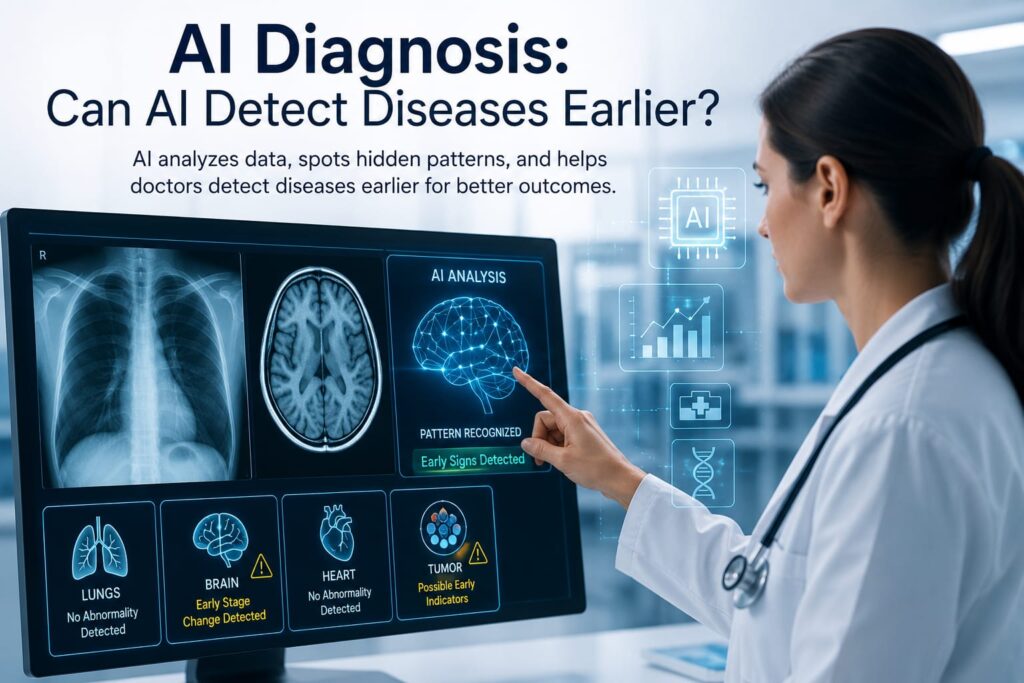
For example, an AI system analyzing a chest X-ray may highlight an area that deserves closer examination. The doctor can then review that area alongside the patient’s symptoms, medical history, and other tests.
Research published in Scientific Reports found that an FDA-cleared AI system improved physicians’ ability to detect abnormalities on chest X-rays when compared with physicians working without AI assistance.
What Is AI-Powered Medical Diagnosis?
AI-powered medical diagnosis refers to the use of artificial intelligence and machine-learning technologies to help identify diseases, abnormalities, or health risks from medical information.
Unlike a traditional computer program that follows a fixed set of instructions, many modern AI systems learn patterns from large datasets.
What information can AI analyze?
Depending on the system, AI may analyze:
- X-rays
- CT scans
- MRI scans
- Ultrasound images
- Pathology slides
- ECG recordings
- Blood-test results
- Patient symptoms
- Electronic health records
- Genetic and molecular data
- Physiological measurements
This makes AI particularly useful for tasks involving large quantities of structured or visual information.
The FDA notes that AI technologies can support image processing, early disease detection, diagnosis, prognosis, risk assessment, and the identification of patterns in disease progression.
How AI Detects Diseases
The process may look complicated, but the basic idea is relatively straightforward.
Step 1 — Collect medical data
AI requires data to learn.
Researchers may provide thousands or millions of medical images, laboratory results, or other clinical records, depending on the application.
Step 2 — Train the AI model
Machine-learning algorithms examine examples and learn relationships between features in the data and known clinical outcomes.
For instance, an image-analysis model may learn patterns associated with tumors, fractures, bleeding, or other abnormalities.
Step 3 — Test the model
Researchers then evaluate the system using data it has not previously seen.
This is important because an AI system that performs well on its training data may not necessarily perform well in a different hospital or patient population.
Step 4 — Support clinical decisions
Once appropriately validated and authorized for its intended use, an AI tool can provide information to healthcare professionals.
The doctor remains responsible for interpreting the result within the patient’s broader clinical context.
Can AI Detect Diseases Earlier Than Doctors?
Sometimes—but the answer is not simply yes or no.
AI can potentially identify subtle patterns in medical data before they become obvious to a human observer. This is one reason early disease detection is an important area of AI research.
For example, an algorithm may analyze thousands of image characteristics simultaneously. A physician, meanwhile, must combine image findings with symptoms, history, physical examination, and other information.
AI can therefore be particularly valuable as a second set of eyes.
However, detecting a pattern is not the same as diagnosing a patient.
A clinical diagnosis may require:
- Medical history
- Physical examination
- Laboratory testing
- Imaging
- Specialist interpretation
- Follow-up testing
- Patient-specific risk factors
Research also shows why human oversight remains important. A large study of AI assistance in chest X-ray interpretation found that incorrect AI predictions could negatively affect radiologists’ performance in some situations.
Therefore, the strongest model is often doctor + AI, rather than doctor versus AI.
Where AI Is Already Being Used in Medical Diagnosis
AI medical diagnosis is not merely a futuristic concept.
The FDA maintains a list of AI-enabled medical devices authorized for marketing in the United States, including systems used in areas such as radiology and cardiovascular care.
Medical imaging
Radiology is one of the most developed areas of clinical AI.
AI can help identify abnormalities in:
- Chest X-rays
- CT scans
- MRI images
- Mammograms
- Ultrasound
- Other diagnostic images
The goal is often not to replace radiologists but to help prioritize cases, identify suspicious findings, and support interpretation.
Cancer detection
AI is also being investigated for cancer screening and diagnosis.
Machine-learning systems can analyze medical images and pathology slides for patterns associated with cancer.
A systematic review of AI in digital pathology reported high diagnostic accuracy across the studies analyzed, but it also found substantial concerns about study quality and risk of bias.
This distinction is crucial: promising research results do not automatically mean an AI system is ready for routine clinical use.
Cardiovascular disease
AI can analyze ECGs and other cardiovascular data to identify patterns associated with heart conditions or risk.
The FDA’s current AI-enabled-device listings include cardiovascular algorithms, demonstrating that this technology is moving into real clinical applications.
Neurological conditions
AI is being explored for neurological diseases, including applications involving brain imaging, biomarkers, and clinical information.
For example, the FDA cleared a blood-based diagnostic device in 2025 to aid in diagnosing Alzheimer’s disease in certain symptomatic adults. While this particular test is not itself an AI diagnosis, it demonstrates the broader movement toward earlier
Benefits of AI-Powered Medical Diagnosis
1. Earlier detection
One of the biggest advantages is the possibility of identifying disease-related patterns earlier.
Earlier detection can potentially lead to earlier testing, treatment, and monitoring.
2. Faster analysis
AI can analyze large datasets rapidly.
In busy healthcare environments, this could help clinicians prioritize urgent cases.
3. Support for doctors
Doctors can use AI as an additional source of information.
This is particularly valuable when the clinical workload is high.
4. Improved consistency
An AI system can apply the same computational process repeatedly.
That may help reduce certain forms of variation between individual assessments.
5. Personalized healthcare
In the future, AI could combine multiple types of patient information to support more personalized risk assessment and diagnosis.
The FDA specifically identifies personalized diagnostics as an area of potential benefit for AI/ML-enabled medical devices.
Challenges and Risks of AI Medical Diagnosis
AI is powerful, but it is not infallible.
Bias in medical data
If an AI model is trained on limited or unrepresentative datasets, its performance may vary across populations.
This is particularly important when systems are used across different countries, ethnic backgrounds, age groups, or healthcare environments.
Research has shown that AI-assisted diagnosis can improve physician performance while still leaving important differences across patient groups.
False positives
An AI system may flag something as suspicious when it is not actually disease.
This can lead to unnecessary tests, anxiety, and additional healthcare costs.
False negatives
The opposite problem can be even more concerning.
If AI fails to identify a disease, clinicians may receive false reassurance.
Lack of transparency
Some AI models can be difficult to interpret.
Healthcare professionals need to understand when a system is reliable and when its output should be questioned.
Privacy and security
Medical information is highly sensitive.
Healthcare organizations must protect patient data and ensure that AI systems comply with applicable privacy, security, and regulatory requirements.
Performance can change
AI systems may behave differently when deployed in a new hospital or with new equipment and patient populations.
The FDA is actively examining how the real-world performance of AI-enabled medical devices should be monitored, including the possibility of performance drift.
Best Practices for Using AI in Healthcare
Healthcare organizations considering AI should take a careful, evidence-based approach.
Validate before deployment
Do not assume that an AI system works simply because it performs well in a demonstration.
Independent clinical validation matters.
Keep humans involved
AI should support qualified healthcare professionals rather than encourage patients to make medical decisions without professional guidance.
Evaluate different patient populations
Testing should consider whether the technology performs consistently across relevant groups.
Monitor performance after deployment
Healthcare organizations should continue evaluating an AI system after implementation.
This is particularly important because models, workflows, equipment, and patient populations can change.
Check regulatory status
Organizations should understand whether an AI product is authorized or approved for its intended medical use in the relevant jurisdiction.
The FDA has issued guidance addressing lifecycle management and planned changes for AI-enabled medical-device software.
Common Mistakes to Avoid
When discussing or implementing AI-powered medical diagnosis, avoid these mistakes:
Assuming AI is always more accurate than doctors.
Treating an AI prediction as a final diagnosis.
Using a medical AI tool outside its intended purpose.
Ignoring false positives and false negatives.
Failing to evaluate bias.
Using poorly validated tools.
Ignoring patient privacy.
Believing impressive laboratory results automatically translate to real-world clinical benefits.
Removing human oversight from important medical decisions.
The safest approach is to view AI as a clinical support technology, not an unquestionable authority.
Practical Checklist for AI Medical Diagnosis
Before adopting or evaluating an AI diagnostic solution, ask:
What medical problem does the AI solve?
What data was used to develop it?
Has it been independently validated?
What are its sensitivity and specificity?
What patient populations were included?
What happens when the AI is wrong?
Is the technology authorized for its intended use?
How is patient data protected?
Is a qualified healthcare professional involved?
How will performance be monitored over time?
This checklist can help healthcare organizations make more informed decisions.
The Future of AI-Powered Medical Diagnosis
The next stage of healthcare AI may involve combining different kinds of information rather than analyzing one dataset at a time.
Imagine an AI system that can evaluate a patient’s:
- Medical history
- Blood results
- Medical images
- Genetic information
- Symptoms
- Medication history
- Vital signs
Together, these data could provide a more complete picture of a patient’s health.
This is one reason multimodal AI is attracting significant interest in medical research. However, researchers are also emphasizing the need for careful evaluation because impressive AI performance in controlled environments does not automatically guarantee safe clinical use.
Regulation is evolving as well. In 2026, the FDA published a discussion paper focused specifically on regulatory considerations for generative-AI-enabled medical devices, reflecting the rapidly changing technology landscape.
The future, therefore, is unlikely to be about machines simply replacing doctors.
Instead, it may be about creating smarter healthcare systems in which technology handles large-scale data analysis while medical professionals provide judgment, context, empathy, and accountability.
CTA — Explore the Future of Healthcare AI
Artificial intelligence is moving from research laboratories into real healthcare environments.
If your organization is exploring AI-powered medical diagnosis, healthcare automation, or emerging medical technologies, now is the time to understand both the opportunities and the risks.
Follow Future Science AI for practical insights into artificial intelligence, healthcare innovation, robotics, quantum technology, space science, and the technologies shaping tomorrow.
Frequently Asked Questions
https://futurescienceai.com/blog/ai-healthcare/ai-diagnosis/
1. What is AI-powered medical diagnosis?
AI-powered medical diagnosis uses artificial intelligence and machine learning to analyze medical information and help healthcare professionals identify diseases, abnormalities, or health risks.
2. Can AI diagnose diseases better than doctors?
AI can outperform or complement clinicians on certain narrowly defined diagnostic tasks, especially some medical-image analysis tasks. However, performance varies by application, and AI should not be treated as a universal replacement for doctors.
3. Can AI detect diseases earlier?
Yes, AI can potentially identify subtle patterns associated with disease earlier than they might otherwise be recognized. However, early detection depends on the quality of the data, the AI model, the disease, and clinical validation.
4. What diseases can AI help detect?
AI is being used or studied for applications involving cancer, cardiovascular conditions, neurological disorders, eye diseases, lung abnormalities, and many other conditions.
5. Is AI medical diagnosis safe?
AI medical diagnosis can be useful when appropriately designed, validated, regulated, and monitored. However, AI can make errors, so qualified healthcare professionals and appropriate clinical safeguards remain essential.
Conclusion
https://www.valpo.edu/ai-in-disease-prevention/
AI-powered medical diagnosis has the potential to make healthcare faster, more data-driven, and more capable of identifying certain diseases at an earlier stage.
The technology can analyze medical images and complex datasets at remarkable speed. In some applications, research has shown that AI assistance can improve physicians’ diagnostic performance.
Nevertheless, AI is not a magic replacement for medical expertise.