AI Energy Management: How Artificial Intelligence Is Making Power Grids Smarter
https://indicium.ai/content-hub/how-ai-is-changing-smart-grid-management
Introduction
AI energy management is changing how electricity systems are monitored, planned, and operated. Traditional power grids were designed around relatively predictable electricity generation and consumption. Today, that model is becoming more difficult to maintain.
Electric vehicles, data centers, heat pumps, solar panels, wind farms, batteries, and increasingly electrified industries are changing when and where electricity is produced and consumed. At the same time, extreme weather and aging infrastructure can create additional pressure on power networks.
Artificial intelligence can help utilities and energy companies make sense of enormous amounts of data. Instead of simply reacting to problems, intelligent systems can identify patterns, forecast demand, detect unusual behavior, and recommend better ways to balance supply and consumption.
The result is a smarter approach to managing electricity.
Table of Contents
· Why AI Energy Management Matters
· What Is AI Energy Management?
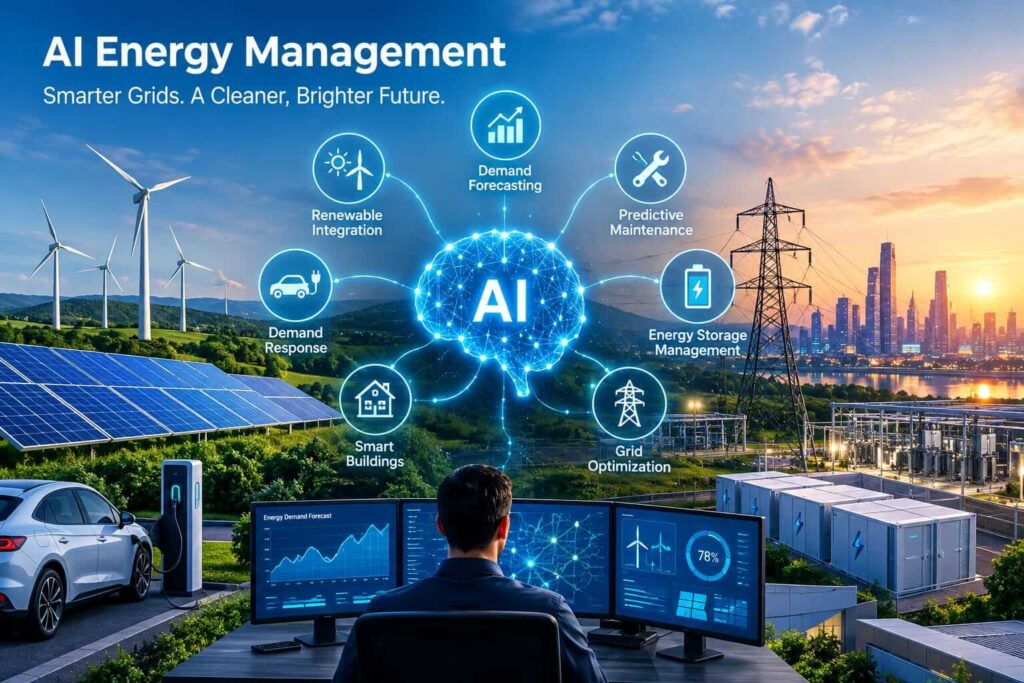
· How AI Makes Power Grids Smarter
· Key Applications of AI in Energy
· Benefits of AI Energy Management
· AI and Renewable Energy Integration
· AI, Batteries, and Energy Storage
· How Businesses Can Use AI Energy Management
· Challenges and Risks
· Best Practices for Implementing AI
· Common Mistakes to Avoid
· Practical AI Energy Management Checklist
· CTA
· Frequently Asked Questions
· Conclusion
Why AI Energy Management Matters
Electricity demand is becoming more complex.
For example, a traditional utility may have had to predict electricity use based mainly on historical consumption, weather, and seasonal patterns. Now it may also need to consider EV charging, rooftop solar, battery storage, industrial loads, smart buildings, and data centers.
This creates a difficult balancing problem.
If electricity demand suddenly rises, grid operators need to respond quickly. If renewable generation suddenly falls because wind speeds decrease or clouds cover solar panels, the system may also need to adjust.
AI can process these changing variables much faster than manual analysis.
The International Energy Agency reports that global electricity demand is expected to continue growing strongly through 2030, while grids face increasing pressure from electrification, data centers, renewable generation, and other technologies.
Therefore, smarter energy management is becoming increasingly important.
What Is AI Energy Management?
AI energy management means using artificial intelligence, machine learning, predictive analytics, and related digital technologies to monitor and optimize energy systems.
In simple terms, an AI system can learn from large amounts of information and use that information to help answer questions such as:
· How much electricity will customers need tomorrow?
· When will demand reach its highest point?
· How much solar or wind power is likely to be available?
· Which grid equipment may develop a fault?
· When should a battery charge or discharge?
· Where could congestion occur?
· Which energy assets should be prioritized?
· How can electricity be distributed more efficiently?
The technology does not necessarily replace human grid operators.
Instead, AI can provide forecasts, recommendations, warnings, and analysis that help people make faster and better-informed decisions.
Modern AI applications can range from relatively simple machine-learning models to advanced systems capable of analyzing multiple data sources simultaneously.
How AI Makes Power Grids Smarter
A smart power grid combines physical electricity infrastructure with sensors, communication networks, software, automation, and data.
AI adds another layer of intelligence.
Energy Demand Forecasting
One of the most important applications is predicting future electricity demand.
Machine-learning models can analyze historical consumption together with factors such as:
· Weather
· Temperature
· Time of day
· Day of the week
· Seasonal patterns
· Industrial activity
· EV charging behavior
· Building occupancy
· Previous electricity demand
Better forecasting helps utilities prepare for periods of high or low demand.
For example, an AI model could predict that electricity consumption will increase sharply during a very hot afternoon because millions of cooling systems are expected to operate simultaneously.
Utilities can then plan resources accordingly.
Renewable Energy Forecasting
Solar and wind generation can change depending on weather conditions.
AI can analyze weather forecasts, historical production, satellite information, and other data to estimate how much renewable electricity may be generated.
This is particularly useful because accurate forecasting can help grid operators coordinate renewable generation with other resources.
Predictive Maintenance
Power grids contain transformers, transmission lines, substations, switches, batteries, and other critical equipment.
Equipment failure can cause outages and expensive repairs.
AI can analyze sensor readings, inspection images, maintenance records, temperature data, vibration patterns, and other information to identify signs of potential problems.
Instead of waiting for equipment to fail, operators can investigate problems earlier.
This approach is known as predictive maintenance.
Grid Optimization
AI can help identify better ways to use available grid capacity.
It can evaluate multiple conditions and help operators understand where congestion may occur, how electricity could flow through the network, and which actions may reduce operational pressure.
This becomes especially important as electricity systems become more decentralized.
Smart Demand Response
Not every electricity user needs to consume power at exactly the same time.
Demand response allows certain loads to shift their electricity use when appropriate.
For example, smart systems could adjust EV charging, industrial processes, heating systems, or building cooling within agreed limits.
AI can help determine when these flexible loads should operate.
Key Applications of AI in Energy
AI energy management is not limited to one part of the electricity system.
Smart Buildings
AI can analyze building occupancy, temperature, weather, and historical electricity use.
It can then optimize heating, cooling, lighting, and other systems.
This can help businesses reduce unnecessary consumption while maintaining comfortable indoor conditions.
Electric Vehicles
EV charging creates a new electricity demand that can be difficult to manage if everyone charges at the same time.
AI can help coordinate charging schedules based on electricity demand, available renewable generation, battery requirements, and grid conditions.
Energy Storage
Battery storage can absorb electricity when supply is high and release it when electricity is needed.
AI can help determine when charging and discharging may provide the greatest value.
Grid Security
Digital power systems create cybersecurity challenges.
AI-based monitoring can help identify unusual network behavior and potentially suspicious activity.
However, AI itself must also be protected because incorrect or manipulated outputs could create operational risks
Benefits of AI Energy Management
When properly designed and implemented, AI energy management can provide several advantages.
Better Forecasting
More accurate demand and renewable forecasts can improve energy planning.
Improved Reliability
Early detection of equipment problems can help reduce unexpected failures.
Greater Renewable Integration
AI can help utilities manage variable solar and wind generation more effectively.
Better Use of Existing Infrastructure
Intelligent analysis can help identify opportunities to use available grid capacity more efficiently.
Faster Decision-Making
AI can process large datasets much faster than manual analysis.
Improved Energy Efficiency
Businesses and buildings can use AI to identify unnecessary energy consumption and optimize operations.
Support for Electrification
As transportation, heating, manufacturing, and other sectors become more electrified, intelligent management can help coordinate the additional demand.
AI and Renewable Energy Integration
Renewable energy is one of the most important reasons intelligent grid management is becoming more valuable.
Solar and wind generation are variable. Solar output changes throughout the day, while wind generation can change with weather conditions.
A modern grid therefore needs flexibility.
AI can combine renewable forecasts with electricity demand forecasts. This can help operators understand whether the system may have too much or too little electricity at a particular time.
For example, imagine a region with strong solar generation during the afternoon.
An AI-based energy management system could help coordinate:
1. Solar electricity production
2. Battery charging
3. EV charging
4. Industrial demand
5. Building energy consumption
6. Grid constraints
Instead of treating each component separately, intelligent systems can analyze them as parts of one interconnected system.
AI, Batteries, and Energy Storage
Energy storage is becoming increasingly important as electricity systems become more flexible.
A battery does not simply need to store electricity. Operators also need to determine when it should charge and when it should discharge.
AI can consider factors such as:
· Electricity demand
· Renewable generation
· Electricity prices
· Weather forecasts
· Battery condition
· Expected future demand
· Grid congestion
For example, an intelligent system might determine that charging a battery during a period of abundant solar generation could be useful, while releasing some stored electricity during a later demand peak may provide greater grid value.
This is one reason AI and energy storage are increasingly connected.
How Businesses Can Use AI Energy Management
AI energy management is not only relevant to large utilities.
Businesses can also use intelligent energy systems.
A factory, office building, warehouse, shopping center, or data facility may monitor electricity consumption through smart meters and connected equipment.
AI can then identify patterns and potential opportunities.
A Simple Business Example
Imagine a manufacturing facility that experiences its highest electricity demand between 2 p.m. and 5 p.m.
An AI system analyzes several months of consumption and discovers that some non-essential processes can operate earlier without affecting production.
The business can then shift those activities.
Similarly, smart HVAC systems could adjust cooling based on occupancy and weather conditions.
The goal is not simply to use less electricity.
The goal is to use electricity more intelligently.
Best Practices for Implementing AI Energy Management
Organizations considering AI should start with a clear problem rather than adopting AI simply because it is popular.
Step 1: Identify the Energy Problem
Decide whether the main issue is demand forecasting, energy waste, equipment maintenance, renewable integration, or another challenge.
Step 2: Improve Data Quality
AI depends on data.
Check whether meter readings, sensor information, weather data, maintenance records, and operational data are accurate and consistent.
Step 3: Start With a Low-Risk Application
Forecasting, anomaly detection, and predictive maintenance can be useful starting points.
The latest IEA analysis highlights forecasting, maintenance, inspection, and planning as areas where AI adoption is advancing because outputs can often be reviewed before affecting critical operations.
Step 4: Test the Model
Compare AI predictions with real-world results.
Track accuracy and identify situations where the model performs poorly.
Step 5: Keep Humans in the Loop
AI should not automatically control safety-critical infrastructure without appropriate safeguards.
Human oversight, clear accountability, cybersecurity, and fallback procedures are essential.
Step 6: Scale Gradually
Once a system demonstrates reliable performance, organizations can expand it to additional applications.
Common Mistakes to Avoid
Using Poor-Quality Data
Even sophisticated AI cannot compensate for unreliable input data.
Expecting Instant Savings
AI implementation requires infrastructure, integration, testing, and staff training.
Ignoring Cybersecurity
Connected energy systems can create additional attack surfaces.
Treating AI as a Replacement for Experts
Energy infrastructure is highly complex. Engineers, operators, and energy specialists remain important.
Using a Black-Box System Without Governance
Organizations should understand how AI outputs are produced and establish appropriate monitoring and accountability.
The UK energy regulator Ofgem specifically emphasizes safe, secure, fair, sustainable, explainable, and accountable AI use in the energy sector.
Practical AI Energy Management Checklist
Before deploying an AI energy solution, ask:
- What specific energy problem are we solving?
- Do we have reliable historical data?
- Are smart meters or sensors available?
- Can the AI model be tested safely?
- Can humans review important recommendations?
- Are cybersecurity controls in place?
- Is customer data protected?
- Can the system integrate with existing software?
- Are performance metrics clearly defined?
- Is there a fallback process if the AI system fails?
- Can the solution scale later?
- Are regulatory requirements understood?
A checklist like this can prevent organizations from focusing too heavily on the AI model while overlooking the surrounding infrastructure.
The Future of AI Energy Management
The next stage of AI energy management will likely involve increasingly connected energy systems.
Instead of analyzing electricity demand, renewable generation, storage, EVs, buildings, and grid equipment separately, advanced systems can coordinate information across the wider energy ecosystem.
Digital twins can also help operators simulate potential grid conditions before making operational decisions.
Agentic AI is another emerging area. Such systems could potentially coordinate multiple analytical steps and tools, although safety-critical applications require much stronger testing, governance, explainability, and human oversight.
The European Commission is already supporting digitalization and AI initiatives focused on areas such as grid optimization, energy efficiency, demand flexibility, and renewable technologies.
The future, therefore, is not simply about adding AI to existing electricity infrastructure. It is about creating energy systems that can observe, predict, adapt, and respond more intelligently.
CTA: Make Energy Management Smarter
Is your organization looking for smarter ways to understand energy consumption, improve efficiency, or prepare for a more digital electricity system?
Start by identifying your biggest energy challenge and exploring how data, automation, and AI can address it.
Contact your energy technology partner today to discuss an AI energy management strategy tailored to your organization.
Whether the goal is better forecasting, smarter energy storage, renewable integration, or improved operational efficiency, the right digital strategy can turn energy data into practical decisions.
Frequently Asked Questions
What is AI energy management?
AI energy management uses artificial intelligence and machine learning to monitor, forecast, and optimize energy consumption, generation, storage, and grid operations.
How does AI make power grids smarter?
AI analyzes large amounts of data from smart meters, sensors, weather systems, energy assets, and grid operations. It can then forecast demand, detect anomalies, optimize resources, and support faster decisions.
Can AI help integrate renewable energy?
Yes. AI can forecast solar and wind generation and help coordinate renewable electricity with demand, battery storage, and other grid resources.
Can AI reduce energy costs?
AI can identify inefficient consumption patterns and help businesses or utilities optimize when and how electricity is used. Actual savings depend on the system, energy prices, infrastructure, and implementation.
What are the biggest risks of AI in energy management?
Important risks include inaccurate data, cybersecurity threats, privacy concerns, poor model performance, lack of explainability, and inappropriate automation of safety-critical decisions. Strong testing and human oversight are therefore important.
Conclusion
Lorem ipsum dolor sit amet, consectetur adipiscing elit. Ut elit tellus, luctus nec ullamcorper mattis, pulvinar dapibus leo.AI energy management is becoming an important part of the transition toward smarter, more flexible electricity systems.
As electricity demand grows and energy systems incorporate more solar, wind, batteries, EVs, smart buildings, and digital infrastructure, traditional approaches alone may not be enough.
AI can help utilities and businesses forecast demand, predict equipment problems