
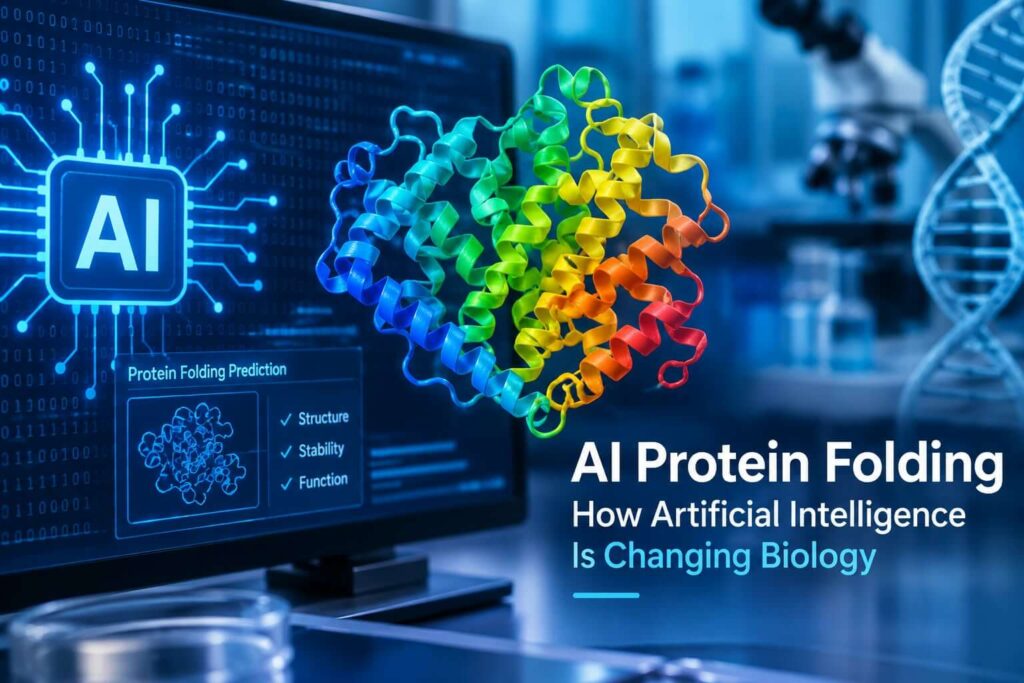
AI Protein Folding: How Artificial Intelligence Is Changing Biology
https://deepmind.google/blog/alphafold-using-ai-for-scientific-discovery-2020/
Introduction
AI protein folding is changing how scientists understand one of biology’s most difficult problems: how a protein’s amino acid sequence determines its three-dimensional shape. Proteins control countless processes inside living organisms, from transporting molecules to supporting immune responses and enabling chemical reactions.
For decades, researchers relied heavily on laboratory experiments to determine protein structures. These methods can be extremely valuable, but they may also require significant time, resources, and specialized equipment. Today, artificial intelligence can predict many protein structures much faster, giving researchers a powerful new way to investigate biology.
The development of systems such as AlphaFold has pushed protein structure prediction into a new era. The AlphaFold Protein Structure Database now provides hundreds of millions of predicted protein structures for researchers worldwide.
So, how does AI protein folding work, and why could it matter for medicine, biotechnology, agriculture, and drug discovery? Let’s explore.
Table of Contents
- · What Is AI Protein Folding?
- · Why Protein Folding Matters
- · How AI Protein Folding Works
- · AlphaFold and the Rise of AI Biology
- · How AI Protein Folding Is Changing Drug Discovery
- · Benefits of AI Protein Folding
- · Other Applications of Protein Structure AI
- · Limitations and Challenges
- · Best Practices for Using AI Protein Predictions
- · Common Mistakes to Avoid
- · Practical Checklist
- · Internal and External Link Opportunities
- · Frequently Asked Questions
- · CTA
- · Conclusion
What Is AI Protein Folding?
To understand AI protein folding, first consider what a protein is.
Proteins are biological molecules made from chains of amino acids. The sequence of those amino acids is important because it influences how the chain bends, twists, and folds into a specific three-dimensional structure.
That structure is closely connected to the protein’s biological function.
A simple way to think about it is this:
Amino acid sequence → 3D protein structure → biological function
The challenge is that a protein chain can potentially adopt an enormous number of shapes. Determining the correct structure experimentally can therefore be difficult.
AI approaches change the process by learning patterns from large biological datasets. Instead of testing every possible structure, machine-learning systems can predict which three-dimensional arrangement is most likely.
Why Does Protein Folding Matter?
Protein structure is important because biological molecules do not work only because of their chemical ingredients. Their physical shape also matters.
For example, a drug may need to fit into a particular pocket on a protein. An antibody needs to recognize a specific molecular target. An enzyme needs a suitable structure to interact with its substrate.
If scientists understand the shape of a protein, they can gain valuable clues about how it works.
Protein folding and disease
Incorrect protein folding can be associated with biological disorders. Therefore, understanding protein structures can help researchers investigate disease mechanisms.
However, structure prediction does not automatically provide a complete explanation of a disease. Biology is much more complicated than a single protein shape.
Researchers often need experimental evidence, genetic information, biochemical studies, and clinical data to understand the complete picture.
Protein folding and drug discovery
Drug discovery is another major area of interest.
A potential drug molecule often interacts with a biological target such as a protein. Knowing the target’s structure can help scientists investigate possible binding sites and develop better hypotheses for laboratory testing.
This does not mean AI can instantly create a finished medicine. Instead, AI can help researchers narrow down possibilities and prioritize experiments.
How Does AI Protein Folding Work?
Modern protein-folding systems use sophisticated machine-learning techniques trained on biological information.
At a simplified level, the process can be described in several stages.
Start with a protein sequence
Researchers provide an amino acid sequence representing a protein.
The sequence contains information about the building blocks that make up the protein.
Learn biological relationships
AI models analyze patterns learned from protein sequences, known structures, and related biological information.
These patterns can help the model estimate how different parts of the protein are likely to interact.
Predict a three-dimensional structure
The system generates a predicted structural model.
Instead of physically folding a protein in a laboratory, the AI performs computational calculations to estimate its likely arrangement.
Estimate confidence
A prediction is not automatically correct simply because an AI system produced it.
Modern tools provide confidence information that can help researchers understand which parts of a predicted structure are more reliable.
This distinction is extremely important
AlphaFold and the Rise of AI Biology
One of the most influential developments in this field has been AlphaFold, developed by Google DeepMind.
AlphaFold demonstrated that AI could predict many protein structures with remarkable accuracy. Google DeepMind describes protein structure prediction as a longstanding challenge in biology and reports that AlphaFold can produce predictions much faster than traditional experimental approaches.
The AlphaFold Protein Structure Database, developed by Google DeepMind and EMBL-EBI, makes a huge collection of predicted structures available to researchers. The database provides open access to more than 200 million predictions and currently reports more than 260 million protein structure predictions across its broader database content.
This accessibility is important because scientists do not always need to start from zero.
Instead, they can search existing predictions, examine structures, compare proteins, and use the information to develop new research questions.
AlphaFold 3 expands the picture
The technology has also moved beyond predicting individual protein structures.
AlphaFold 3 was designed to predict structures involving proteins and other biological molecules, including DNA, RNA, small molecules, ions, and modified residues. Research published in Nature reported improvements in predicting several types of biomolecular interactions.
That matters because cells are not made of isolated proteins.
Biological processes depend on interactions among many different molecules.
How AI Protein Folding Is Changing Drug Discovery
Drug discovery is one of the most exciting potential applications of AI protein folding.
Traditional drug development can involve years of research and large numbers of experiments. Scientists need to identify biological targets, investigate molecules, test candidates, assess safety, and eventually conduct clinical trials.
AI can support earlier stages of this process.
Finding potential drug targets
Protein structure predictions can help researchers understand proteins associated with diseases.
A structural model may reveal regions that deserve further investigation.
Understanding protein-ligand interactions
A drug molecule may interact with a specific region of a protein.
Advanced AI systems can help predict these interactions, although experimental validation remains essential.
AlphaFold 3, for example, was developed to model complexes containing proteins, nucleic acids, small molecules, ions, and modified residues.
Reducing early-stage research time
Computational predictions can help researchers prioritize which ideas to test in the laboratory.
That can potentially reduce unnecessary experiments and make research workflows more efficient.
However, AI is best viewed as a research accelerator rather than a replacement for scientists.
Benefits of AI Protein Folding
Faster structural predictions
Traditional experimental structure determination can take substantial time. AI predictions can provide useful structural hypotheses much faster.
Lower research barriers
Open databases allow researchers, students, and institutions to explore predicted structures without performing every experiment themselves.
Support for drug research
Structural predictions can help researchers investigate disease-related proteins and possible molecular interactions.
Better biological understanding
Protein structures can provide clues about molecular function and biological mechanisms.
Support for biotechnology
Companies and research teams can use computational protein insights when exploring enzymes, therapeutics, diagnostics, and other biological products.
Global scientific collaboration
Open databases make protein structure information more accessible to researchers around the world.
This is particularly important for international research communities in North America, Europe, the UK, and other regions.
Other Applications of Protein Structure AI
The impact of AI protein folding extends beyond conventional drug discovery.
Disease research
Researchers can investigate proteins involved in diseases and compare structural differences.
Vaccine research
Protein structures can help scientists study viral proteins and their interactions with antibodies.
The AlphaFold database includes collections related to viruses, antimicrobial resistance, neglected tropical diseases, and global health research.
Enzyme engineering
Scientists can explore how enzymes are structured and investigate possible modifications.
This could support areas such as industrial biotechnology, food production, and environmental applications.
Agricultural biotechnology
Protein structure prediction may help researchers understand plant proteins, crop diseases, and biological processes relevant to agriculture.
Synthetic biology
AI-generated structural insights can support the design and study of biological systems.
What Are the Limitations of AI Protein Folding?
Despite its impressive progress, AI protein folding has important limitations.
Predictions are not experimental proof
A predicted structure is a computational model.
It should not automatically be treated as a laboratory-confirmed structure.
The AlphaFold database itself warns that predictions have varying confidence and are intended for theoretical modelling rather than clinical use.
Biology is dynamic
Proteins are not always rigid objects.
They can change shape, interact with other molecules, and behave differently under different biological conditions.
Therefore, a single predicted structure may not represent every state of a protein.
Complex interactions remain difficult
Predicting interactions involving multiple molecules can be more challenging than predicting a single protein.
Even advanced models cannot eliminate uncertainty.
Experimental validation remains important
Researchers still need laboratory experiments to confirm important findings.
AI can generate useful hypotheses, but science depends on testing those hypotheses.
Best Practices for Using AI Protein Predictions
If you are a researcher, science communicator, student, or biotechnology professional exploring AI protein folding, follow these principles.
Check prediction confidence
Do not treat every part of a model as equally reliable.
Compare multiple sources
Where possible, compare AI predictions with experimentally determined structures and established databases.
Understand the biological context
A structure alone does not explain everything about a protein.
Consider sequence information, biological function, interactions, and experimental evidence.
Use predictions to guide experiments
The strongest workflow is often:
AI prediction → scientific hypothesis → laboratory testing → validation → improved understanding
Avoid clinical overclaims
Do not describe a computational prediction as a medical diagnosis or clinically validated result.
Common Mistakes to Avoid
When discussing AI protein folding online, several mistakes can reduce accuracy and credibility.
· Saying AI has completely solved biology.
· Treating every predicted structure as experimentally confirmed.
· Claiming AI can create a medicine instantly.
· Ignoring prediction confidence.
· Using outdated information about AlphaFold.
· Confusing protein structure prediction with complete biological understanding.
· Making medical claims without scientific evidence.
· Relying on one AI prediction without validation.
For a science website, careful language is especially important because readers may use your content to understand complicated scientific developments.
Practical AI Protein Folding Checklist
Before publishing or using information about AI protein folding, check:
· Is the protein sequence clearly identified?
· Is the prediction source trustworthy?
· Has confidence information been reviewed?
· Are experimental structures available for comparison?
· Are claims supported by scientific evidence?
· Have limitations been explained?
· Are medical claims avoided?
· Are scientific terms explained for beginners?
· Are authoritative sources linked?
· Is the information current?
Frequently Asked Questions
What is AI protein folding?
AI protein folding is the use of artificial intelligence and machine learning to predict the three-dimensional structure of proteins from biological information such as amino acid sequences.
Why is protein folding important?
Protein folding matters because a protein’s three-dimensional structure strongly influences how it functions and interacts with other molecules.
Is AlphaFold the same as AI protein folding?
AlphaFold is one of the best-known AI systems for protein structure prediction. However, AI protein folding is a broader field that includes multiple computational approaches and research systems.
Can AI protein folding discover new medicines?
AI protein folding can support drug discovery by helping researchers understand protein structures and molecular interactions. However, potential medicines still require extensive laboratory testing and clinical development.
Are AI protein structure predictions always accurate?
No. Accuracy varies depending on the protein, region, interaction, and prediction method. Researchers should examine confidence scores and validate important predictions experimentally.
CTA: Explore the Future of AI and Biology
Artificial intelligence is opening new possibilities across biology, healthcare, biotechnology, and scientific research.
Want to stay informed about the technologies shaping tomorrow’s world?
Explore more science and AI insights on FutureScienceAI.com. Discover practical explanations of artificial intelligence, healthcare technology, quantum computing, space exploration, and other emerging technologies.
Conclusion
AI protein folding has transformed an important part of modern biological research. Instead of relying only on slow and resource-intensive experimental approaches, scientists can now use AI to generate powerful structural predictions and investigate proteins at an unprecedented scale.
Systems such as AlphaFold have demonstrated the potential of artificial intelligence to accelerate scientific discovery. Newer approaches, including AlphaFold 3, are expanding the focus from individual protein structures toward complex interactions between proteins and other biological molecules.
Still, AI is not a replacement for biology experiments. Predictions have limitations, and important findings must be interpreted carefully and validated with appropriate evidence.
The bigger opportunity is collaboration between AI and human scientists.
As computational models become more capable, they could help researchers investigate diseases, improve drug discovery, engineer useful proteins, understand biological systems, and explore new areas of biotechnology.
In other words, AI protein folding is not simply about predicting shapes. It is becoming part of a much larger transformation in how we understand the molecular machinery of life.
https://futurescienceai.com/blog/health-science/ai-drug-discovery-the-future-of-medicine/