AI Water Management: How Technology Is Solving the Global Water Crisis
Introduction
Water is one of the world’s most important resources, yet managing it is becoming increasingly difficult. Population growth, climate change, urbanization, pollution, agriculture, and aging infrastructure are putting pressure on freshwater supplies.
This is where AI Water technology is becoming increasingly important.
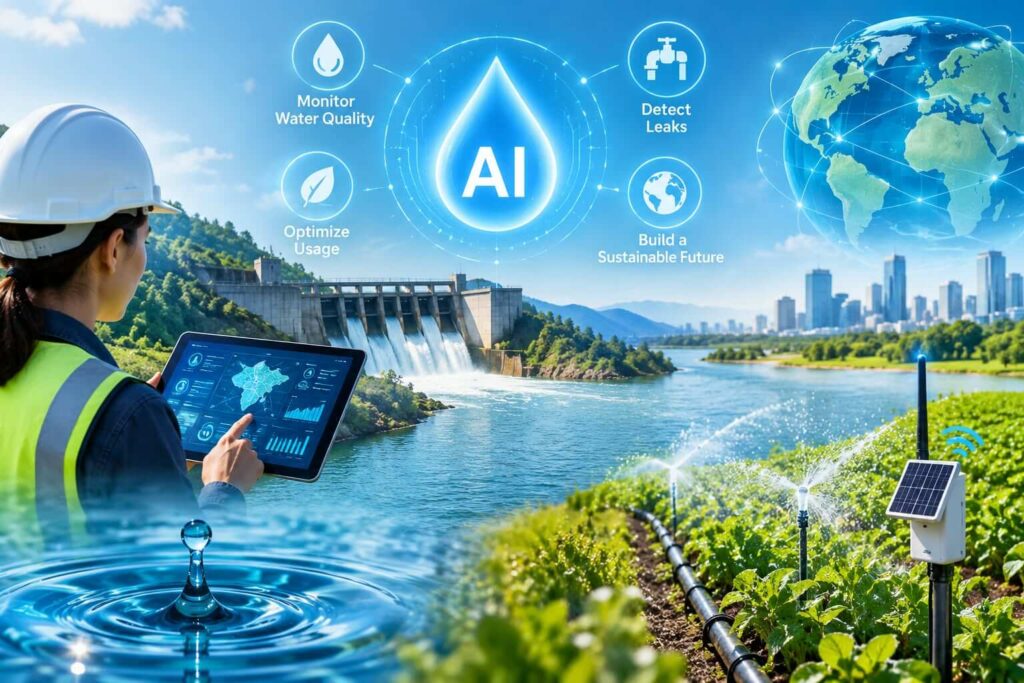
Artificial intelligence can analyze enormous amounts of information from sensors, satellites, weather systems, pipelines, reservoirs, farms, and treatment plants. As a result, water managers can identify problems earlier, forecast demand, detect leaks, improve water quality monitoring, and make better decisions.
The technology will not solve the global water crisis by itself. However, when combined with good infrastructure, scientific knowledge, responsible policies, and efficient water use, AI can become a powerful tool for building more resilient water systems.
Table of Contents
1. Why the Global Water Crisis Matters
2. What Is AI Water Management?
3. How AI Is Transforming Water Management
4. AI for Water Leak Detection
5. AI for Water Quality Monitoring
6. AI for Drought and Flood Prediction
7. AI in Smart Agriculture
8. AI for Wastewater Treatment and Water Reuse
9. Benefits of AI Water Technology
10. Challenges and Risks
11. Best Practices for Implementing AI Water Systems
12. Practical Checklist
13. The Future of AI Water Management
14. FAQ
15. CTA
16. Conclusion
Why the Global Water Crisis Matters
Water scarcity is no longer a problem limited to a few dry regions. It affects communities, agriculture, industries, ecosystems, and economies around the world.
UN-Water reports that approximately 2.1 billion people still lack safely managed drinking water, while billions more experience inadequate water access during parts of the year.
Climate change is adding another layer of complexity.
Changing rainfall patterns, droughts, floods, melting glaciers, rising temperatures, and groundwater pressure can make water supplies more unpredictable. The World Meteorological Organization has also highlighted increasingly variable and extreme conditions across the global water cycle.
At the same time, agriculture remains the largest user of freshwater worldwide, accounting for about 72% of global freshwater withdrawals according to recent FAO data reported by UN-Water.
Therefore, simply finding more water is not enough.
The world also needs to manage existing water resources more intelligently.
That is where AI can help.
What Is AI Water Management?
AI Water management means using artificial intelligence, machine learning, sensors, automation, satellite data, and predictive analytics to monitor and manage water resources more efficiently.
Instead of relying only on manual inspections or historical records, smart water systems can process large volumes of real-time information.
For example, an AI system may analyze:
- Water flow
- Pressure levels
- Weather conditions
- Soil moisture
- Reservoir levels
- Water consumption
- Pipeline conditions
- Chemical measurements
- Satellite imagery
- Historical demand
- Energy consumption
Machine-learning models can then identify patterns and unusual changes.
For example, if water pressure suddenly changes in a particular section of a city, an AI system could flag the area for investigation.
This changes water management from a mainly reactive process into a more predictive one.
How AI Is Transforming Water Management
AI can support almost every stage of the water cycle.
1. Real-Time Monitoring
IoT sensors can continuously collect information from water networks, treatment plants, reservoirs, farms, and industrial facilities.
AI can analyze this information and identify unusual patterns.
Research published in Water in 2026 describes AIoT systems that combine IoT sensors and machine learning for continuous monitoring, anomaly detection, water-quality assessment, drought and flood prediction, irrigation, and reservoir management.
This can give operators a much clearer picture of what is happening.
2. Predictive Analytics
Traditional systems often respond after a problem occurs.
AI can instead look for early warning signals.
For example, predictive models can estimate:
- Future water demand
- Potential equipment failures
- Drought conditions
- Flood risks
- Changes in water quality
- Abnormal consumption
- Potential pipeline problems
This information can help organizations plan before an emergency develops.
AI Water for Leak Detection
Water loss is one of the biggest challenges facing many water networks.
Pipelines can develop leaks because of aging infrastructure, corrosion, pressure changes, equipment problems, or physical damage.
AI can analyze flow and pressure data to identify unusual patterns.
How AI Leak Detection Works
A smart water network may collect information from sensors positioned throughout a distribution system.
The AI model learns what normal behavior looks like.
If the system detects an unexpected difference between water entering a network and water reaching consumers, it can identify a possible leak.
The technology can also help prioritize inspections.
Instead of checking every pipeline equally, utility teams can focus their attention on areas showing stronger warning signals.
Recent research in the Journal AWWA describes how utilities are using machine learning and AI approaches to support leak detection, scheduling, and infrastructure decisions.
For households and buildings, smart flow-monitoring devices can also identify unusual consumption patterns.
The U.S. EPA notes that leak detection and flow-monitoring devices can alert users to unexpected water use and help reduce water waste and damage.
AI Water Quality Monitoring
Clean water is just as important as having enough water.
Traditional water-quality monitoring often involves collecting samples and sending them for laboratory analysis. This process remains important, but it can take time.
AI and sensor technology can provide additional continuous monitoring.
Sensors can collect information about parameters such as:
- Temperature
- pH
- Turbidity
- Dissolved oxygen
- Conductivity
- Chemical indicators
AI models can analyze these measurements and detect unusual patterns.
For example, if a river or treatment system suddenly shows an unexpected change, an automated system can alert operators.
Research published in npj Clean Water in 2026 reviewed more than 100 studies involving AI applications across areas including water pollution, drinking water, and infrastructure regulation.
AI does not replace laboratory testing or expert judgment. Instead, it can provide an additional layer of monitoring and early warning.
AI for Drought and Flood Prediction
Water management has to deal with two seemingly opposite problems: too little water and too much water.
AI can help with both.
Drought Prediction
Machine-learning models can combine historical climate information, rainfall data, soil moisture, groundwater information, satellite observations, and other variables.
The resulting models can help identify changing drought conditions.
Early warnings can support decisions about:
- Irrigation
- Reservoir management
- Water restrictions
- Crop planning
- Emergency preparation
- Municipal water supplies
Flood Prediction
AI can also analyze rainfall, river levels, terrain, weather forecasts, and historical flood information.
When combined with real-time sensors, these systems can help identify changing flood risks.
UN-Water reports that water-related hazards have increased in frequency and that better monitoring and early warning are important for resilience.
AI in Smart Agriculture
Agriculture consumes a large share of freshwater withdrawals worldwide.
Therefore, improving agricultural water efficiency could have a major impact.
AI-powered irrigation systems can combine:
- Soil-moisture sensors
- Weather forecasts
- Crop information
- Temperature
- Humidity
- Evapotranspiration estimates
- Historical irrigation data
The system can then recommend when and how much water should be applied.
For example, if soil moisture is already sufficient and rainfall is expected soon, an intelligent irrigation system could reduce unnecessary watering.
This approach can help farmers move from fixed irrigation schedules toward data-driven irrigation.
AI for Wastewater Treatment and Water Reuse
Wastewater is increasingly being viewed as a resource rather than simply something that needs to be discarded.
Modern treatment facilities can use sensors and automated systems to monitor treatment processes.
AI can analyze operational data and help operators optimize processes such as:
- Aeration
- Chemical dosing
- Energy consumption
- Treatment performance
- Equipment maintenance
- Water-quality monitoring
Water reuse is also gaining attention.
In the United States, the EPA’s 2026 Water Reuse Action Plan 2.0 focuses on expanding safe water reuse for applications including industry while protecting public health and water resources.
In September 2026, the EPA also announced a G20 water-reuse initiative focused on expanding safe reuse of treated water and improving water resilience.
This demonstrates how technology, water reuse, and resource efficiency are becoming increasingly connected
Benefits of AI Water Technology
AI Water systems can provide several potential benefits.
Better Leak Detection
AI can identify unusual flow and pressure patterns that may indicate water loss.
Improved Water Efficiency
Smart systems can help organizations understand where and when water is being consumed.
Faster Problem Detection
Continuous monitoring can identify anomalies sooner than occasional manual inspections.
Better Forecasting
AI can support predictions related to demand, drought, floods, and infrastructure performance.
Lower Operational Costs
Better planning can potentially reduce unnecessary maintenance, energy use, and water losses.
Improved Agricultural Irrigation
Farmers can use data to apply water according to crop and environmental conditions.
Stronger Climate Resilience
Better forecasts and monitoring can help communities prepare for changing water conditions.
Challenges and Risks of AI Water Management
AI is powerful, but it is not a magic solution.
Poor Data Quality
AI models depend on reliable data.
If sensors are inaccurate or datasets contain gaps, predictions may also become unreliable.
High Initial Costs
Installing sensors, communication systems, cloud infrastructure, and AI software can require significant investment.
Cybersecurity
Connected water infrastructure can create cybersecurity risks.
Utilities need strong authentication, network protection, monitoring, backups, and incident-response procedures.
Privacy
Smart meters can reveal detailed information about water consumption.
Organizations should therefore use appropriate privacy and data-governance practices.
Human Oversight
AI recommendations should not automatically replace experienced engineers, scientists, operators, or water managers.
Human expertise remains essential.
Unequal Access
Advanced digital water systems may be easier for wealthy utilities and organizations to adopt.
Therefore, technology investment should also consider affordability and access.
Best Practices for Implementing AI Water Systems
Organizations considering AI should begin with a clear problem rather than adopting technology simply because it is new.
Step 1: Identify the Main Water Problem
Decide whether the priority is:
- Leakage
- Water quality
- Irrigation
- Demand forecasting
- Flood prediction
- Drought management
- Energy efficiency
Step 2: Collect Reliable Data
Install and maintain appropriate sensors.
Make sure measurements are accurate and consistent.
Step 3: Start With a Pilot Project
Rather than transforming an entire water network immediately, test the system in one area.
This makes it easier to evaluate performance.
Step 4: Combine AI With Human Expertise
Engineers and water professionals should review important recommendations.
Step 5: Monitor Performance
Track measurable outcomes such as:
- Water saved
- Leaks detected
- Response time
- Energy consumed
- Maintenance costs
- Prediction accuracy
Step 6: Scale Gradually
Once the pilot demonstrates value, the organization can expand the system.
Common Mistakes to Avoid
When implementing AI Water technology, organizations should avoid several common mistakes.
Ignoring data quality:
More data does not automatically mean better AI.
Replacing humans completely:
AI should support decision-making rather than eliminate professional oversight.
Ignoring cybersecurity:
Connected infrastructure requires strong security controls.
Focusing only on software:
AI cannot compensate for severely damaged physical infrastructure.
Using one solution everywhere:
Water networks differ by geography, climate, infrastructure, regulations, and population.
Ignoring long-term maintenance:
Sensors and digital systems require regular updates, calibration, security checks, and maintenance
Practical AI Water Management Checklist
Before launching an AI-powered water project, ask:
- Do we have reliable water-use data?
- What problem are we trying to solve?
- Can sensors provide real-time information?
- Is the existing infrastructure ready?
- Do we have cybersecurity protections?
- Who will monitor the AI system?
- How will success be measured?
- Can the project scale?
- Are privacy requirements being addressed?
- Do water professionals have final oversight?
If the answers are clear, an organization has a stronger foundation for implementing smart water technology.
The Future of AI Water Management
The next generation of water systems will likely become increasingly connected.
Imagine a city where smart meters, reservoirs, treatment plants, weather services, satellites, pumps, and pipelines continuously exchange information.
AI could analyze these data streams and help water managers understand the entire system in near real time.
Digital twins may also become increasingly important.
A digital twin can create a virtual representation of a physical water network. Operators can then use simulations to explore potential changes before implementing them in the real world.
AI could also work alongside robotics, autonomous inspection systems, advanced sensors, and satellite monitoring.
The result could be a more predictive water-management model.
Instead of asking, “What went wrong?”, operators may increasingly ask, “What is likely to happen next, and what should we do now?”
That shift could become one of the most important developments in digital water management
FAQ: AI Water Management
1. What is AI Water management?
AI Water management is the use of artificial intelligence, sensors, machine learning, and data analytics to monitor, predict, and improve the use of water resources.
2. How can AI reduce water waste?
AI can analyze water-flow patterns, detect unusual consumption, identify potential leaks, and optimize irrigation and other water-intensive processes.
3. Can AI predict droughts and floods?
Yes. AI models can analyze weather, rainfall, soil, river, satellite, and historical data to support drought and flood forecasting. However, accuracy depends on data quality and model design.
4. Can AI improve water quality?
AI can analyze continuous sensor data and identify unusual water-quality patterns. It can provide early warnings, although laboratory testing and professional assessment remain important.
5. What is the future of AI Water technology?
Future systems are likely to combine AI with IoT sensors, satellite observations, digital twins, automation, smart meters, and advanced water-treatment technologies to create more predictive and efficient water networks.
Make Water Management Smarter
The global water challenge requires more than one technology. It requires better infrastructure, responsible policies, conservation, scientific research, investment, and smarter decision-making.
AI Water technology can become an important part of that solution.
For utilities, agricultural organizations, industries, cities, and technology teams, the opportunity is to use AI where it provides measurable value: detecting leaks earlier, monitoring quality, forecasting demand, improving irrigation, supporting drought planning, and optimizing treatment systems.
Want to explore how emerging AI and technology can support your organization’s sustainability goals? Contact your technology or water-management team, request a consultation, or start with a small pilot project focused on one measurable water challenge.
Conclusion
https://www.weforum.org/stories/climate-action/ai-water-risk-management/
The global water crisis is becoming more complex because water demand, climate change, aging infrastructure, pollution, and extreme weather are interacting in new ways.
AI Water technology offers a practical way to make water management more intelligent and predictive.
From leak detection and smart irrigation to water-quality monitoring, drought forecasting, wastewater treatment, and water reuse, AI can help organizations make better use of limited resources.
However, successful implementation requires more than algorithms. Reliable data, strong infrastructure, cybersecurity, human expertise, and responsible governance are equally important.
The future of water management will not be completely automated. Instead, it will increasingly combine human expertise with artificial intelligence and real-time data.
That combination could help communities and organizations build water systems that are more efficient, resilient, and prepared for the challenges ahead.