Space Solar Power: Can We Get Energy From Space?
Introduction
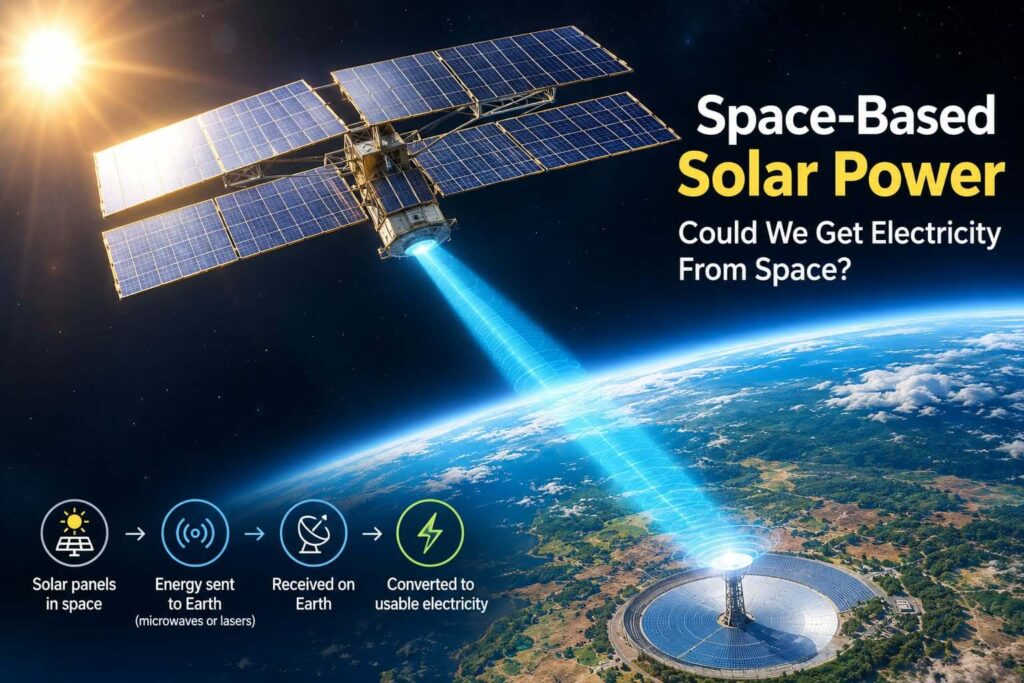
Space Solar Power sounds like science fiction, but scientists and engineers are seriously investigating whether satellites could collect sunlight in orbit and deliver electricity to Earth. The basic idea is simple: place large solar power systems in space, capture sunlight, convert it into energy, and transmit that energy wirelessly to a receiving station on Earth.
Unlike conventional solar farms, a space-based system would not have to wait for sunrise or worry about clouds covering its panels. In theory, it could provide electricity much more continuously.
NASA has studied the potential of space-based solar power, while organizations such as the European Space Agency (ESA) and Japan Aerospace Exploration Agency (JAXA) are researching technologies that could make the concept practical. However, major challenges remain, particularly launch costs, enormous infrastructure requirements, power transmission, maintenance, safety, and economics.
So, could we really get electricity from space? The answer is potentially yes—but not at large commercial scale yet.
Table of Contents
- · What Is Space Solar Power?
- · How Does Space Solar Power Work?
- · Why Does Space Solar Power Matter?
- · Benefits of Solar Power From Space
- · Major Challenges
- · Space Solar Power vs Ground-Based Solar
- · Current Research and Projects
- · Best Practices for Understanding the Technology
- · Common Misconceptions
- · Practical Checklist
- · Frequently Asked Questions
- · CTA
- · Conclusion
What Is Space Solar Power?
Space Solar Power, also called space-based solar power (SBSP), is a proposed energy system that collects solar energy outside Earth’s atmosphere and sends it to Earth.
A typical system would use a very large solar array positioned in orbit. The solar panels would generate electricity from sunlight. Instead of sending electricity through traditional cables, the system would convert the electrical energy into a form that can travel wirelessly.
The energy could then be directed toward a receiving station on Earth, where it would be converted back into electricity and connected to the power grid.
JAXA describes the concept as a system that collects solar energy in space, converts it into microwave or laser beams, transmits the energy to Earth, and converts it into electrical power.
In simple terms, imagine a solar farm floating in space instead of sitting on land.
How Does Space Solar Power Work?
The concept involves several major stages.
Collecting sunlight in orbit
Large solar panels would be placed in orbit around Earth. These panels would capture sunlight and convert it into electrical energy.
Space has one important advantage: there is no atmosphere between the Sun and the solar panels.
Ground-based solar systems lose some incoming sunlight because Earth’s atmosphere absorbs and scatters solar radiation.
Converting solar energy
The solar panels would produce electricity. However, sending conventional electricity directly from orbit to Earth is not practical.
Therefore, the electricity would be converted into electromagnetic energy.
Two major approaches being investigated are:
· Microwave power transmission
· Laser power transmission
Microwave systems are particularly important in many proposed designs.
Beaming power to Earth
A transmitting system would direct the energy toward a receiving station on Earth.
The receiving station, sometimes called a rectenna, would capture the microwave energy and convert it back into electricity.
Connecting to the grid
Finally, the electricity could be supplied to homes, businesses, industrial facilities, data centers, or other users through the existing electricity grid.
The complete process can therefore be summarized as:
Sunlight → Space Solar Panels → Electricity → Wireless Transmission → Ground Receiver → Electricity Grid
Why Does Space Solar Power Matter?
The global energy system is changing rapidly.
Countries in North America and Europe are investing heavily in renewable energy, electrification, energy storage, smart grids, and low-carbon technologies.
However, renewable energy sources have different limitations.
Solar panels on Earth produce less electricity at night and can be affected by clouds. Wind turbines depend on wind conditions. Batteries can help balance these fluctuations, but large-scale storage can add cost and complexity.
Space Solar Power offers a different concept.
Because the satellite would receive sunlight above the atmosphere, it could potentially provide power for much longer periods than conventional solar farms.
The UK government describes SBSP as a potential source of clean, continuous energy that could operate day and night and in different weather conditions. The UK has also commissioned studies examining the feasibility of smaller SBSP systems for possible early markets in the 2030s.
Benefits of Space Solar Power
Solar energy could be available almost continuously
One of the biggest attractions is consistency.
A solar satellite could receive sunlight for much longer periods than a solar farm on the ground.
That could potentially make space-based solar power useful as a source of reliable renewable electricity.
Less dependence on weather
Clouds, rain, snow, and atmospheric conditions can reduce solar generation on Earth.
A space-based system could largely avoid these problems because the solar collectors would operate above the atmosphere.
Reduced pressure on land
Large solar farms require significant areas of land.
Space Solar Power could move the energy collection infrastructure away from valuable land used for agriculture, conservation, housing, and industry.
However, the receiving stations on Earth would still require suitable locations.
Potential support for energy security
Countries that depend heavily on imported fuels are interested in technologies that could diversify their energy systems.
A mature space solar network could theoretically provide another source of electricity without relying directly on coal, oil, or natural gas.
For Europe, this could have strategic importance as countries continue developing low-carbon energy systems.
Potential applications beyond Earth
The technology could eventually have uses in space itself.
Future lunar bases, spacecraft, satellites, and industrial facilities could potentially receive wireless energy.
NASA has also identified technologies such as wireless power transmission, autonomous systems, and in-space assembly as areas that could benefit from SBSP research.
The Biggest Challenges of Space Solar Power
The idea is promising, but building a commercial system would be extremely difficult.
Launch costs
This is one of the biggest problems.
A commercial solar satellite could require enormous amounts of hardware to be transported into orbit.
Every solar panel, structural component, transmitter, processor, and other component has to be manufactured and delivered into space.
NASA’s analysis found that launch and manufacturing costs are major barriers to the development of SBSP.
Reusable rockets can reduce launch costs, but the scale of the infrastructure remains a major challenge.
Building enormous structures in space
A utility-scale solar satellite would be much larger than most spacecraft operating today.
Engineers may need robots capable of assembling huge structures in orbit.
This is already an area of active research.
In 2025, the UK Atomic Energy Authority and Space Solar demonstrated robotic technology intended to explore how robots could assemble very large space structures, including proposed solar power satellites.
Wireless power transmission
Sending useful amounts of energy from orbit to Earth is another major challenge.
Wireless power transmission has been demonstrated at much smaller scales, but commercial SBSP would require dramatically greater power levels.
ESA notes that the physics behind radio-frequency transmission is already used in telecommunications, but SBSP would require much larger quantities of energy to be transmitted efficiently.
Cost of electricity
Even if the technology works, it must compete with cheaper energy sources.
NASA’s 2024 study found that its representative SBSP designs were more expensive than terrestrial alternatives under the assumptions used in the analysis. It estimated lifecycle electricity costs could be 12 to 80 times higher than terrestrial alternatives in those reference cases.
That does not mean the technology can never become competitive.
Lower launch prices, automated manufacturing, reusable spacecraft, improved solar cells, and better power transmission could change the economics.
Space debris and maintenance
Large orbital structures would need protection from space debris and micrometeoroids.
They would also need regular inspection and maintenance.
This creates another difficult question:
How do you repair a power station hundreds or thousands of kilometers above Earth?
Robotic servicing could become an important part of the answer.
Space Solar Power vs Ground-Based Solar
Both technologies use sunlight, but their operating environments are very different.
Ground-based solar
Traditional solar farms:
· Are easier to build and maintain
· Are already commercially available
· Have relatively low installation costs
· Require land
· Depend on local sunlight and weather
· Do not produce electricity at night without storage
Space-based solar
Space Solar Power could potentially:
· Collect sunlight for longer periods
· Reduce weather-related interruptions
· Deliver electricity wirelessly
· Reduce the need for huge solar farms on Earth
· Support continuous renewable generation
However, it currently faces much greater technical and financial barriers.
Therefore, Space Solar Power should not be viewed as a replacement for today’s solar panels.
Instead, it is better understood as a potential future addition to the global energy system
Current Research and Future Development
https://www.nasa.gov/organizations/otps/space-based-solar-power-report/
Several major organizations are investigating space-based solar concepts.
NASA
NASA published a detailed Space-Based Solar Power study in 2024. The study examined the potential costs, greenhouse gas emissions, technical requirements, and development challenges of systems that could potentially operate around 2050.
NASA’s work does not mean that commercial space solar power is ready today.
Instead, it helps identify the technologies and economic conditions required to make the concept more realistic.
European Space Agency
ESA’s SOLARIS initiative has investigated the technical, economic, and policy questions surrounding space-based solar power.
The concept involves collecting solar energy in orbit and transmitting it wirelessly to receiving stations on Earth.
ESA sees the technology as a possible long-term complement to Europe’s renewable energy system.
Japan
JAXA has been researching Space Solar Power Systems for decades.
Its work includes wireless power transmission, space solar cells, large-scale space structures, and technologies for reducing risks from orbital debris.
Best Practices for Understanding Space Solar Power
Because this technology is still developing, readers should be careful when evaluating claims about it.
Look for realistic timelines
Be cautious when an article claims that homes will soon receive electricity directly from giant solar satellites.
Large-scale commercial deployment requires many technological and economic breakthroughs.
Separate demonstrations from commercial systems
A small wireless power demonstration proves that a principle works.
It does not automatically prove that the same technology can deliver gigawatts of affordable electricity to millions of people.
Compare costs
Always compare space solar with existing technologies such as:
· Ground-based solar
· Wind power
· Hydropower
· Nuclear energy
· Battery storage
· Long-duration energy storage
The best energy solution will depend on cost, reliability, geography, infrastructure, and environmental impact.
Common Mistakes to Avoid
Mistake 1: Calling it science fiction
Space Solar Power is based on established physical principles. The challenge is scaling those principles economically.
Mistake 2: Assuming it is commercially ready
It is not.
Major organizations are still researching the technology and its economics.
Mistake 3: Ignoring launch requirements
A space solar satellite could require enormous quantities of hardware in orbit.
Launch and assembly costs are therefore central to the discussion.
Mistake 4: Assuming sunlight automatically means cheap electricity
Solar energy itself is abundant.
The difficult part is collecting it in space, transmitting it safely, maintaining the infrastructure, and delivering affordable electricity to consumers.
Practical Space Solar Power Checklist
Before evaluating a proposed project, ask:
· Where will the satellite operate?
· How much electricity will it generate?
· How much hardware must be launched?
· How will the system be assembled?
· How will energy reach Earth?
· How efficient is the transmission system?
· What happens during equipment failure?
· How will space debris be managed?
· How much will electricity cost?
· Can it compete with terrestrial renewable energy?
· What regulations will apply?
· What environmental impacts need further study?
These questions help separate genuine engineering progress from exaggerated claims.
Frequently Asked Questions
What is Space Solar Power?
Space Solar Power is a proposed energy technology that collects sunlight using solar systems in orbit and transmits the resulting energy wirelessly to Earth.
Can we get electricity from space?
Yes, in principle. Spacecraft can collect solar energy, and wireless energy transmission has been demonstrated. However, delivering large amounts of affordable electricity from orbit remains a major engineering and economic challenge.
Is Space Solar Power available commercially today?
No. Large-scale commercial Space Solar Power is not currently operating as a mainstream electricity source. NASA, ESA, JAXA, and other organizations continue to study the technology.
Why is solar power from space useful?
The biggest potential advantage is consistent access to sunlight. A space-based system could potentially collect solar energy without many of the interruptions caused by nighttime and terrestrial weather.
When could Space Solar Power become practical?
There is no guaranteed deployment date. Government and industry studies are examining possible development pathways from the 2030s onward, while NASA has analyzed scenarios involving systems operating around 2050. The actual timeline will depend on launch costs, manufacturing, power transmission, regulation, and investment.
Could Space Solar Power Really Change the Energy Industry?
The concept deserves attention because it addresses one of renewable energy’s biggest challenges: reliable electricity generation.
Solar and wind power are already transforming electricity systems. However, their output changes with weather and time.
Space Solar Power takes a completely different approach.
Instead of building bigger energy systems on Earth, engineers would place part of the energy-generation infrastructure in orbit.
That is a massive engineering challenge. Yet, if launch costs fall and robotic space construction becomes practical, the economics could look very different in the future.
The UK’s recent research into smaller-scale SBSP systems also shows that researchers are exploring possible pathways toward earlier applications instead of waiting for enormous gigawatt-scale systems immediately.
This could eventually create opportunities across aerospace, robotics, energy, telecommunications, artificial intelligence, manufacturing, and advanced materials
CTA: Follow the Future of Energy Technology
https://futurescienceai.com/blog/space-astronomy/future-of-space-exploration-future-science-ai/
The future of energy will not depend on one technology alone.
From artificial intelligence and smart grids to renewable energy, robotics, quantum technology, and space-based systems, innovation is changing how humanity produces and uses electricity.
Want to understand the technologies that could shape tomorrow’s world? Explore more science and future-technology articles on FutureScienceAI.
Conclusion
Space Solar Power could one day transform the way we think about renewable electricity.
The basic idea is fascinating: collect sunlight in space, convert it into energy, beam that energy to Earth, and deliver it to the power grid.
The technology offers potential advantages, including more consistent access to sunlight, reduced dependence on weather, and new possibilities for global energy security.
However, major challenges remain. Launch costs, massive orbital structures, wireless power transmission, maintenance, space debris, environmental considerations, and electricity prices all need to be addressed.
Current research from NASA, ESA, JAXA, the UK government, and other organizations shows that serious work is already underway.
For now, Space Solar Power is best viewed not as a replacement for today’s solar farms, but as a long-term energy technology under development.
If engineers can make orbital manufacturing, reusable launch systems, wireless power transmission, and large-scale space infrastructure affordable, electricity from space could move from an ambitious concept toward a practical part of the world’s clean-energy future.
The biggest question is no longer simply “Can we collect solar energy in space?”
The real question is:
“Can we build the technology cheaply, safely, and reliably enough to make it worthwhile?”
That is the challenge that will determine whether Space Solar Power becomes one of the defining energy technologies of the future.