
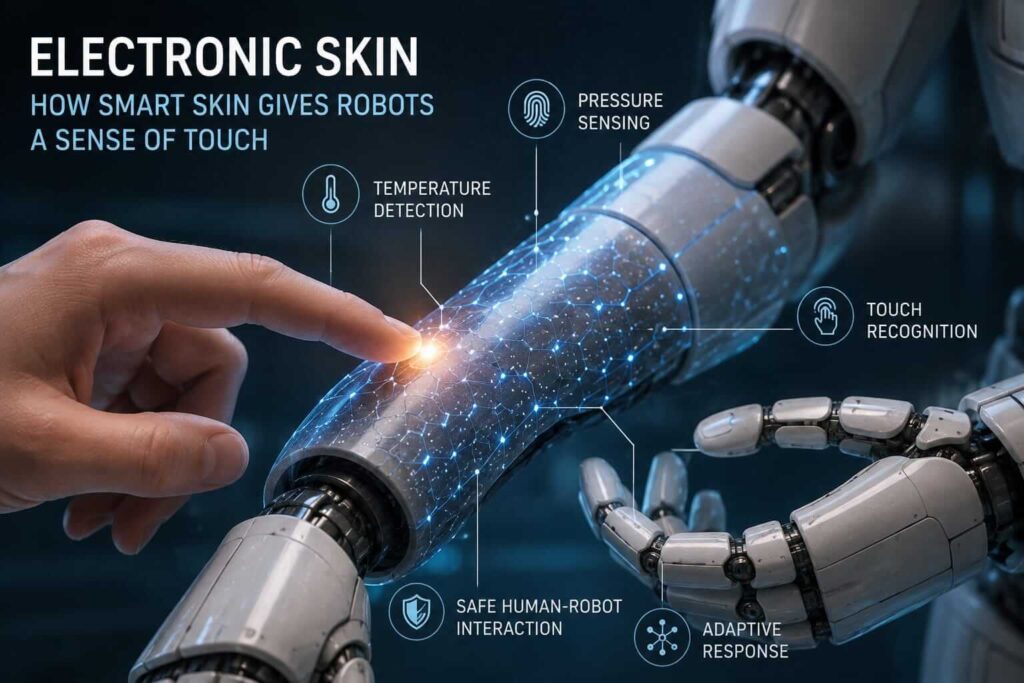
Electronic Skin: How Smart Skin Could Give Robots a Sense of Touch
Imagine a robot picking up a fragile glass, holding a strawberry without damaging it, or helping an older person stand without applying too much pressure. Cameras can help robots see these objects, but vision alone cannot tell a machine exactly how something feels in its grip. This is where electronic skin could change robotics.
Electronic skin, often called e-skin, is a flexible sensing technology designed to imitate some of the sensory abilities of human skin. Depending on its design, it can detect pressure, force, stretching, vibration, temperature, and even more advanced physical or chemical signals. Researchers are now working to make these systems thinner, more flexible, intelligent, durable, and easier to manufacture.
The goal is not necessarily to make robots “feel” exactly like humans. Instead, researchers want machines to collect useful tactile information and respond to their surroundings more intelligently.
Table of Contents
1. What Is Electronic Skin?
2. Why Do Robots Need a Sense of Touch?
3. How Does Electronic Skin Work?
4. What Can Electronic Skin Detect?
5. How Electronic Skin Could Transform Robotics
6. Real-World Applications
7. Latest Developments in Electronic Skin
8. Benefits and Advantages
9. Challenges and Limitations
10. Best Practices for Developing Smart Robotic Skin
11. Common Mistakes to Avoid
12. Practical Checklist
13. Frequently Asked Questions
14. Call to Action
15. Conclusion
What Is Electronic Skin?
Electronic Skin is a thin, flexible electronic sensing system inspired by biological skin.
Human skin contains different types of receptors that respond to mechanical and thermal stimuli. Together, these receptors help us recognize pressure, vibration, temperature, texture, movement, and other sensations.
Scientists are attempting to reproduce some of these capabilities using flexible materials, miniature sensors, electronic circuits, and software.
In robotics, an e-skin system can be placed over areas such as:
- Robotic hands
- Fingers
- Arms
- Grippers
- Humanoid robot bodies
- Prosthetic limbs
- Collaborative robots
- Soft robotic systems
Instead of relying only on cameras or traditional force sensors at a few specific points, a flexible sensor network can provide information across a much larger surface.
Research reviews describe electronic skin as a promising technology for robotics and prosthetics because tactile sensing can help machines detect pressure, force, slip, temperature, and other environmental information.
Why Do Robots Need a Sense of Touch?
Robots are becoming increasingly capable of seeing, moving, planning, and communicating. However, physical interaction remains difficult.
Consider a robotic hand holding an egg.
A camera may identify the egg’s shape and location. An AI model may determine that the object is fragile. But the robot still needs to know whether it is gripping the egg too tightly or whether the object is beginning to slip.
Humans solve this problem naturally through touch.
Our fingers continuously receive tactile information while we manipulate objects. Robots need comparable feedback if they are expected to perform delicate physical tasks.
Vision Alone Is Not Enough
Computer vision answers questions such as:
“What is this object?”
Touch can help answer:
“How much force am I applying?”
“Is the object slipping?”
“Is the surface soft or hard?”
“Is the object becoming warmer?”
That combination of vision and touch could make future robots significantly more capable.
How Does Electronic Skin Work?
At a basic level, Electronic Skin converts physical changes into electrical signals.
When something touches an e-skin surface, its sensors detect a change. Electronics then translate that change into data. Finally, software or an AI system interprets the information and determines what action should happen next.
The process can be simplified into four stages:
Touch → Sensor → Data → Response
For example, imagine a robotic hand picking up a cup.
1. The fingers contact the cup.
2. Sensors detect pressure and force.
3. The system analyzes the signals.
4. The robot adjusts its grip.
This feedback loop can happen rapidly.
Types of Tactile Sensors
Researchers are developing several different sensor technologies.
Common approaches include:
- Capacitive sensors: Detect changes in electrical capacitance caused by deformation.
- Piezoresistive sensors: Detect changes in electrical resistance when pressure is applied.
- Piezoelectric sensors: Generate electrical signals in response to mechanical stress.
- Triboelectric sensors: Generate electrical signals through contact and separation.
- Optical sensors: Use changes in light to detect deformation or touch.
- Magnetic sensors: Detect changes associated with movement or deformation.
Each approach has advantages and limitations depending on the application.
What Can Electronic Skin Detect?
The capabilities of an Electronic Skin system depend on its sensors and processing architecture.
A sophisticated system could potentially detect several forms of information.
Pressure and Force
Pressure sensing is one of the most important applications.
A robot can use pressure information to determine whether it is gripping an object gently or applying excessive force.
Slip and Vibration
Detecting movement between the robot’s surface and an object is particularly valuable.
If a cup begins slipping, tactile feedback could allow the robot to increase its grip before dropping it.
Temperature
Some Electronic Skin systems incorporate temperature sensing. This could help robots distinguish between objects or identify potentially dangerous temperatures.
Texture
Advanced tactile systems can analyze vibration and pressure patterns to distinguish surfaces.
A robot might eventually distinguish between smooth glass, rough fabric, paper, or other materials through tactile information.
Chemical Information
The technology is also moving beyond basic physical touch.
A 2025 study reported an artificial skin system combining physical sensing with optical detection of molecular signals, demonstrating how robotic skin could eventually provide information beyond pressure and temperature.
That points toward an interesting future: robotic skin may eventually become a broader environmental sensing platform.
How Electronic Skin Could Transform Robotics
The most exciting possibility is not simply giving robots another sensor.
It is giving them continuous feedback about physical interaction.
More Precise Robotic Hands
Robotic hands currently struggle with objects that are fragile, irregular, slippery, or unfamiliar.
Electronic Skin could provide additional feedback while an object is being manipulated.
For example, a robot could:
- Detect when an object begins slipping.
- Reduce force when an object is fragile.
- Adjust its grip when an object changes position.
- Recognize different surface textures.
- Respond to unexpected contact.
This could improve robotic dexterity considerably.
Safer Human-Robot Collaboration
Safety is another major application.
Industrial robots increasingly work alongside people. A tactile layer could provide additional information when physical contact occurs.
Instead of relying exclusively on cameras or predefined movement zones, robots could potentially detect contact directly across their surfaces.
That could become especially important for collaborative robots designed to operate near workers.
Better Healthcare Robots
Healthcare is another promising area.
Robots designed to assist patients may eventually need to interact physically with people in a controlled and gentle manner.
A tactile system could help a robot recognize how much force it is applying.
However, these applications require extremely high reliability, careful testing, privacy protection, and appropriate safety standards.
Real-World Applications of Electronic Skin
The technology has potential across several industries.
Manufacturing
Factories could use tactile robots for assembly, packaging, inspection, and material handling.
A robot equipped with tactile feedback could detect subtle changes during manipulation instead of depending entirely on visual information.
Logistics and Warehousing
Warehouse robots deal with objects of different sizes, weights, shapes, and materials.
Electronic Skin could help robotic grippers handle packages more reliably.
Healthcare
Future assistive robots and prosthetic technologies could use tactile sensing to improve physical interaction.
Electronic Skin research already spans robotics, prosthetics, and healthcare applications.
Humanoid Robots
Humanoid robots may be among the biggest beneficiaries.
If a humanoid robot is expected to operate in environments designed for humans, it needs more than vision.
It needs to understand physical contact.
Electronic Skin could eventually cover hands, arms, and other areas of a humanoid robot, creating a distributed tactile sensing system.
Latest Developments in Electronic Skin
Electronic Skin is moving beyond simple pressure sensors.
One important direction is multimodal sensing, where one system can collect multiple types of information.
In March 2026, researchers reported a bio-inspired origami capacitive robotic e-skin designed for multimodal sensing. The work highlights ongoing efforts to make flexible robotic skin more capable while addressing the complexity of conventional sensor arrays.
Another 2026 study described a scalable fabrication approach for multimodal e-skin, combining tactile, bending, thermal, and proximity sensing within a flexible platform.
Neuromorphic Electronic Skin
Another major direction is neuromorphic processing.
Traditional sensors can produce enormous amounts of tactile data. Sending all of that information to a central processor can increase latency and energy use.
Neuromorphic systems attempt to process information in ways inspired by biological nervous systems.
Research published in Nature Materials in 2025 highlighted neuromorphic mechanosensory skin capable of efficient tactile texture discrimination.
This could eventually allow robots to respond to touch faster and with less computational overhead.
Self-Healing and Damage-Tolerant Skin
A robot working in a factory or outdoor environment may damage its artificial skin.
Researchers are therefore exploring flexible, stretchable, self-healing, and fault-tolerant approaches.
One 2025 Nature Communications study proposed a self-rerouting sensor network designed to maintain electronic-skin functionality despite severe damage.
That is important because a useful robotic skin must be more than sensitive. It must also survive real-world conditions.
Benefits of Electronic Skin
The potential advantages include:
- Better robotic dexterity: Robots can respond to physical contact.
- Improved object handling: Tactile feedback can help control grip.
- Greater safety: Contact information can support safer interaction.
- More natural human-robot interaction: Robots can respond to physical cues.
- Energy-efficient processing: Neuromorphic approaches may reduce unnecessary data processing.
- Flexible integration: Thin sensors can conform to curved surfaces.
- Multimodal perception: One platform can potentially sense several environmental signals.
Importantly, these benefits depend on the quality, reliability, and integration of the entire system.
Challenges and Limitations
https://futurescienceai.com/blog/artificial-intelligence/humanoid-robots-everyday-life/
Despite impressive research progress, Electronic Skin is not yet equivalent to human skin.
Durability
Robotic surfaces experience friction, impacts, stretching, dust, moisture, and repeated movement.
An Electronic Skin system must remain reliable under these conditions.
Manufacturing Complexity
Large robotic surfaces may require thousands or even millions of sensing elements.
Connecting, powering, calibrating, and processing all those sensors is difficult.
Data Processing
A large tactile sensor array can produce huge volumes of information.
Researchers need efficient methods to process useful signals without creating unnecessary computational loads.
Cost
Advanced materials and manufacturing processes can make sophisticated Electronic Skin expensive.
For widespread adoption, production needs to become more scalable.
Human-Like Perception Is Extremely Difficult
Human skin does not simply detect pressure.
It combines multiple receptor types, biological processing, movement, memory, and nervous-system interpretation.
Replicating that complete system remains a major scientific challenge.
Best Practices for Developing Smart Robotic Skin
For organizations exploring tactile robotics, the best approach is to begin with a specific use case.
Step 1: Define the Physical Task
Determine exactly what the robot needs to feel.
Is it pressure, slip, temperature, vibration, texture, or a combination?
Step 2: Select Appropriate Sensors
Choose the sensor technology according to the environment and required sensitivity.
Step 3: Design for Flexibility
Robotic skin needs to follow curved surfaces without losing performance.
Step 4: Plan Data Processing Early
Sensor hardware and AI software should be designed together rather than treated as separate systems.
Step 5: Test Under Real Conditions
Laboratory performance does not automatically guarantee reliable operation in factories, hospitals, warehouses, or homes.
Step 6: Measure Reliability
Track sensor accuracy, response time, durability, calibration stability, energy consumption, and failure rates.
This systematic approach can reduce development risks while creating a clearer path toward commercialization.
Common Mistakes to Avoid
When discussing or developing Electronic Skin, several mistakes are easy to make.
Mistake 1: Assuming Electronic Skin equals human skin.
Most systems reproduce only selected aspects of biological touch.
Mistake 2: Focusing only on sensitivity.
A highly sensitive sensor is not automatically useful if it is fragile or difficult to manufacture.
Mistake 3: Ignoring data processing.
Collecting tactile information is only half the problem. The robot must interpret it.
Mistake 4: Forgetting real-world conditions.
Temperature, moisture, dust, repeated bending, and mechanical damage can affect performance.
Mistake 5: Treating AI as a replacement for sensors.
AI can interpret tactile data, but it still needs reliable physical information from the environment.
Practical Electronic Skin Checklist
https://www.therobotreport.com/electronic-skin-robot-sense-of-touch/
Before evaluating a robotic Electronic Skin system, consider:
- What physical signals must it detect?
- Does it need pressure, force, slip, temperature, or texture sensing?
- Can the sensors conform to curved surfaces?
- How quickly can the system respond?
- How much data will the sensor array produce?
- Where will tactile information be processed?
- Can the system survive repeated contact?
- How will damaged sensors be identified?
- What is the expected manufacturing cost?
- Has the system been tested outside laboratory conditions?
- What safety requirements apply to the intended application?
Frequently Asked Questions
What is Electronic Skin?
Electronic Skin is a flexible sensing technology inspired by human skin. It uses sensors and electronic systems to detect physical information such as pressure, force, temperature, vibration, and movement.
Can Electronic Skin make robots feel?
Electronic Skin can give robots a form of artificial tactile perception. However, it does not currently reproduce the complete complexity of human touch. Instead, it allows robots to detect and interpret selected physical signals.
Why is Electronic Skinimportant for robots?
Electronic Skin can provide information that cameras cannot easily capture, such as grip pressure, contact force, vibration, and slipping. This can improve robotic manipulation and physical interaction.
Where can Electronic Skin be used?
Potential applications include industrial robots, humanoid robots, prosthetic limbs, healthcare robots, humanoid robots, prosthetic limbs, healthcare robotics, warehouse automation, soft robotics, and human-machine interfaces.
Will Electronic Skinreplace human skin?
No. The objective is not simply to replace biological skin. Instead, researchers are developing artificial sensing systems that reproduce useful characteristics of human touch for machines and medical technologies.
Call to Action — Explore the Future of Smart Robotics
The combination of Electronic Skin, artificial intelligence, flexible electronics, and robotics could fundamentally change how machines interact with the physical world.
For technology companies, robotics developers, researchers, and organizations exploring automation, now is the time to understand where tactile technology is heading.
Want to explore how emerging AI and robotics
CONCLUSION
Electronic Skin is bringing robots one step closer to having a human-like sense of touch. By combining flexible sensors, artificial intelligence, and advanced materials, smart skin can help robots detect pressure, temperature, texture, and physical contact. This technology could make robots safer, more precise, and better equipped to work alongside humans.
From healthcare and prosthetics to manufacturing, space exploration, and everyday robotics, the potential applications of electronic skin are enormous. Although challenges such as durability, energy efficiency, cost, and realistic sensory processing still need to be solved, research is progressing rapidly.
As Electronic Skin continues to improve, the future of robotics may no longer be limited to machines that can see and move. Robots could also learn to feel and respond to the world around them, making them more intelligent, adaptable, and useful in real-world environments. The development of smart artificial touch could ultimately become one of the key technologies shaping the next generation of human-robot interaction.