
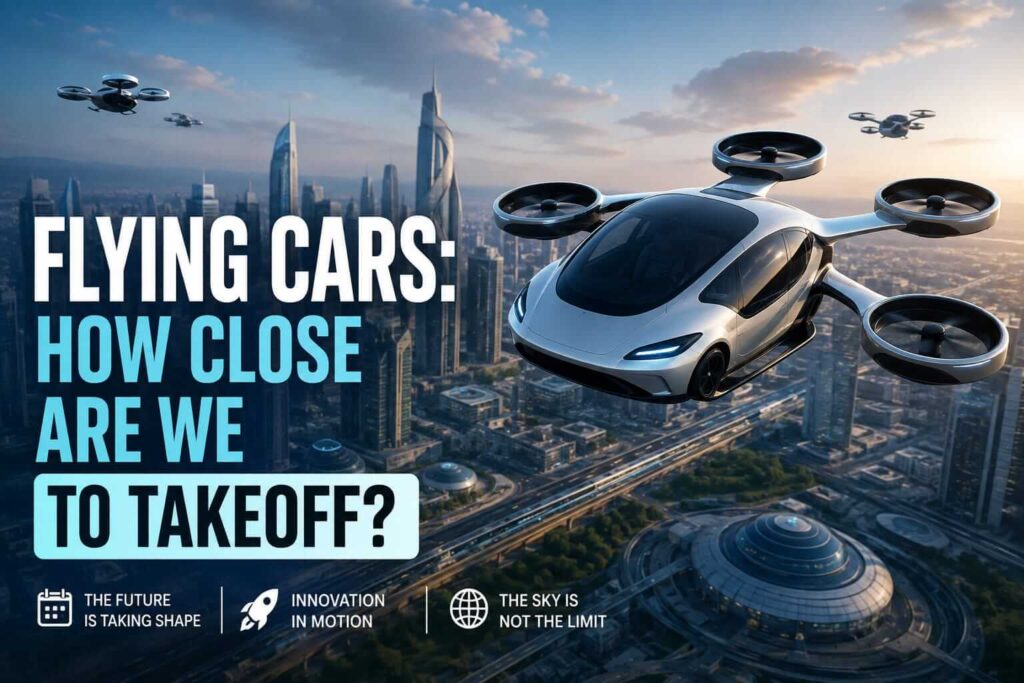
Flying Cars: How Close Are We to Takeoff?
Introduction
Flying cars have moved from science-fiction movies into real engineering laboratories, flight-test programs, and aviation regulations. Companies are now developing electric aircraft that can take off vertically, fly like airplanes, and potentially carry passengers across cities without using roads.
However, there is an important distinction between a flying vehicle that can physically fly and a flying car that can safely, affordably, and routinely operate as part of everyday transportation.
That difference explains why the future of flying cars is both exciting and complicated.
Modern electric vertical takeoff and landing aircraft, commonly called eVTOLs, are already undergoing flight testing. At the same time, regulators in the United States and Europe are developing rules for operating these new aircraft. In 2024, the U.S. Federal Aviation Administration finalized rules covering powered-lift pilot certification and operations, creating an important regulatory foundation for air taxis and similar aircraft.
So, how close are we?
The short answer is: much closer to commercial air taxis than to a flying car sitting in every household garage.
Table of Contents
1. Why Flying Cars Matter
2. What Are Flying Cars?
3. How Do eVTOL Flying Cars Work?
4. How Close Are Flying Cars to Reality?
5. Benefits of Flying Cars
6. The Biggest Challenges
7. Flying Cars vs. Traditional Transportation
8. What the Future Could Look Like
9. Common Mistakes and Misconceptions
10. Practical Flying-Car Readiness Checklist
11. CTA
12. Frequently Asked Questions
13. Conclusion
Why Flying Cars Matter?
Traffic congestion is one of the biggest problems facing growing cities. Millions of people spend hours every week traveling between homes, offices, airports, and other destinations.
Road expansion cannot solve every transportation problem.
Flying vehicles offer a different approach: instead of adding another lane to an already crowded road, they could use three-dimensional airspace.
For example, imagine traveling from a busy downtown area to an airport. A conventional taxi might spend an hour in traffic. An electric air taxi could potentially travel directly between designated landing locations.
This does not mean every person will own a personal aircraft. Instead, the first major use case is likely to be air-taxi services, airport transfers, medical transportation, cargo delivery, and other short-distance routes.
NASA describes advanced air mobility as an emerging transportation concept involving new aircraft and operating systems designed to move people and goods in ways that complement existing transportation. This broader ecosystem is important because flying cars will need more than aircraft; they will need infrastructure, airspace management, digital systems, and trained operators.
What Are Flying Cars?
The phrase “flying car” can be misleading.
Most modern projects described as flying cars are not simply ordinary cars with wings attached. Many are electric vertical takeoff and landing aircraft, or eVTOLs.
These aircraft combine features from helicopters, airplanes, and electric vehicles.
What Makes an eVTOL Different?
A typical eVTOL design may use several electric motors and propellers.
During takeoff, the aircraft generates vertical lift. Once airborne, some designs transition toward efficient forward flight using wings.
This approach can provide several advantages:
- No conventional runway may be required.
- Electric motors can be mechanically simpler than traditional engines.
- Multiple motors can provide redundancy.
- Vertical takeoff could make short urban routes practical.
- Electric propulsion may reduce local emissions during operation.
However, eVTOLs are still aircraft. They must meet demanding aviation safety requirements before carrying passengers commercially.
Archer Aviation, for example, states that its aircraft must progress through separate FAA certification stages, including type, production, and operational certification before passenger service.
How Do Flying Cars Work?
The basic idea is surprisingly easy to understand.
Step 1 — Vertical Takeoff
Instead of accelerating along a runway, an eVTOL uses vertically directed thrust to lift away from the ground.
This is one reason these aircraft could be useful in cities.
Step 2 — Transition to Forward Flight
After gaining sufficient altitude, some aircraft change the direction of their thrust.
The wings then generate much of the lift needed for efficient forward flight.
This combination is important because hovering requires significant energy, while wing-supported flight can be more efficient.
Step 3 — Cruise
During the main portion of the journey, the aircraft travels toward its destination using electric propulsion and aerodynamic lift.
The aircraft’s flight computer, navigation equipment, sensors, and pilot work together to maintain a safe flight.
Step 4 — Vertical Landing
Near the destination, the aircraft slows down and returns to a vertical-flight configuration.
It can then land at a specially designed location known as a vertiport.
In other words, the future of flying cars may look less like “drive your car into the sky” and more like booking an electric air taxi from one vertiport to another.
How Close Are Flying Cars to Reality?
This is where the story becomes especially interesting.
Flying cars are no longer purely theoretical. Several companies have built full-scale aircraft, performed flight tests, and entered formal certification programs.
The regulatory environment is also developing.
In October 2024, the FAA finalized a powered-lift rule covering pilot qualifications, training, and operational requirements. The FAA specifically identified air taxis, cargo delivery, and other urban and rural applications as potential powered-lift operations.
Europe is also developing its regulatory framework. EASA has introduced rules and guidance covering manned VTOL-capable aircraft and their operations.
That means the industry has passed an important stage: regulators are no longer treating advanced air mobility simply as a distant concept.
Nevertheless, certification remains one of the biggest hurdles.
Companies must demonstrate that their aircraft are safe, reliable, manufacturable, and suitable for real-world operations.
As of 2026, the realistic expectation is that limited commercial air-taxi services will arrive before mass-market personal flying cars.
Some companies are targeting commercial operations in the second half of the decade, but certification schedules can change.
Therefore, anyone claiming that flying cars will suddenly become as common as automobiles should be cautious.
Benefits of Flying Cars
If the technology becomes commercially viable, flying cars could change transportation in several important ways.
Faster Urban Travel
The biggest advantage could be time.
Instead of following roads through congested areas, aircraft can travel more directly between locations.
A 50-mile road journey could potentially become a much shorter aerial trip, depending on the route and operating conditions.
Reduced Traffic Pressure
Flying vehicles would not eliminate road traffic.
However, moving some passengers and cargo into the air could reduce pressure on heavily congested transportation networks.
Airport Connections
Airport transportation is one of the most practical early applications.
An air taxi could connect an airport with a downtown vertiport, business district, or nearby transportation hub.
H3: Emergency and Medical Uses
Advanced air mobility could also support:
- Emergency medical transportation
- Disaster response
- Remote-area access
- Time-sensitive cargo
- Infrastructure inspections
These uses may become important even before passenger air taxis become widespread.
Electric Propulsion
Battery-electric aircraft could reduce direct operational emissions compared with conventional combustion-powered helicopters, although their overall environmental impact still depends on electricity generation, battery production, aircraft efficiency, and other factors.
The Biggest Challenges Facing Flying Cars
The technology is promising, but several obstacles remain.
Battery Energy Density
Batteries store much less energy per kilogram than aviation fuel.
That creates a major engineering challenge.
Aircraft must remain lightweight while carrying enough energy for the flight, reserve requirements, passengers, and safety systems.
Better batteries could significantly improve range and economics.
Safety
Aviation has extremely high safety expectations.
A commercial flying taxi cannot simply be “good enough.” It must be dependable under a wide range of operating conditions.
Designers therefore need redundancy, reliable flight controls, emergency procedures, battery safety systems, and extensive testing.
Noise
Electric motors can be quieter than traditional helicopter engines, but that does not mean eVTOLs will be silent.
Propellers moving large amounts of air can still create noticeable sound.
For urban operations, community acceptance will be just as important as technical performance.
Infrastructure
Where will flying cars land?
Cities will need vertiports, charging systems, passenger facilities, maintenance locations, and connections to ground transportation.
Without suitable infrastructure, even an excellent aircraft cannot provide a useful transportation network.
Cost
The first flights are unlikely to be cheap.
Aircraft certification, manufacturing, infrastructure, maintenance, trained personnel, and insurance all cost money.
The long-term goal is to make air-taxi services affordable enough for regular transportation rather than treating every flight as a luxury experience.
Flying Cars vs. Traditional Transportation
Flying cars should not be viewed as a complete replacement for cars, trains, buses, or airplanes.
Instead, they may become another layer of the transportation system.
For example:
Car: Flexible for short trips and door-to-door travel.
Train: Efficient for large numbers of passengers traveling along established routes.
Airplane: Best suited to longer-distance journeys.
eVTOL air taxi: Potentially useful for fast, short-distance trips where road congestion is severe.
This suggests that the future could involve multimodal transportation.
A passenger might take a train from one city to another, an air taxi from the airport to a business district, and then a conventional vehicle for the final few miles.
That is a much more realistic vision than replacing every car with a flying machine.
What Could Flying Cars Look Like in the Future?
https://futurescienceai.com/blog/future-tech/what-is-digital-twin-technology/
The first generation of flying cars will probably operate through controlled networks.
Passengers may use an app to select a route, reserve a seat, travel to a nearby vertiport, and board an aircraft operated by a trained pilot.
Over time, automation could become increasingly important.
Artificial intelligence could assist with:
- Route planning
- Weather monitoring
- Collision avoidance
- Aircraft diagnostics
- Traffic coordination
- Predictive maintenance
However, AI does not automatically make aviation safe.
Autonomous flight systems must be thoroughly tested and certified before they can replace human pilots in passenger operations.
The long-term future could involve highly automated fleets that communicate with one another and with air-traffic management systems.
That vision is technically possible, but it remains a much bigger step than simply building an aircraft that can fly.
Common Mistakes and Misconceptions
“Flying Cars Will Be Everywhere Soon”
Probably not.
Commercial air taxis are much more likely to appear first in selected cities and routes.
“Flying Cars Are Just Cars With Wings”
Modern eVTOLs are generally aircraft rather than conventional road cars that happen to fly.
“Electric Means Completely Environmentally Friendly”
Electric propulsion can reduce direct emissions, but batteries, electricity generation, manufacturing, and infrastructure all have environmental impacts.
“Certification Is Just a Paperwork Problem”
It is not.
Certification exists to demonstrate that an aircraft can operate safely.
That process can take years because aviation authorities must evaluate complex systems and evidence.
“Every Flying Car Will Be Autonomous”
Not necessarily.
Some aircraft may initially operate with pilots, while automation develops gradually.
Practical Flying-Car Readiness Checklist
Before believing that flying cars are ready for everyday use, look for these signs:
- Aircraft has completed extensive flight testing.
- Type certification has been achieved.
- Production certification has been achieved.
- Operational approval is available.
- Qualified pilots or approved autonomous systems are available.
- Vertiports are operating.
- Charging infrastructure is available.
- Emergency procedures have been tested.
- Insurance and maintenance systems are established.
- Ticket prices are practical for ordinary travelers.
- Local communities accept the aircraft’s noise and operations.
The important lesson is simple: a successful prototype is not the same thing as a successful transportation service.
Ready for the Future of Transportation?
Flying cars are no longer just a futuristic idea. They are becoming a serious aerospace and transportation technology.
However, the biggest opportunity may not be personal flying cars.
The first successful market could be electric air taxis operating on carefully selected routes.
As certification progresses, battery technology improves, and vertiport networks develop, these aircraft could gradually become a new part of urban transportation.
If you are interested in emerging technologies, artificial intelligence, space, and the science shaping tomorrow’s world, explore more technology and future-science content on Future Science AI.
The future does not arrive all at once. It is built through thousands of engineering improvements, safety tests, regulatory decisions, and real-world experiments
Frequently Asked Questions About Flying Cars
1. Are flying cars real in 2026?
Yes. Several companies have developed and tested eVTOL aircraft. However, widespread personal flying cars are not yet a normal form of transportation. The industry is moving toward commercial air-taxi operations rather than immediate mass ownership.
2. When will flying cars be available to the public?
Limited commercial air-taxi services could begin in selected markets during the late 2020s, depending on certification, infrastructure, and individual company progress. Mass adoption will likely take considerably longer.
3. How do flying cars take off?
Many modern flying-car concepts use electric vertical takeoff and landing technology. Multiple motors and propellers generate upward thrust, allowing the aircraft to take off without a conventional runway.
4. Are electric flying cars safe?
Safety is one of the industry’s biggest priorities. eVTOL manufacturers must pass rigorous testing and aviation certification before carrying passengers commercially. Regulators also establish operational and pilot requirements.
5. Will flying cars replace normal cars?
Probably not. Flying cars are more likely to complement cars, buses, trains, and airplanes. Their strongest early applications may involve fast airport transfers, urban air taxis, emergency services, and specialized transportation.
Conclusion
So, how close are flying cars?
The answer depends on what we mean by “flying car.”
If we mean a personal vehicle that anyone can purchase, park outside their home, and fly wherever they want, that future is still far away.
If we mean electric aircraft that can vertically take off, carry passengers, and operate as an air-taxi service, the future is much closer.
The technology already exists. Full-scale eVTOL aircraft are flying, regulators are creating operational frameworks, and companies are working through the demanding certification process.
Nevertheless, major challenges remain, including battery performance, safety, infrastructure, noise, regulation, cost, and public acceptance.