
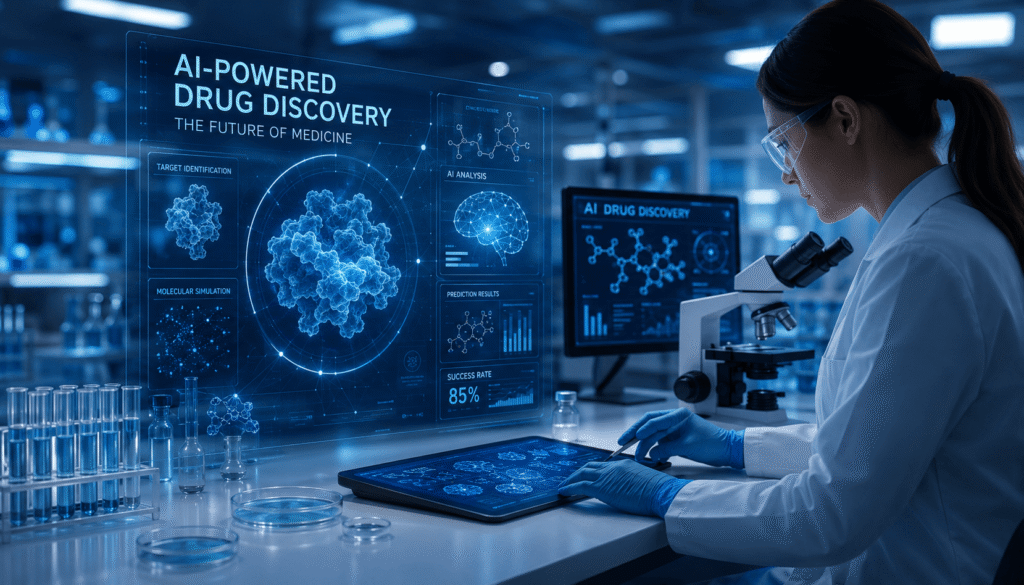
How AI Is Revolutionizing Drug Discovery
Introduction
AI Drug Discovery is transforming one of the most important industries in the world—healthcare. Developing a new medicine traditionally takes years of research, billions of dollars, and countless clinical trials. Today, artificial intelligence is helping scientists accelerate this process, identify promising drug candidates faster, and reduce development costs.
As healthcare systems face increasing pressure to deliver effective treatments more efficiently, AI is becoming a powerful tool in pharmaceutical research. This technology has the potential to improve patient outcomes, support innovation, and reshape the future of medicine.
The traditional drug discovery process is often slow, expensive, and highly complex. Researchers must analyze vast amounts of biological data, identify disease targets, test thousands of compounds, and conduct multiple phases of clinical trials.
AI Drug Discovery changes this approach by using machine learning algorithms, predictive analytics, and advanced data processing to uncover patterns that humans might miss. As a result, pharmaceutical companies can make better decisions faster and improve the likelihood of developing successful treatments
Table of Contents
1. Introduction
2. Why AI Drug Discovery Matters
3. What Is AI Drug Discovery?
4. How AI Is Transforming the Drug Development Process
5. Benefits of AI in Drug Discovery
6. Best Practices for AI-Powered Pharmaceutical Research
7. Common Mistakes and Challenges
8. Practical AI Drug Discovery Checklist
9. Call to Action
10. Frequently Asked Questions
11. Conclusion
Why AI Drug Discovery Matters
Healthcare innovation is critical as populations age and chronic diseases become more common.
Several factors make AI Drug Discovery increasingly important:
- Rising research and development costs
- Growing demand for personalized medicine
- Increasing complexity of diseases
- Large volumes of biomedical data
- Need for faster treatment development
AI helps address these challenges by improving efficiency throughout the drug development lifecycle.
What Is AI Drug Discovery?
AI Drug Discovery refers to the use of artificial intelligence technologies to assist scientists in identifying, designing, testing, and optimizing new medicines.
Instead of relying solely on traditional laboratory methods, researchers can use AI to analyze massive datasets and predict which compounds are most likely to succeed.
Key Technologies Behind AI Drug Discovery
Machine Learning
Machine learning systems identify patterns within biological and chemical data.
These models can:
- Predict drug effectiveness
- Identify disease targets
- Analyze patient responses
Deep Learning
Deep learning algorithms process highly complex datasets, helping researchers discover hidden relationships between molecules and diseases.
Natural Language Processing (NLP)
NLP helps scientists analyze millions of research papers, clinical studies, and medical reports.
This reduces the time needed to gather valuable insights.
How AI Is Transforming the Drug Development Process
Target Identification
The first step in drug discovery is identifying biological targets associated with disease.
AI can analyze:
- Genomic data
- Protein structures
- Clinical records
- Scientific literature
This helps researchers identify potential treatment targets more efficiently.
Drug Candidate Screening
Traditional screening often requires testing thousands of compounds.
AI significantly speeds up this process by predicting which molecules are most likely to interact successfully with a target.
Drug Design and Optimization
AI can recommend modifications to improve:
- Drug safety
- Effectiveness
- Stability
- Bioavailability
Researchers can test virtual models before moving into expensive laboratory experiments.
Clinical Trial Optimization
Clinical trials represent one of the most expensive stages of drug development.
AI can improve:
- Patient recruitment
- Trial design
- Risk assessment
- Data monitoring
These improvements help reduce costs and accelerate approval timelines.
Benefits of AI in Drug Discovery
Faster Development Timelines
Traditional drug development can take more than a decade.
AI helps reduce research timelines by automating complex analytical tasks.
Reduced Costs
Bringing a new drug to market often costs billions of dollars.
AI can reduce unnecessary testing and improve resource allocation.
Improved Success Rates
Many drug candidates fail during development.
AI improves decision-making by identifying promising candidates earlier.
Personalized Medicine
AI supports the development of treatments tailored to individual patients.
By analyzing genetic and clinical data, researchers can create more targeted therapies.
Enhanced Disease Understanding
AI can uncover previously unknown relationships between diseases, genes, and biological pathways.
This leads to new treatment opportunities
Real-World Examples of AI Drug Discovery
Rare Disease Research
AI helps researchers analyze genetic mutations associated with rare diseases, enabling faster identification of potential treatments.
Cancer Treatment Development
Machine learning models are helping scientists discover targeted cancer therapies by identifying biomarkers and treatment pathways.
Infectious Disease Response
During global health emergencies, AI can rapidly evaluate existing compounds and identify candidates for further testing.
Precision Medicine
Healthcare providers increasingly use AI-driven insights to personalize treatment plans based on patient characteristics.
Best Practices for AI-Powered Pharmaceutical Research
Invest in High-Quality Data
AI systems perform best when trained on accurate and diverse datasets.
Organizations should prioritize:
- Data quality
- Data security
- Data governance
Encourage Cross-Disciplinary Collaboration
Successful AI Drug Discovery requires collaboration between:
- Data scientists
- Biologists
- Chemists
- Physicians
Maintain Regulatory Compliance
Researchers must ensure compliance with healthcare regulations and ethical standards.
Continuously Validate Models
AI predictions should be validated through laboratory testing and clinical studies.
Human expertise remains essential.
Common Mistakes and Challenges
Overreliance on AI
AI is a powerful tool but cannot replace scientific judgment.
Researchers should combine AI insights with expert analysis.
Poor Data Quality
Incomplete or biased datasets can produce unreliable results.
Lack of Transparency
Some AI systems operate as “black boxes,” making decisions difficult to interpret.
Transparency is critical for trust and regulatory approval.
Regulatory Complexity
Healthcare regulations vary across regions, requiring careful planning and compliance.
Practical AI Drug Discovery Checklist
Before implementing AI in pharmaceutical research, organizations should ensure:
✔️ High-quality biomedical datasets
✔️ Strong data security measures
✔️ Skilled AI and healthcare teams
✔️ Regulatory compliance frameworks
✔️ Continuous model validation
✔️ Ethical AI governance
✔️ Clinical testing procedures
✔️ Long-term innovation strategy
✔️ Collaboration with healthcare experts
✔️ Performance monitoring systems
Ready to Explore the Future of Healthcare?
Artificial intelligence is changing healthcare faster than ever before. Understanding AI Drug Discovery can help professionals, researchers, and technology enthusiasts stay ahead of emerging trends.
Visit Future Science AI for more expert insights into artificial intelligence, healthcare innovation, future technologies, and scientific breakthroughs. Subscribe today and stay informed about the technologies shaping tomorrow’s world.
Frequently Asked Questions
Q1:What is AI Drug Discovery?
AI Drug Discovery uses artificial intelligence technologies to identify, design, and optimize new medicines more efficiently than traditional methods.
Q2:How does AI help pharmaceutical companies?
AI helps companies analyze large datasets, identify drug candidates, optimize clinical trials, and reduce research costs.
Q3:Can AI replace scientists in drug discovery?
No. AI supports researchers by improving efficiency and decision-making, but human expertise remains essential.
Q4:What are the benefits of AI in healthcare?
AI improves diagnostic accuracy, accelerates research, supports personalized medicine, and enhances patient outcomes.
Q5:Is AI Drug Discovery the future of medicine?
Many experts believe AI Drug Discovery will play a major role in future healthcare innovation by making treatment development faster and more effective.
Conclusion
AI Drug Discovery is revolutionizing the pharmaceutical industry by transforming how medicines are researched, designed, and developed. Through machine learning, predictive analytics, and advanced data processing, AI helps researchers accelerate development timelines, reduce costs, and improve treatment outcomes.
While challenges such as data quality, transparency, and regulatory compliance remain, the benefits are substantial. As technology continues to evolve, AI Drug Discovery will likely become a cornerstone of modern healthcare innovation.
Organizations that embrace AI-driven pharmaceutical research today will be better positioned to develop the life-saving treatments of tomorrow.