The Biggest Challenges in Quantum Computing
Introduction
Quantum computing has the potential to transform industries ranging from healthcare and finance to cybersecurity and scientific research. While traditional computers process information using bits that represent either 0 or 1, quantum computers use qubits, enabling them to perform many calculations simultaneously.
Despite this exciting potential, the biggest challenges in quantum computing continue to slow widespread adoption. Researchers and technology companies are making significant progress, but several technical, financial, and practical barriers remain before quantum computers become part of everyday business and research.
Understanding these challenges helps businesses, students, and technology enthusiasts prepare for the future while separating realistic expectations from hype.
Table of Contents
- Introduction
- Why Quantum Computing Matters
- What Makes Quantum Computing Different?
- The Biggest Challenges in Quantum Computing
- Benefits of Solving These Challenges
- Best Practices for Preparing for the Quantum Future
- Common Mistakes to Avoid
- Practical Checklist
- Frequently Asked Questions
- Conclusion
Why the Biggest Challenges in Quantum Computing Matter
Quantum computing is no longer just a research topic. Governments, universities, and leading technology companies are investing billions of dollars into developing practical quantum systems.
If these systems become reliable, they could:
- Discover new medicines faster
- Improve artificial intelligence
- Optimize global supply chains
- Enhance weather forecasting
- Solve complex scientific problems
- Revolutionize financial modeling
However, achieving these goals depends on overcoming significant obstacles.
Businesses also need to understand these challenges before investing in quantum technology. Knowing the current limitations helps organizations make informed decisions about future opportunities.
What Makes Quantum Computing Different?
https://www.ibm.com/think/topics/quantum-computing
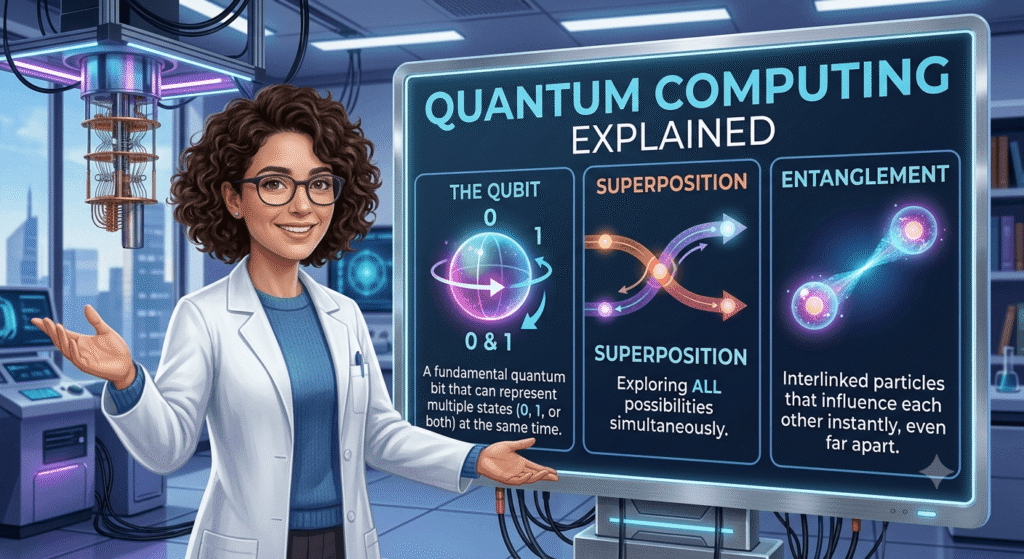
Unlike classical computers that process one calculation at a time, quantum computers rely on the principles of quantum mechanics.
Superposition
A qubit can exist in multiple states simultaneously, allowing quantum computers to process many possibilities at once.
Entanglement
Two qubits can become connected even when separated, enabling faster and more complex calculations.
Quantum Interference
Quantum systems use interference to amplify correct answers while reducing incorrect ones.
These unique properties make quantum computers incredibly powerful for certain types of problems, but they also introduce major engineering challenges.
The Biggest Challenges in Quantum Computing
https://futurescienceai.com/blog/quantum-technology/quantum-ai-future-intelligent-computing/
1. Qubit Instability
One of the largest barriers is keeping qubits stable.
Qubits are extremely sensitive to their environment. Tiny changes in temperature, vibration, electromagnetic radiation, or surrounding particles can disturb their quantum state.
When this happens, calculations become inaccurate.
Researchers often cool quantum processors to temperatures colder than outer space to reduce interference, but maintaining these conditions is expensive and technically demanding.
2. Quantum Error Correction
Errors occur much more frequently in quantum systems than in classical computers.
Unlike traditional computers, simply copying quantum information is impossible because of the laws of quantum mechanics.
Scientists are developing sophisticated quantum error correction techniques, but these require thousands of additional physical qubits to create a single reliable logical qubit.
This remains one of the biggest engineering hurdles in the field.
3. Scalability
Today’s quantum computers typically contain dozens or hundreds of qubits.
Future commercial applications may require millions of high-quality qubits working together reliably.
Scaling from small laboratory systems to large commercial machines involves solving problems related to hardware design, cooling systems, connectivity, manufacturing, and energy efficiency.
As a result, scalability remains one of the most difficult challenges facing researchers.
4. Extremely High Costs
Building quantum computers requires specialized equipment, advanced laboratories, and highly trained experts.
Some essential components include:
- Cryogenic cooling systems
- Precision lasers
- Vacuum chambers
- Superconducting materials
- Advanced control electronics
These requirements make quantum research expensive, limiting widespread adoption for smaller organizations.
5. Limited Practical Applications Today
Although quantum computing has tremendous long-term potential, today’s machines remain useful for only a limited number of specialized problems.
Most businesses still rely on classical computers because they are faster, cheaper, and more reliable for everyday computing tasks.
Researchers continue developing quantum algorithms that may unlock broader commercial value in the coming years
Benefits of Overcoming the Biggest Challenges in Quantum Computing
If researchers successfully solve these obstacles, quantum computing could transform many industries.
Potential benefits include:
- Faster drug discovery
- More secure communication systems
- Improved climate modeling
- Smarter artificial intelligence
- Better logistics optimization
- Advanced materials science
- Financial risk analysis
- Space exploration breakthroughs
Governments and technology companies continue investing because the long-term rewards could be enormous.
Best Practices for Preparing for the Quantum Future
Although practical quantum computers are still developing, individuals and organizations can take steps today to prepare for the coming changes.
Stay Informed About Industry Progress
Quantum computing is advancing quickly. Following trusted research organizations and technology companies can help you understand new breakthroughs and realistic timelines.
Useful resources include universities, scientific journals, and leading quantum research programs.
Learn the Basics of Quantum Computing
You don’t need to be a physicist to understand quantum computing.
Start by learning:
- What qubits are
- How superposition works
- Why entanglement matters
- Basic quantum algorithms
- Current business applications
A solid foundation makes it easier to evaluate future developments.
Explore Hybrid Computing
For the foreseeable future, classical and quantum computers are expected to work together rather than compete.
Many businesses will use hybrid systems where:
- Classical computers handle everyday tasks.
- Quantum computers solve highly specialized problems.
Understanding this approach helps organizations plan realistic technology strategies.
Invest in Workforce Skills
Companies preparing for the quantum era should encourage employees to build skills in:
- Artificial Intelligence
- Data Science
- Cybersecurity
- Mathematics
- Programming
- Quantum Information Science
A knowledgeable workforce will be better equipped to adopt quantum technologies when they become commercially viable.
Common Mistakes to Avoid
Many people misunderstand the current state of quantum computing. Avoid these common mistakes:
Believing Quantum Computers Will Replace All Computers
Quantum computers are designed for specific types of complex calculations. They are unlikely to replace laptops, smartphones, or office computers.
Expecting Immediate Commercial Adoption
While progress is exciting, practical large-scale quantum computing still faces significant technical barriers.
Ignoring Cybersecurity Implications
Quantum computing could eventually affect modern encryption methods. Organizations should begin learning about post-quantum cryptography rather than waiting until the technology becomes mainstream.
Falling for Marketing Hype
Not every announcement represents a revolutionary breakthrough. Focus on peer-reviewed research and trusted industry sources instead of exaggerated claims.
Overlooking Collaboration
Quantum computing is a multidisciplinary field involving physics, engineering, computer science, mathematics, and materials science. Successful innovation depends on collaboration across these disciplines.
Practical Checklist
Use this checklist to stay prepared for the future of quantum computing:
✅ Learn the basics of quantum mechanics.
✅ Understand the biggest challenges in quantum computing.
✅ Follow trusted industry news and research.
✅ Explore hybrid computing strategies.
✅ Monitor advances in quantum hardware.
✅ Stay informed about post-quantum cybersecurity.
✅ Invest in AI, data science, and cloud computing skills.
✅ Watch how businesses adopt quantum solutions over the coming years.
Take the Next Step
Quantum computing is evolving rapidly, and staying informed today can give you a competitive advantage tomorrow.
At Future Science AI, we publish expert, easy-to-understand articles on artificial intelligence, quantum technology, space exploration, robotics, and emerging innovations. Explore our latest content to stay ahead of the technologies shaping the future.
Frequently Asked Questions (FAQ)
1. What are the biggest challenges in quantum computing?
The biggest challenges in quantum computing include qubit instability, quantum error correction, scalability, high development costs, and limited practical applications.
2. Why are qubits difficult to maintain?
Qubits are extremely sensitive to heat, vibration, and electromagnetic interference. Even small environmental changes can cause errors in quantum calculations.
3. Will quantum computers replace classical computers?
No. Quantum computers are designed for specialized tasks, while classical computers remain the best choice for everyday computing needs. Both technologies are expected to work together.
4. Which industries will benefit most from quantum computing?
Healthcare, finance, logistics, cybersecurity, materials science, energy, and artificial intelligence are among the industries expected to benefit significantly.
5. When will quantum computing become mainstream?
There is no exact timeline. Many experts believe practical large-scale quantum computing will take several more years as researchers continue solving major technical and engineering challenges.
Conclusion
The biggest challenges in quantum computing highlight just how complex this revolutionary technology is. From maintaining stable qubits and correcting errors to reducing costs and improving scalability, researchers still have significant obstacles to overcome.
Despite these challenges, the future remains promising. Continued investment from governments, universities, and leading technology companies is accelerating innovation. As breakthroughs continue, quantum computing could transform healthcare, cybersecurity, finance, artificial intelligence, climate research, and many other industries.
For businesses, students, and technology enthusiasts, now is the perfect time to understand the opportunities and limitations of quantum computing. Building knowledge today will help you make informed decisions and prepare for the next wave of technological innovation.