AI Agents vs Traditional AI: What’s the Difference?
Artificial intelligence is moving beyond simply answering questions or recognizing patterns. Understanding AI agents vs traditional AI is becoming increasingly important as businesses begin using AI systems that can plan tasks, use digital tools, make decisions, and take actions with less human supervision.
Traditional AI remains extremely useful. It can classify information, predict outcomes, detect unusual activity, recommend products, and automate specific processes. AI agents, however, are designed to go further by working toward a goal and dynamically deciding what steps to take.
For businesses in the USA, Canada, Europe, and the UK, this difference could influence how organizations approach automation, customer service, software development, research, marketing, and operations.
Table of Contents
1. Why AI Agents vs Traditional AI Matters
2. What Is Traditional AI?
3. What Are AI Agents?
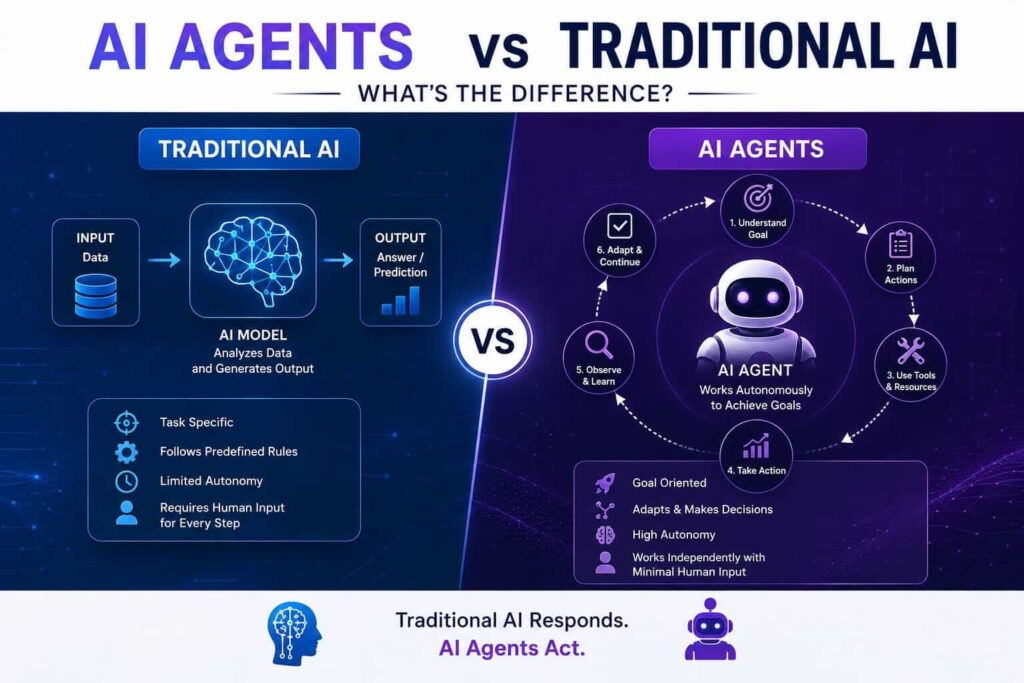
4. AI Agents vs Traditional AI: The Main Differences
5. How AI Agents Work
6. Benefits of Traditional AI
7. Benefits of AI Agents
8. Real-World Examples
9. Which One Should Businesses Choose?
10. Best Practices for Using AI Agents
11. Common Mistakes to Avoid
12. Practical AI Adoption Checklist
13. CTA: Prepare Your Business for Agentic AI
14. Frequently Asked Questions
15. Conclusion
Why AI Agents vs Traditional AI Matters
For years, many AI systems worked in a relatively predictable way.
A company would provide data, define a task, and the AI would produce an output. For example, a fraud detection system might analyze a credit-card transaction and assign a risk score.
That model is still valuable.
However, newer AI systems can interact with applications, retrieve information, create plans, execute multiple steps, evaluate results, and continue working toward a defined objective.
This development is often described as agentic AI.
Anthropic describes an important distinction between workflows and agents: workflows generally follow predefined paths, while agents can dynamically direct their own processes and tool usage.
That distinction helps explain why AI agents are attracting so much attention.
What Is Traditional AI?
Traditional AI refers broadly to artificial intelligence systems designed to perform specific tasks based on programmed rules, statistical models, machine-learning algorithms, or trained models.
The term does not mean that the technology is outdated. In fact, traditional AI powers many systems people use every day.
H3: Examples of Traditional AI
Traditional AI can be used for:
- Spam email detection
- Fraud detection
- Product recommendations
- Image classification
- Speech recognition
- Customer segmentation
- Predictive maintenance
- Weather forecasting
- Search ranking
- Credit-risk assessment
For example, an online retailer might use AI to analyze a customer’s previous purchases and recommend products.
The system can be highly accurate, but it normally performs a defined function.
It does not necessarily decide to create a plan, search several systems, contact another department, and evaluate the outcome by itself.
What Are AI Agents?
AI agents are AI-powered systems designed to pursue goals by deciding which actions or tools to use.
Microsoft describes an AI agent as a system that achieves a goal by taking action based on information it perceives from its environment.
IBM similarly explains that AI agents can perform tasks by designing workflows with available tools, while interacting with external environments and making decisions.
In simple terms, think of the difference like this:
Traditional AI:
“Here is a task. Give me an answer.”
AI agent:
“Here is a goal. Figure out the steps needed to accomplish it.”
That does not mean an agent is completely independent or always reliable. Human oversight, permissions, testing, and safeguards remain important.
AI Agents vs Traditional AI: The Main Differences
The easiest way to understand the difference is to compare how each system handles tasks.
Feature| Traditional AI| AI Agents
Main purpose| Perform defined tasks| Achieve broader goals
Decision-making| Usually limited| More dynamic
Workflow| Predetermined| Can adapt
Tool use| Often limited or predefined| Can select and use tools
Autonomy| Usually lower| Generally higher
Multi-step tasks| Limited| Stronger capability
Human supervision| Often predictable| Important for higher-risk actions
Adaptability| Task-specific| More flexible
Best for| Repeated processes| Complex workflows
The biggest difference is agency.
Traditional AI generally produces predictions, classifications, recommendations, or responses.
AI agents can combine reasoning, planning, tool use, and action into a larger process.
How AI Agents Work
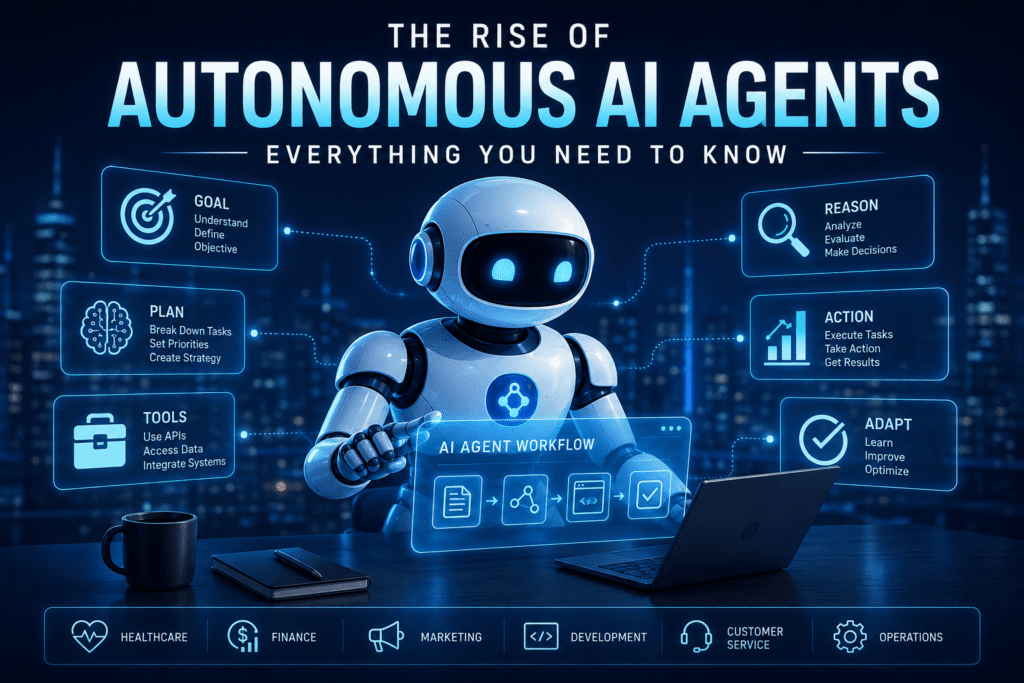
An AI agent commonly operates through a cycle rather than a single input-output interaction.
Step 1 — Receive a Goal
The user or business provides an objective.
For example:
“Research five competitors and prepare a comparison.”
Step 2 — Understand the Task
The agent interprets what needs to be accomplished and determines the likely steps.
Step 3 — Create a Plan
Instead of immediately producing an answer, the system may divide the task into smaller activities.
For example:
1. Identify competitors.
2. Collect relevant information.
3. Compare pricing.
4. Analyze features.
5. Organize the findings.
6. Prepare a report.
Step 4 — Use Tools
An agent may be connected to tools such as:
- Search systems
- Databases
- Company software
- APIs
- Calculators
- Code execution environments
- File systems
- Business applications
Step 5 — Observe the Result
After completing an action, the agent can evaluate the result and determine what should happen next.
Step 6 — Continue or Ask for Help
If the task is complete, it can provide the result.
If something is unclear or requires authorization, a well-designed system can request human input.
This self-directed loop — planning, acting, observing, and adjusting — is a defining characteristic of modern agentic systems.
Benefits of Traditional AI
Traditional AI should not be dismissed simply because AI agents are becoming popular.
For many businesses, traditional AI is still the better choice.
Predictable Performance
When a task is clearly defined, a specialized AI system can provide consistent results.
Easier Control
Because the workflow is usually more constrained, organizations may find it easier to test and monitor.
Efficient Automation
Traditional AI can handle repetitive processes at scale.
For example, a bank could use machine learning to identify suspicious transactions.
Lower Complexity
A simple task does not necessarily require an autonomous agent.
Anthropic recommends using the simplest effective architecture and increasing complexity only when the additional flexibility provides enough value.
Benefits of AI Agents
AI agents become especially interesting when tasks require multiple decisions or systems.
Automation of Multi-Step Work
An agent could potentially gather information, analyze it, prepare an output, and update another system.
Greater Flexibility
Instead of following exactly the same sequence every time, an agent can adapt its approach according to the situation.
Tool Integration
Agents can connect AI reasoning with external tools and business applications.
Reduced Manual Work
Employees can delegate repetitive research, information processing, and administrative tasks while focusing on higher-value responsibilities.
More Proactive Systems
Instead of waiting for a user to ask every question, some agentic systems can monitor tasks and respond when defined conditions occur.
However, greater autonomy also creates greater responsibility. Organizations need appropriate controls around permissions, privacy, security, and human oversight. NIST’s AI Risk Management Framework provides guidance for organizations managing AI risks, while its Generative AI Profile addresses risks associated with generative AI systems.
AI Agents vs Traditional AI: Real-World Examples
The difference becomes clearer when we look at practical situations.
Customer Service
Traditional AI:
A chatbot answers frequently asked questions using predefined information.
AI Agent:
An agent could understand a customer’s issue, retrieve account information, check an order, use a business system, and potentially escalate the case when human intervention is required.
Marketing
Traditional AI:
An AI model predicts which customers are likely to respond to an advertisement.
AI Agent:
An agent could help research an audience, analyze campaign information, generate content ideas, organize tasks, and interact with approved marketing tools.
Software Development
Traditional AI:
An AI assistant suggests or generates code.
AI Agent:
An agent may inspect a codebase, identify an issue, modify files, run tests, analyze failures, and continue working through the development task.
Business Research
Traditional AI:
The system summarizes information provided to it.
AI Agent:
The agent may research several sources, compare findings, identify missing information, and prepare a structured report.
These examples demonstrate that the distinction is not simply about intelligence. It is about how the system operates and how much responsibility it has for completing a task.
Which One Should Businesses Choose?
The answer depends on the problem.
Businesses should not adopt AI agents simply because they are newer.
A traditional AI solution may be better when:
- The task is repetitive.
- The process is predictable.
- Rules are clearly defined.
- High consistency is required.
- Limited autonomy is preferred.
An AI agent may be appropriate when:
- The task involves multiple steps.
- Different tools must be used.
- The process changes depending on results.
- The system needs to make intermediate decisions.
- Employees spend significant time coordinating repetitive activities.
A useful rule is:
Start with the simplest AI architecture that solves the problem.
If a standard model or workflow works well, there may be little reason to introduce an autonomous agent.
Best Practices for Using AI Agents
AI agents can create significant value, but implementation should be approached carefully.
1. Start With a Specific Business Problem
Do not begin with:
“We need an AI agent.”
Begin with:
“Which business process is taking too much time?”
2. Define Clear Objectives
The agent should have a measurable goal.
For example:
“Reduce the time required to process customer support requests.”
3. Limit Permissions
An agent should only access the tools and information it actually needs.
This reduces the potential impact of mistakes.
4. Keep Humans in the Loop
High-impact actions may require approval.
For example, an agent could prepare a financial transaction but require an authorized employee to approve it.
5. Test Before Scaling
Start with a controlled pilot.
Measure:
- Accuracy
- Cost
- Speed
- Reliability
- Error rates
- Human intervention
- Customer satisfaction
6. Monitor Continuously
AI systems can behave differently as models, data, tools, or business environments change.
NIST emphasizes managing AI risks throughout the AI lifecycle rather than treating risk management as a one-time activity.
Common Mistakes to Avoid
Mistake 1 — Assuming More Autonomy Is Always Better
Autonomy can improve productivity, but it can also increase risk.
Mistake 2 — Giving Agents Excessive Permissions
An AI agent connected to important business systems should have carefully controlled access.
Mistake 3 — Ignoring Security
Agents can interact with external information and tools, creating additional security considerations. Recent industry research has highlighted prompt injection and unintended actions as important challenges for agentic systems.
Mistake 4 — Automating a Broken Process
AI will not automatically fix an inefficient business process.
Improve the workflow first, then determine where AI belongs.
Mistake 5 — Forgetting Human Oversight
Important financial, legal, medical, employment, and security decisions may require appropriate human review.
Practical AI Adoption Checklist
Before introducing an AI agent, ask:
- What problem are we solving?
- Could traditional AI solve it?
- Does the task require multiple steps?
- Does the system need external tools?
- What information will it access?
- What actions can it take?
- Which actions require approval?
- How will performance be measured?
- What happens when the agent makes a mistake?
- How will security and privacy be managed?
- Can the system be stopped quickly?
- Who is responsible for monitoring it?
This checklist can help organizations avoid adopting agentic AI simply for the sake of following a technology trend.
CTA: Prepare for the Next Generation of AI
AI is changing from a technology that simply provides answers into systems capable of helping complete entire workflows.
Whether your organization needs traditional AI, generative AI, intelligent automation, or an AI agent, the right solution depends on your goals, processes, data, and risk requirements.
Want to understand how AI could improve your digital strategy? Explore Future Science AI for practical insights into artificial intelligence, emerging technologies, and the future of digital innovation.
Frequently Asked Questions
Q1:What is the main difference between AI agents and traditional AI?
Traditional AI usually performs a specific task or produces an output based on its input. AI agents are designed to pursue goals by planning actions, using tools, and adapting their approach when necessary.
Q2:Are AI agents better than traditional AI?
Not always. Traditional AI can be more appropriate for predictable, repetitive, and highly controlled tasks. AI agents are more useful when a problem requires flexible, multi-step decision-making.
Q3:Can AI agents work without humans?
Some AI agents can operate with limited human intervention, but complete autonomy is not always desirable. High-impact tasks should have appropriate human oversight, permissions, and safety controls.
Q4:What are AI agents used for?
AI agents can support customer service, research, software development, business operations, marketing, IT automation, data analysis, and other multi-step workflows.
Q5:Are AI agents safe for businesses?
AI agents can be useful, but they introduce additional risks because they may have access to tools, data, and business systems. Organizations should use access controls, monitoring, testing, security measures, and human oversight.
Conclusion
https://www.uschamber.com/co/run/technology/traditional-ai-vs-generative-ai
The debate around AI agents vs traditional AI is not really about which technology will replace the other.
Instead, it is about choosing the right level of intelligence and autonomy for a particular problem.
Traditional AI remains extremely valuable for prediction, classification, recommendations, detection, and other well-defined tasks. AI agents introduce another layer of capability by allowing systems to plan, use tools, make intermediate decisions, and work toward broader objectives.
The future will likely include both approaches.
For simple and predictable processes, traditional AI may remain the smartest choice. For complex workflows requiring flexibility and multiple actions, AI agents may offer significant advantages.
The most successful organizations will not simply adopt the newest AI technology. They will identify real problems, select the appropriate architecture, control risks, measure results, and keep people involved where human judgment matters most.
As AI becomes more capable, understanding this difference will help businesses