
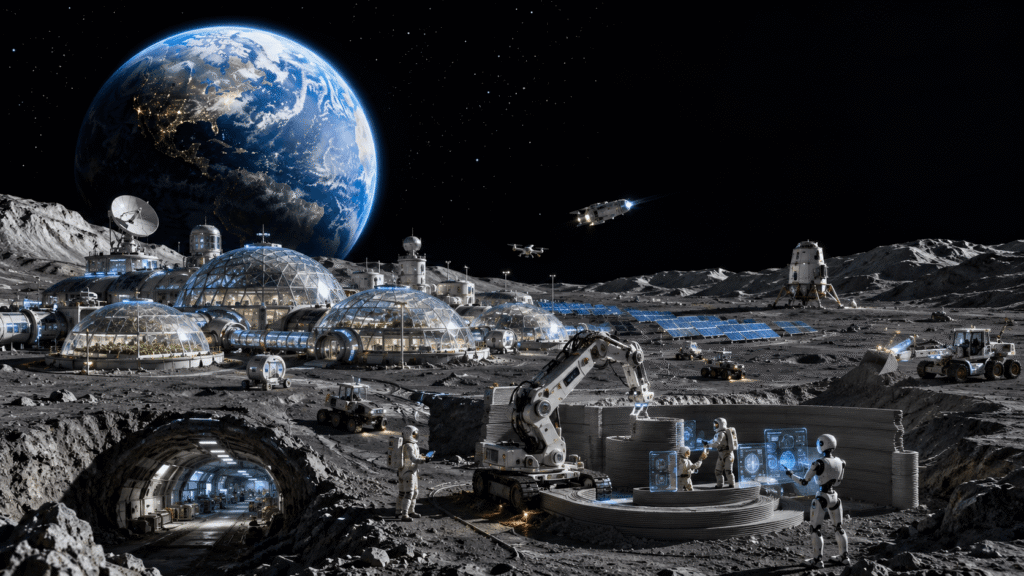
The Future of Moon Colonies
Introduction
The Future of Moon Colonies is no longer limited to science fiction. Governments, private companies, and researchers are actively working toward establishing a long-term human presence on the Moon. With rapid advances in space technology, artificial intelligence, robotics, and sustainable energy, living on the Moon is becoming a realistic goal for the coming decades.
Interest in lunar exploration has increased significantly as organizations search for new scientific discoveries, valuable resources, and opportunities for future space travel. The Moon may become humanity’s first permanent home beyond Earth, serving as a stepping stone for missions to Mars and deeper into our solar system.
This article explores how Moon colonies could become reality, the technologies making them possible, the challenges involved, and what this future could mean for people around the world.
Table of Contents
- Why the Future of Moon Colonies Matters
- What Is a Moon Colony?
- Why Humans Want to Live on the Moon
- Technologies Making Moon Colonies Possible
- Benefits of Lunar Colonization
- Challenges Scientists Must Solve
- Building a Moon Colony Step by Step
- Common Mistakes and Misconceptions
- Practical Checklist
- Frequently Asked Questions
- Conclusion
Why the Future of Moon Colonies Matters?
Space exploration has always pushed humanity to develop new technologies and solve complex problems. The next major milestone is creating permanent settlements beyond Earth.
The Future of Moon Colonies matters because it could:
- Expand scientific research.
- Improve international cooperation.
- Create new industries.
- Support future Mars missions.
- Develop technologies that benefit life on Earth.
- Inspire future generations of scientists and engineers.
Countries including the United States, Canada, European nations, Japan, and others are investing billions of dollars in lunar exploration because they believe the Moon will play a central role in humanity’s future.
What Is a Moon Colony?
A Moon colony is a permanent or semi-permanent human settlement built on the lunar surface. Unlike short-term missions, these communities would allow astronauts, scientists, engineers, and technicians to live and work on the Moon for extended periods.
A successful lunar colony would include:
- Living quarters
- Research laboratories
- Power generation systems
- Food production facilities
- Water recycling systems
- Communication networks
- Medical centers
- Transportation infrastructure
Rather than relying completely on supplies from Earth, Future of Moon Colonies aim to become increasingly self-sufficient.
Why Humans Want to Live on the Moon
Several important reasons explain why governments and private companies are investing heavily in lunar exploration.
Scientific Discovery
The Moon preserves billions of years of geological history. Studying its surface can help scientists understand how Earth and the solar system formed.
Testing Future Space Missions
Before humans travel to Mars, engineers need a nearby location to test life-support systems, habitats, and spacecraft.
The Moon provides the perfect environment for these experiments.
Resource Exploration
Scientists believe the Moon contains valuable resources, including:
- Water ice
- Helium-3
- Rare minerals
- Oxygen trapped in lunar soil
These resources could support long-term space missions and reduce the need to transport supplies from Earth.
Economic Opportunities
Future Moon colonies may create entirely new industries, including:
- Space mining
- Lunar tourism
- Space manufacturing
- Satellite servicing
- Scientific research
Experts believe the global space economy will continue expanding rapidly over the coming decades.
Technologies Making the Future of Moon Colonies Possible
Building a Moon colony requires many advanced technologies working together.
Artificial Intelligence
AI will help astronauts by:
- Monitoring equipment
- Predicting system failures
- Managing energy
- Operating robots
- Supporting medical care
Robotics
Robots may arrive before humans to:
- Construct buildings
- Move materials
- Prepare landing sites
- Perform dangerous repairs
Autonomous construction robots could reduce both costs and risks.
3D Printing
Transporting construction materials from Earth is expensive.
Future missions may use lunar soil to 3D-print:
- Homes
- Landing pads
- Roads
- Storage facilities
- Radiation shields
This technology could dramatically lower mission costs.
Renewable Energy
Reliable power is essential for survival.
Possible energy sources include:
- Large solar farms
- Advanced batteries
- Small nuclear reactors
- Hydrogen fuel systems
Continuous power will support communications, research, and life-support systems.
Water Recycling
Water is one of the most valuable resources in space.
Future Moon colonies will recycle nearly every drop of water used for:
- Drinking
- Cooking
- Hygiene
- Agriculture
Scientists are also exploring ways to extract water from lunar ice deposits
Benefits of Future of Moon Colonies
Establishing human settlements on the Moon could provide many long-term benefits.
- Accelerated Scientific Research
- Permanent laboratories would allow continuous experiments that cannot be performed on Earth.
- Better Space Technologies
- Developing lunar infrastructure will drive innovation in:
- Robotics
- Artificial intelligence
- Renewable energy
- Medical technology
- Communications
- Many of these technologies could improve everyday life on Earth.
- Stronger International Collaboration
- Space exploration encourages countries to work together on shared goals.
- Joint missions can reduce costs while accelerating scientific progress.
- Gateway to Mars
- Many experts view the Moon as humanity’s training ground for future missions to Mars.
- Astronauts can gain valuable experience living in another world before traveling much farther from Earth.
- New Economic Opportunities
- Moon colonies could create jobs in:
- Aerospace engineering
- Robotics
- AI development
- Space logistics
- Construction
- Telecommunications
- Entire new industries may emerge as commercial space activity grows.
Challenges Facing the Future of Moon Colonies
While the Future of Moon Colonies is exciting, significant challenges must be overcome before permanent settlements become a reality.
Future of Moon Colonies Radiation Exposure
Unlike Earth, the Moon has no thick atmosphere or global magnetic field to protect people from harmful solar and cosmic radiation. Long-term exposure can increase health risks, making radiation shielding a top priority.
Scientists are exploring solutions such as:
- Building habitats underground
- Covering structures with lunar soil (regolith)
- Developing advanced radiation-resistant materials
Future of Moon Colonies Extreme Temperatures
The Moon experiences dramatic temperature swings, ranging from around 127°C (260°F) during the day to -173°C (-280°F) at night.
Future habitats will require:
- High-performance insulation
- Advanced heating and cooling systems
- Reliable energy storage
Limited Resources
Every kilogram launched from Earth is expensive. Moon colonies must become as self-sufficient as possible by producing:
- Oxygen
- Water
- Food
- Construction materials
- Energy
Resource recycling will be essential for long-term survival.
Health Effects of Low Gravity
The Moon’s gravity is only about one-sixth that of Earth’s. Living in this environment for months or years may affect:
- Bone strength
- Muscle mass
- Heart health
- Balance
- Immune function
Researchers are studying exercise programs and medical technologies to reduce these risks.
High Costs
Building a lunar settlement requires enormous investments in:
- Spacecraft
- Launch systems
- Habitat construction
- Communications
- Research
- Maintenance
As reusable rockets and new technologies improve, these costs are expected to decrease over time.
How Moon Colonies Could Be Built Step by Step?
Creating a permanent lunar settlement will likely happen in phases rather than all at once.
Step 1: Robotic Exploration
Robotic missions will map resources, test landing sites, and gather scientific data before people arrive.
Step 2: Establish Temporary Bases
Astronauts will begin living on the Moon for weeks or months while testing new equipment and life-support systems.
Step 3: Build Permanent Habitats
Autonomous robots and 3D-printing technologies may construct living spaces using lunar materials.
Step 4: Produce Local Resources
Colonists will gradually generate:
- Oxygen
- Water
- Building materials
- Fuel
- Food
Reducing dependence on Earth will improve sustainability.
Step 5: Expand the Community.
As infrastructure grows, Moon colonies could welcome:
- Scientists
- Engineers
- Medical specialists
- Construction teams
- Researchers
- Eventually, commercial workers and tourists
Future of Moon Colonies Common Mistakes and Misconceptions
Many people misunderstand what lunar colonization will involve.
Mistake 1: Moon Colonies Will Happen Overnight
Building a permanent settlement will take many years of planning, testing, and international cooperation.
Mistake 2: Everyone Will Move to the Moon
The Moon is unlikely to become a replacement for Earth. Early colonies will house small groups of trained professionals.
Mistake 3: Technology Alone Solves Everything
Human factors such as teamwork, mental health, governance, and resource management are just as important as engineering.
Mistake 4: The Moon Has Unlimited Resources
Although valuable materials exist, they must be carefully located, extracted, and managed responsibly
Practical Checklist for Understanding Future of Moon Colonies
Learn the goals of modern lunar exploration.
 Follow developments in reusable rocket technology.
Understand how AI and robotics support space missions.
Explore advances in sustainable energy systems.
Stay informed about international space partnerships.
Keep up with future Moon and Mars missions.
Take the Next Step in Exploring Future Science
Space exploration is evolving faster than ever, and staying informed helps you understand the technologies shaping tomorrow.
Ready to discover more? Explore additional articles on Future Science AI to learn about artificial intelligence, space technology, robotics, quantum computing, and future innovations. Share this article with fellow space enthusiasts and subscribe for the latest updates on emerging science and technology
Frequently Asked Questions
1. What is the Future of Moon Colonies?
The Future of Moon Colonies involves creating sustainable human settlements using advanced technologies such as AI, robotics, renewable energy, and resource recycling. These colonies could support scientific research and future missions to Mars.
2. Why do scientists want to build colonies on the Moon?
Scientists hope to study the Moon, test new technologies, use local resources, and prepare for long-duration space missions beyond Earth.
3. Will ordinary people be able to live on the Moon?
Not initially. Early Moon colonies will most likely be occupied by astronauts, researchers, engineers, and other trained professionals. Commercial opportunities may expand in the future.
4. What are the biggest challenges for Moon colonies?
Major challenges include radiation, extreme temperatures, limited resources, low gravity, transportation costs, and maintaining life-support systems.
5. How will Moon colonies help Earth?
Research conducted on the Moon can lead to advances in medicine, robotics, artificial intelligence, clean energy, communications, and sustainable technologies that benefit people on Earth
Conclusion
The Future of Moon Colonies represents one of humanity’s most ambitious scientific and engineering goals. Although many technical and environmental challenges remain, rapid progress in space exploration, robotics, artificial intelligence, and sustainable technologies is bringing the vision of permanent lunar settlements closer to reality.
The Moon could become a gateway to deeper space exploration, a center for scientific discovery, and a platform for developing technologies that improve life on Earth. As governments, private companies, and international partners continue to invest in lunar missions, the dream of living and working on the Moon is steadily moving from imagination to possibility.
Whether you’re interested in science, technology, or the future of humanity, understanding the Future of Moon Colonies offers a fascinating glimpse into the next chapter of space exploration.