
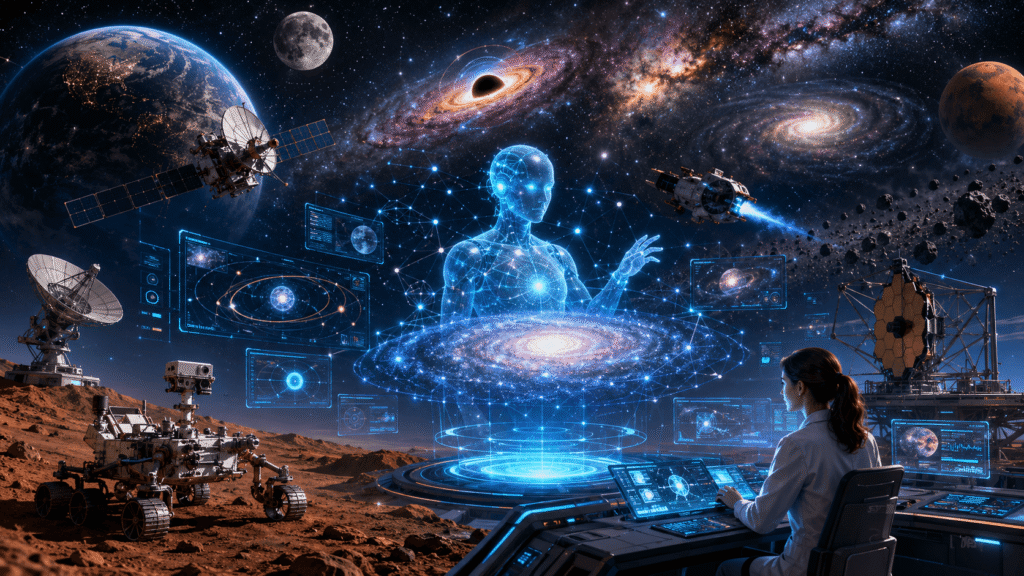
How AI Is Helping Scientists Explore Space
Introduction
How AI Is Helping Scientists Explore Space is transforming modern astronomy and space exploration faster than ever before. Artificial intelligence allows researchers to process enormous amounts of space data, automate spacecraft operations, detect distant planets, and even help search for signs of life beyond Earth.
As space missions become more ambitious, traditional methods alone are no longer enough. AI gives scientists the ability to analyze information in seconds that would otherwise take months or even years.
From autonomous Mars rovers to intelligent satellites and powerful telescopes, AI is becoming one of the most valuable technologies in space science.
Whether you are interested in technology, science, or the future of humanity, understanding AI’s role in space exploration offers fascinating insights into where innovation is taking us next.
Table of Contents
- Why AI Is Transforming Space Exploration
- What Is Artificial Intelligence in Space Science?
- How AI Analyzes Massive Space Data
- AI-Powered Spacecraft and Satellites
- AI in Planet Discovery
- AI and Mars Exploration
- AI for Deep Space Missions
- Benefits of AI in Space Research
- Best Practices
- Common Mistakes
- Practical Checklist
- FAQs
- Conclusion
Why AI Is Transforming Space Exploration
Space exploration has entered a new era. Every satellite, telescope, rover, and spacecraft generates enormous amounts of information every day. Scientists simply cannot examine all this data manually.
Artificial intelligence solves this challenge by identifying patterns, recognizing objects, and making predictions with remarkable speed and accuracy.
Several factors are driving the rapid adoption of AI in space research:
- Increasing amounts of astronomical data
- More complex space missions
- Growing demand for autonomous spacecraft
- Faster scientific discoveries
- Lower mission costs
- Improved mission safety
Without AI, many modern space discoveries would take significantly longer to achieve.
What Is Artificial Intelligence in Space Science?
Artificial intelligence refers to computer systems that can perform tasks requiring human intelligence, including learning, reasoning, recognizing images, making predictions, and solving problems.
In space science, AI helps researchers:
Analyze Telescope Images
Modern telescopes capture millions of images of galaxies, stars, nebulae, and planets. AI automatically identifies interesting objects that deserve further investigation.
Predict Space Weather
Solar storms can damage satellites and communication systems. AI models help scientists predict these events more accurately, allowing agencies to protect valuable equipment.
Control Autonomous Spacecraft
Communication with distant spacecraft may take several minutes—or even hours. AI enables spacecraft to make immediate decisions without waiting for commands from Earth.
Detect Equipment Problems
Machine learning systems continuously monitor spacecraft health and identify potential failures before they become serious
How AI Analyzes Massive Space Data
Modern observatories collect enormous amounts of information every single day.
For example:
- High-resolution telescope images
- Radio signals
- Satellite observations
- Planetary measurements
- Atmospheric data
- Deep-space sensor readings
Processing these datasets manually would require thousands of scientists.
Instead, AI algorithms rapidly organize, classify, and analyze this information.
Key advantages include:
- Detecting hidden patterns
- Identifying unusual cosmic events
- Removing noisy or inaccurate data
- Predicting astronomical phenomena
- Accelerating research timelines
Scientists can then focus on interpreting discoveries rather than spending countless hours sorting data.
AI-Powered Spacecraft and Satellites
One of the most exciting developments in modern space exploration is the rise of intelligent spacecraft.
Traditional spacecraft rely heavily on instructions from Earth. However, communication delays become a major challenge as missions travel farther into space.
AI allows spacecraft to operate more independently.
Examples include:
Autonomous Navigation
AI calculates safer and more efficient routes while avoiding hazards.
Intelligent Resource Management
Spacecraft monitor power usage, battery levels, fuel consumption, and onboard systems without constant human supervision.
Image Recognition
AI selects the most valuable images to transmit back to Earth, saving bandwidth and improving mission efficiency.
Fault Detection
Machine learning systems recognize early warning signs of hardware failures, allowing corrective action before critical systems are affected.
These capabilities increase mission reliability while reducing operational costs.
How AI Is Discovering New Planets
Finding planets outside our solar system, known as exoplanets, is one of the most exciting areas of modern astronomy. Space telescopes collect huge amounts of light data from millions of stars, making manual analysis almost impossible.
AI helps scientists examine this data much faster and with greater accuracy.
Detecting Tiny Changes in Starlight
When a planet passes in front of a star, the star’s brightness decreases slightly. AI algorithms can detect these tiny changes, even when they are difficult for humans to notice.
Reducing False Discoveries
Not every signal represents a planet. Dust, instrument errors, or other celestial objects can create misleading patterns. AI filters out these false signals, allowing scientists to focus on genuine discoveries.
Speeding Up Planet Confirmation
Instead of spending months reviewing telescope data, AI identifies the most promising planetary candidates in hours or days. This enables researchers to confirm discoveries much more quickly.
As AI technology advances, scientists expect to discover many more Earth-like planets that could potentially support life.
Example:
AI has been used to analyze data from NASA’s planet-hunting missions, helping researchers identify exoplanets that traditional methods initially missed
How AI Is Helping Scientists Explore Space In Mars Exploration
Mars remains one of humanity’s top priorities for future exploration. However, operating robots millions of miles away presents major challenges.
Artificial intelligence allows Mars missions to become more independent and efficient.
Autonomous Navigation
Mars rovers encounter rocks, sand dunes, and steep slopes. AI helps them:
- Detect obstacles
- Choose safer routes
- Reduce travel time
- Minimize the risk of getting stuck
Scientific Target Selection
Rather than waiting for instructions from Earth, AI can identify interesting rocks, soil samples, and geological formations worth investigating.
Equipment Monitoring
Machine learning continuously checks rover systems, including:
Battery health
- Wheel performance
- Camera status
- Temperature
- Communication systems
Early detection of technical problems increases the mission’s lifespan
AI for Deep Space Missions
As missions travel farther from Earth, communication delays become unavoidable. A signal sent to a distant spacecraft may take several minutes—or even hours—to arrive.
Because of this, spacecraft must increasingly make decisions on their own.
AI makes autonomous exploration possible by enabling spacecraft to:
- Adjust flight paths
- Avoid unexpected hazards
- Manage onboard resources
- Prioritize scientific observations
- Respond to emergencies
This independence is especially important for future missions to distant planets, moons, and asteroids.
AI will also play a vital role in future crewed missions, helping astronauts manage spacecraft systems and make informed decisions during long-duration space travel
Benefits of How AI Is Helping Scientists Explore Space
Artificial intelligence is improving nearly every stage of space exploration.
Some of the biggest advantages include:
How AI Is Helping Scientists Explore Space Faster Scientific Discoveries
AI processes enormous datasets in minutes instead of months, allowing scientists to identify new patterns and make discoveries more quickly.
How AI Is Helping Scientists Explore SpaceHigher Accuracy
Machine learning reduces human error while improving the precision of data analysis and predictions.
How AI Is Helping Scientists Explore SpaceLower Mission Costs
Automation decreases the need for constant manual monitoring, helping space agencies use resources more efficiently.
How AI Is Helping Scientists Explore Space Improved Spacecraft Safety
AI continuously monitors spacecraft systems, detecting potential issues before they become mission-threatening.
How AI Is Helping Scientists Explore Space Better Decision-Making
AI provides scientists with valuable insights based on large datasets, supporting smarter and faster decisions.
How AI Is Helping Scientists Explore Space Continuous Operations
Unlike humans, AI systems can analyze information and monitor spacecraft 24 hours a day without interruption.
Best Practices for Using How AI Is Helping Scientists Explore Space
Although AI is a powerful tool, successful space missions still require careful planning.
Here are some best practices followed by researchers and engineers:
Combine AI with Human Expertise
AI should support scientists rather than replace them. Human knowledge remains essential for interpreting discoveries and making critical decisions.
Train AI Using High-Quality Data
Accurate datasets improve AI performance and reduce errors during analysis.
Continuously Update AI Models
As new discoveries are made, AI systems should be retrained with the latest scientific information to maintain accuracy.
Test Before Deployment
Every AI system should undergo extensive testing in simulated space environments before being used in real missions.
Maintain Human Oversight
Scientists should regularly review AI-generated results to ensure reliability and scientific accuracy.
How AI Is Helping Scientists Explore Space Common Mistakes to Avoid
While AI offers tremendous benefits, several mistakes can reduce its effectiveness.
Avoid these common issues:
- Relying completely on AI without expert review.
- Using outdated or poor-quality training data.
- Ignoring unusual AI predictions that may lead to important discoveries.
- Assuming AI is always correct.
- Failing to update AI systems as technology evolves.
- Neglecting cybersecurity for AI-powered spacecraft and satellites.
By avoiding these mistakes, researchers can improve both mission success and scientific reliability.
How AI Is Helping Scientists Explore Space Practical Checklist
Use this checklist to understand how AI contributes to successful space exploration:
 Understand the basics of artificial intelligence.
Learn how AI analyzes large amounts of space data.
Explore how AI supports spacecraft autonomy.
Follow trusted organizations for the latest discoveries.
Stay informed about AI developments in astronomy and planetary science.
Recognize the importance of human oversight in AI-powered missions.
Take the Next Step in How AI Is Helping Scientists Explore Space
Artificial intelligence is reshaping the future of space exploration, and staying informed about these innovations can help you understand tomorrow’s technologies today.
If you enjoy learning about AI, robotics, quantum computing, and future science, continue exploring our latest resources.
Call to Action (CTA):
Ready to discover more about the future of artificial intelligence and emerging technologies?
Visit Future Science AI for expert articles, practical insights, and the latest updates on AI, space exploration, robotics, and scientific breakthroughs. Stay ahead by exploring our growing collection of educational content and share your favorite articles with others who are passionate about technology.
Frequently Asked Questions (FAQs)
1.How is AI helping scientists explore space?
AI helps scientists explore space by analyzing massive datasets, operating autonomous spacecraft, identifying exoplanets, predicting space weather, and improving mission planning. It speeds up discoveries while reducing the need for constant human intervention.
2. Why is artificial intelligence important for space exploration?
Artificial intelligence is important because it can process huge amounts of information much faster than humans. It improves accuracy, supports autonomous missions, reduces costs, and helps scientists make better decisions during complex space missions.
3. Can AI replace astronauts or space scientists?
No. AI is designed to assist astronauts and scientists, not replace them. Human expertise is still essential for making critical decisions, interpreting scientific discoveries, and planning future missions.
4. How does AI help discover new planets?
AI analyzes telescope data to detect tiny changes in a star’s brightness that may indicate an orbiting planet. It also filters out false signals, allowing scientists to identify promising exoplanets more efficiently.
5. What is the future of AI in space exploration?
The future of AI in space exploration includes smarter spacecraft, autonomous lunar and Mars missions, improved satellite operations, faster scientific discoveries, and support for future human missions to deep space.
Conclusion
How AI Is Helping Scientists Explore Space is changing the way humanity studies the universe. From analyzing enormous amounts of astronomical data to guiding autonomous spacecraft and discovering new planets, artificial intelligence has become an essential tool for modern space research.
As AI technology continues to advance, scientists will be able to conduct more ambitious missions, uncover hidden mysteries of the universe, and improve our understanding of distant worlds. The combination of human expertise and intelligent technology is opening exciting opportunities for exploration that were once considered impossible.
Whether you’re a student, technology enthusiast, researcher, or business professional, keeping up with these developments will help you understand one of the most important technological revolutions of our time.