
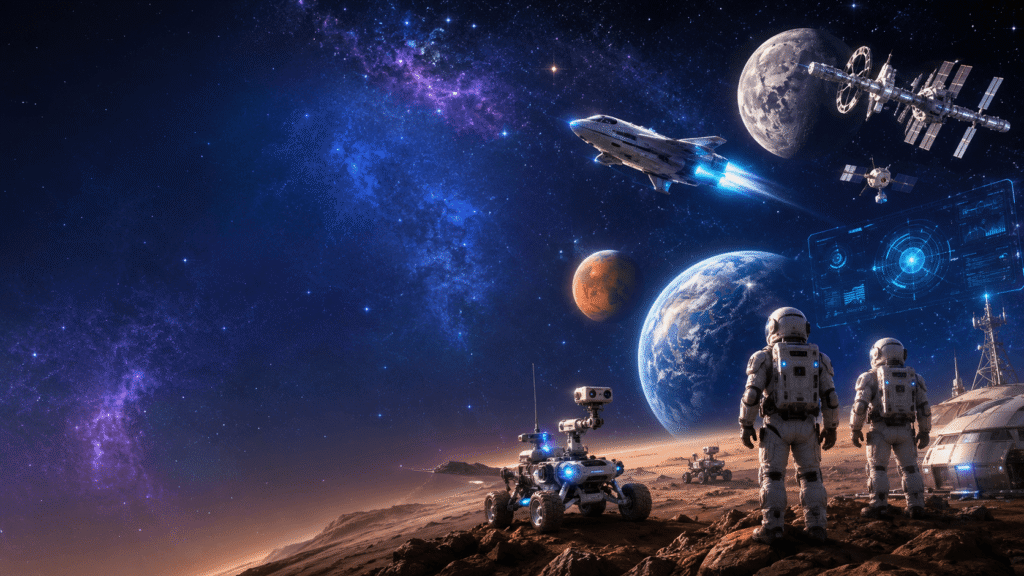
The Future of Space Exploration: What Lies Beyond Earth?
Introduction
Future of Space exploration has evolved dramatically since the first satellite launches and Moon landings. Today, advances in artificial intelligence, robotics, reusable rockets, and advanced materials are opening new possibilities.
Countries across North America and Europe, along with private companies, are working toward long-term goals that include lunar bases, deep-space missions, asteroid mining, and even human settlements beyond Earth.
Future of Space Exploration is no longer about simply reaching space. It is about building a sustainable presence beyond our planet.
Table of Contents
- Introduction
- Why the Future of Space Exploration Matters
- Key Technologies Driving Space Exploration
- Benefits of Future of Space Exploration
- Best Practices for Advancing Space Missions
- Common Mistakes and Challenges
- Practical Checklist
- Call to Action
- FAQ
- Conclusion
Why the Future of Space Exploration Matters
Future of Space Exploration affects much more than astronauts and scientists. Many technologies we use daily were developed through space research.
These include:
- GPS navigation systems
- Satellite communications
- Weather forecasting
- Medical imaging technologies
- Advanced materials
- Earth observation systems
As new missions expand our reach into the solar system, they also create economic opportunities, scientific breakthroughs, and technological innovations.
For businesses, emerging space industries may generate new markets worth trillions of dollars over the coming decades.
Future of Space Exploration: Key Technologies Shaping Tomorrow
Reusable Rocket Technology
One of the biggest breakthroughs in modern space travel is reusable rocket technology.
Instead of discarding rockets after a single launch, companies can recover and reuse them multiple times. This significantly lowers launch costs and increases mission frequency.
Reusable rockets are making space more accessible for research institutions, startups, governments, and commercial organizations.
Artificial Intelligence in Space Missions
Artificial intelligence is becoming a critical part of modern space exploration.
AI systems can:
- Analyze vast amounts of data
- Navigate spacecraft autonomously
- Detect equipment failures
- Assist astronauts during missions
Future missions to distant planets may rely heavily on AI because communication delays make real-time human control difficult.
Lunar Exploration and Moon Bases
Many space agencies are preparing for long-term lunar missions.
The Moon could serve as a staging ground for future missions to Mars and beyond.
Potential lunar infrastructure may include:
- Research stations
- Energy production facilities
- Resource extraction systems
- Astronaut habitats
Establishing a permanent human presence on the Moon could dramatically change future exploration strategies.
Mars Colonization
Mars remains one of the most ambitious goals in space exploration.
Scientists believe the planet may offer opportunities for future human settlements. However, significant challenges remain, including:
- Radiation exposure
- Limited resources
- Harsh environmental conditions
- Long travel times
Despite these obstacles, ongoing research continues to bring Mars colonization closer to reality.
Space Tourism
- Space tourism is transforming from an exclusive government activity into a commercial industry.
- Private companies are developing systems that allow civilians to experience space travel.
- Although current costs remain high, future innovations may make space tourism accessible to a broader audience.
Benefits and Advantages of Future of Space Exploration
Scientific Discovery
Space missions help scientists understand:
- Planetary formation
- Black holes
- Dark matter
- Cosmic evolution
- Potential extraterrestrial life
Every mission contributes valuable knowledge about the universe.
Economic Growth
The commercial space sector is expanding rapidly.
Opportunities include:
- Satellite services
- Space manufacturing
- Telecommunications
- Resource extraction
- Tourism
These industries could create millions of jobs worldwide.
Technological Innovation
Many technologies originally developed for space later become useful on Earth.
Innovations in:
- Robotics
- Healthcare
- Energy systems
- Communication networks
often originate from space-related research.
Global Collaboration
Space exploration encourages international cooperation.
Joint missions often involve multiple countries sharing expertise, funding, and technology.
This collaboration strengthens scientific progress while promoting peaceful partnerships.
Best Practices for Advancing the Future of Space Exploration
Invest in STEM Education
- Future breakthroughs depend on skilled scientists, engineers, and researchers.
- Governments and educational institutions should continue investing in STEM education programs.
Support Public-Private Partnerships
- Collaboration between governments and private companies accelerates innovation and reduces costs.
- Successful partnerships often combine public funding with private sector efficiency.
Prioritize Sustainability
Long-term missions require sustainable solutions.
Future projects should focus on:
- Recycling resources
- Energy efficiency
- Reducing space debris
- Sustainable habitat design
Encourage International Cooperation
- Complex missions benefit from global expertise.
- Cooperation allows nations to share risks, costs, and scientific discoveries.
Common Mistakes and Challenges to Avoid
Ignoring Space Debris
Thousands of inactive satellites and debris fragments currently orbit Earth.
Without proper management, collisions could threaten future missions.
Underestimating Costs
Future of Space Exploration requires significant investment.
Poor planning can lead to delays, budget overruns, and mission failures.
Overlooking Human Factors
Long-duration missions present psychological and physical challenges.
Future planning must address:
- Mental health
- Radiation protection
- Crew safety
- Resource management
Practical Checklist
Use this checklist when evaluating future space exploration developments:
- Monitor emerging space technologies
- Follow major lunar and Mars missions
- Understand AI applications in space
- Stay informed about commercial space companies
- Learn about sustainability initiatives
- Track international space partnerships
- Explore educational opportunities in STEM fields
Call to Action
Interested in the latest developments in science, technology, AI, and space exploration?
Explore more expert insights on Future Science AI and stay informed about the innovations shaping our future. Subscribe to receive updates, discover emerging technologies, and learn how scientific breakthroughs are transforming the world around us.
Frequently Asked Questions (FAQ)
Q1: What is the Future of Space Exploration?
The Future of Space Exploration includes lunar bases, Mars missions, advanced spacecraft, AI-driven operations, and increased commercial participation in space activities.
Q2: Will humans live on Mars someday?
Scientists and engineers are actively developing technologies that could support human settlements on Mars. While challenges remain, long-term habitation is considered a realistic future goal.
Q3: How is AI helping space exploration?
AI assists with spacecraft navigation, data analysis, predictive maintenance, autonomous decision-making, and mission planning.
Q4: What are the biggest challenges facing space exploration?
Major challenges include high costs, radiation exposure, long-distance travel, space debris, and maintaining astronaut health during extended missions.
Q5:Why is Future of Space Exploration important?
Future of Space Exploration drives innovation, supports economic growth, expands scientific knowledge, and helps humanity prepare for future challenges
Conclusion
The Future of Space Exploration represents one of humanity’s most ambitious and inspiring pursuits. Advances in artificial intelligence, reusable rockets, lunar exploration, Mars colonization, and commercial space development are rapidly changing what is possible.
As technology continues to evolve, space exploration will not only expand our understanding of the universe but also deliver innovations that improve life on Earth. By investing in research, education, sustainability, and international cooperation, humanity can unlock extraordinary opportunities beyond our planet.