AI in Everyday Life: 15 Ways Artificial Intelligence Is Changing the Future
Artificial intelligence is no longer something that exists only in research laboratories or futuristic movies. AI in everyday life is already influencing how people communicate, shop, work, learn, travel, manage money, and make decisions.
You may use AI without even realizing it. A smartphone can predict your next word. A streaming service can recommend what to watch. A navigation app can predict traffic. An online store can personalize products. Meanwhile, generative AI tools can help people write, research, summarize information, create images, and organize ideas.
As AI becomes more capable, the bigger question is not whether artificial intelligence will affect daily life. It is how deeply it will become integrated into it.
This guide explores 15 practical ways AI is changing everyday life and what these developments could mean for consumers, professionals, businesses, and families.
Table of Contents
1. Why AI in Everyday Life Matters
2. How AI Is Becoming Part of Daily Life
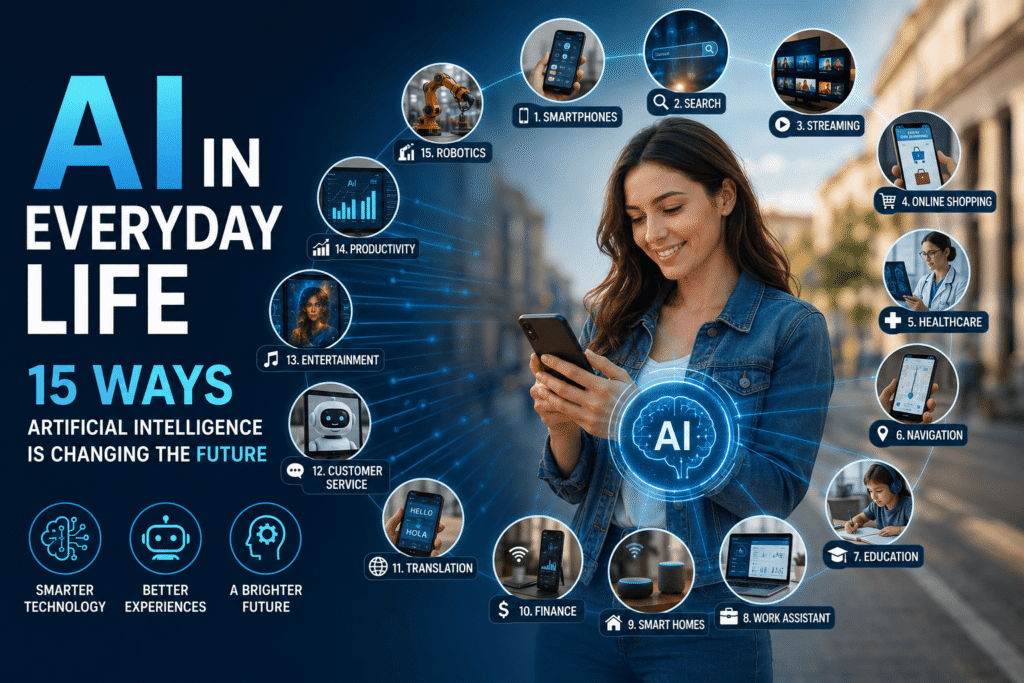
3. 15 Ways AI Is Changing Everyday Life
4. Benefits of AI in Daily Life
5. How to Use AI Responsibly
6. Common Mistakes to Avoid
7. Practical AI Checklist
9. The Future of AI in Everyday Life
10. Frequently Asked Questions
11. Conclusion
You may use AI without even realizing it. A smartphone can predict your next word. A streaming service can recommend what to watch. A navigation app can predict traffic. An online store can personalize products. Meanwhile, generative AI tools can help people write, research, summarize information, create images, and organize ideas.
As AI becomes more capable, the bigger question is not whether artificial intelligence will affect daily life. It is how deeply it will become integrated into it.
This guide explores 15 practical ways AI is changing everyday life and what these developments could mean for consumers, professionals, businesses, and families.
Table of Contents
1. Why AI in Everyday Life Matters
2. How AI Is Becoming Part of Daily Life
3. 15 Ways AI Is Changing Everyday Life
4. Benefits of AI in Daily Life
5. How to Use AI Responsibly
6. Common Mistakes to Avoid
7. Practical AI Checklist
9. The Future of AI in Everyday Life
10. Frequently Asked Questions
11. Conclusion
Why AI in Everyday Life Matters
Artificial intelligence is becoming less visible while becoming more useful.
Instead of always appearing as a separate application called “AI,” the technology is increasingly embedded inside products people already use. Smartphones, search engines, banking platforms, vehicles, healthcare systems, productivity software, and smart-home devices can all use machine learning or generative AI behind the scenes.
This shift matters because it changes how people interact with technology.
For example, traditional software often requires users to follow specific steps. AI-powered software can increasingly understand natural language, recognize patterns, make predictions, and adapt to context.
AI is also moving toward more proactive assistance. New AI agents can perform sequences of tasks rather than simply responding to individual questions. That could eventually make computers feel less like tools waiting for instructions and more like digital assistants that help users accomplish goals.
However, convenience should not replace judgment. AI systems can make mistakes, produce misleading information, expose sensitive data, or reinforce bias. NIST’s AI Risk Management Framework highlights reliability, safety, security, transparency, privacy, and fairness as important characteristics of trustworthy AI.
How AI Is Becoming Part of Daily Life
The most important development is not simply that AI is becoming more powerful. It is becoming *more integrated*.
AI can analyze huge quantities of information in seconds. It can recognize speech, interpret images, identify patterns, generate content, predict outcomes, and automate repetitive activities.
As a result, AI is moving into areas that affect ordinary routines.
Here are 15 examples.
15 Ways AI Is Changing Everyday Life
1. Smartphones Are Becoming More Intelligent
Modern smartphones use AI for many functions, including voice recognition, photography, translation, security, recommendations, and text prediction.
For example, computational photography can automatically improve lighting, remove unwanted noise, identify objects, and optimize images.
Voice assistants can also interpret spoken commands and perform tasks such as setting reminders, searching for information, or controlling compatible devices.
In the future, smartphones may become increasingly proactive by understanding context and helping users complete tasks across multiple applications.
2. AI Is Changing How We Search for Information
Search is moving beyond traditional lists of web pages.
AI can summarize information, understand conversational questions, identify relationships between topics, and help users explore complicated subjects.
This can be especially useful when someone wants an explanation rather than a simple fact.
However, users should still verify important information. AI-generated answers can sound confident even when they are incomplete or incorrect.
Tip:For medical, financial, legal, or safety-related information, use AI as a starting point rather than the final authority.
3. Streaming Services Use AI to Recommend Content
Netflix, Spotify, YouTube, and other platforms use recommendation systems to predict what users may want to watch or listen to.
These systems can consider factors such as previous activity, viewing duration, searches, ratings, and patterns shared across users.
The result is a personalized experience.
Instead of manually searching through thousands of options, users receive recommendations tailored to their interests.
4. AI Is Transforming Online Shopping
E-commerce platforms increasingly use AI to personalize shopping experiences.
AI can recommend products, predict customer preferences, improve search results, identify potentially fraudulent transactions, and help businesses manage inventory.
For shoppers, this can make product discovery faster.
For businesses, AI can provide insights into customer behavior and help predict demand.
The challenge is maintaining transparency and privacy while creating useful personalization.
5. AI Is Changing Healthcare
Healthcare is one of the most promising areas for artificial intelligence.
AI can help analyze medical images, organize clinical information, support research, identify patterns, and accelerate drug discovery.
For example, machine-learning systems can analyze large datasets that would take humans much longer to examine manually.
However, AI should support healthcare professionals rather than blindly replace them.
Doctors and qualified medical professionals remain essential for interpreting patient circumstances, discussing treatment options, and making clinical decisions.
6. AI Is Improving Navigation and Transportation
Navigation apps already use predictive technology to estimate traffic, calculate routes, and identify delays.
AI can analyze historical traffic patterns alongside real-time information to recommend alternative routes.
Transportation companies can also use AI for fleet management, route optimization, maintenance prediction, and driver assistance.
Looking ahead, AI could become increasingly important in autonomous vehicles and intelligent transportation infrastructure.
7. AI Is Changing Education and Learning
Students can use AI to explain difficult concepts, generate practice questions, organize study material, summarize complex information, and brainstorm ideas.
For teachers, AI can assist with lesson planning, administrative work, and educational content.
However, students should not treat AI as a shortcut for learning.
The best approach is to use AI as a *learning partner* rather than an answer machine.
For example, instead of asking AI to complete an assignment, a student can ask it to explain a difficult concept and then solve a similar problem independently.
8. AI Is Becoming a Workplace Assistant
AI is changing office work by helping with tasks such as:
- Drafting emails
- Summarizing meetings
- Analyzing documents
- Creating presentations
- Organizing information
- Generating reports
- Writing and reviewing code
- Automating repetitive workflows
This does not necessarily mean every job will disappear.
Instead, many jobs may change as AI handles repetitive tasks while humans focus more on judgment, creativity, communication, strategy, and relationship-building.
AI agents may accelerate this shift by completing multiple connected tasks with less human intervention.
9. Smart Homes Are Becoming More Adaptive
Smart-home technology is moving beyond simple remote control.
AI-powered systems can learn patterns and respond to changing conditions.
For example, a smart system could optimize heating, cooling, lighting, or energy consumption based on occupancy and user preferences.
AI-powered security systems can also identify unusual activity and distinguish between people, animals, vehicles, and other objects.
The future home may therefore become more responsive without requiring constant manual control.
10. AI Is Helping People Manage Personal Finances
AI can help consumers categorize spending, detect unusual transactions, analyze financial patterns, and provide budgeting insights.
Banks and financial institutions also use machine learning for fraud detection and risk analysis.
However, financial decisions require caution.
AI-generated financial advice can be incomplete or based on assumptions that do not match an individual’s circumstances.
Therefore, consumers should verify important financial recommendations and understand the limitations of automated tools.
11. AI Is Improving Translation and Communication
Language barriers are becoming easier to overcome.
AI-powered translation systems can translate text, speech, and increasingly complex conversations between languages.
This can benefit travelers, international businesses, students, researchers, and families.
Real-time translation could become even more natural as AI improves its understanding of context, accents, tone, and cultural differences.
For global audiences in the USA, Canada, Europe, and the UK, this could make international communication significantly easier.
12. AI Is Changing Customer Service
Many companies now use AI chatbots and virtual assistants to answer routine questions.
Instead of waiting for a human representative, customers can receive immediate help with simple tasks such as checking order information, finding policies, or troubleshooting common problems.
The best systems should provide an easy path to human support when a question becomes complicated.
AI can therefore reduce waiting times, but human customer service remains important for sensitive or unusual situations.
13. AI Is Transforming Entertainment and Creativity
Generative AI can create text, images, audio, video, music concepts, and other forms of digital content.
For creators, this can accelerate brainstorming and experimentation.
A designer might use AI to explore visual concepts. A writer might use it to organize ideas. A video creator could use AI for editing assistance.
However, creators should pay attention to copyright, licensing, originality, disclosure, and the terms governing the tools they use.
AI should expand human creativity—not eliminate the human perspective that makes creative work meaningful
14. AI Is Helping With Personal Productivity
AI productivity tools can act as digital assistants.
They can help users organize tasks, summarize long documents, draft messages, create schedules, extract information, and manage repetitive workflows.
For busy professionals and business owners, this can save valuable time.
The key is to automate the right tasks.
A good rule is simple:
Automate repetitive work. Keep humans responsible for important decisions.
15. AI Is Moving Into Physical Robots
One of the most interesting developments is the combination of AI with robotics.
Instead of AI existing only inside software, intelligent systems are increasingly being connected to machines that can interact with the physical world.
Researchers and companies are working on robots capable of navigating environments, recognizing objects, manipulating items, and completing practical tasks.
Recent industry activity shows growing interest in “physical AI,” including robots designed for homes, factories, and transportation.
This could eventually make robotic assistants much more useful in everyday environments
Benefits of AI in Daily Life
When implemented responsibly, AI can provide several important benefits.
Greater Convenience
AI can reduce the number of repetitive steps required to complete everyday tasks.
Better Personalization
Recommendation systems can adapt services to individual preferences.
Faster Information Access
AI can help people process large amounts of information quickly.
Improved Accessibility
Speech recognition, translation, image descriptions, and assistive technologies can make digital services easier to use.
Higher Productivity
AI can automate repetitive tasks and allow people to focus on higher-value work.
New Scientific Opportunities
Researchers can use AI to analyze enormous datasets and identify patterns that might otherwise be difficult to discover.
How to Use AI Responsibly
The growing presence of AI also creates new responsibilities.
Before trusting an AI-generated result, consider:
1. Is the information important enough to verify?
2. Could an incorrect answer cause harm?
3. Am I sharing private or confidential information?
4. Does the AI system explain where important information comes from?
5. Should a human expert make the final decision?
For businesses, responsible AI should include appropriate privacy, security, human oversight, testing, and governance.
NIST’s framework recommends managing AI risks throughout the system lifecycle rather than treating safety as something that happens only after deployment.
Common AI Mistakes to Avoid
Relying on AI Without Verification
AI can produce inaccurate information. Always fact-check important claims.
Sharing Sensitive Information
Avoid entering passwords, private financial information, confidential business documents, or sensitive personal data into an AI service unless you understand how that information is handled.
Using AI Instead of Learning
Students and professionals should use AI to improve their knowledge rather than avoid developing their own skills.
Assuming AI Is Always Neutral
AI systems can reflect limitations or biases in their data, design, and deployment.
Automating High-Stakes Decisions Without Oversight
Important decisions involving health, employment, finance, education, or safety deserve appropriate human review.
Practical AI Checklist
Before adopting an AI tool, ask:
- What problem does this AI tool actually solve?
- Is the provider trustworthy?
- What data does the system collect?
- Can sensitive information be protected?
- How accurate are the results?
- Can a human review important decisions?
- Does the tool provide meaningful productivity benefits?
- Are there copyright or licensing concerns?
- Can the tool be removed easily if it stops being useful?
- Does the technology meet applicable rules and organizational policies?
The Future of AI in Everyday Life
The next stage of artificial intelligence will likely be less about opening a separate AI application and more about AI becoming part of the technology people already use.
AI assistants could coordinate multiple tasks. Smart homes could become more adaptive. Vehicles could become more autonomous. Healthcare systems could use AI to support earlier detection and more personalized care. Robots could eventually handle practical physical tasks.
At the same time, society will need better standards for privacy, transparency, security, accountability, and human oversight.
The European Union’s regulatory approach is one example of how governments are developing rules around artificial intelligence, while organizations such as NIST continue developing frameworks for trustworthy AI.
Frequently Asked Questions
1.What is AI in everyday life?
AI in everyday life refers to artificial intelligence technologies built into products and services people use regularly, including smartphones, search engines, navigation apps, streaming platforms, banking systems, smart homes, and productivity tools.
2. How does AI affect daily life?
AI affects daily life by helping people search for information, communicate, navigate, shop, learn, work, manage finances, access healthcare services, and personalize digital experiences.
3. What are the biggest benefits of artificial intelligence?
The biggest benefits include automation, personalization, faster information processing, improved accessibility, productivity gains, and new opportunities for scientific and technological innovation.
4. Is AI safe to use?
AI can be useful when used responsibly, but it is not automatically safe or accurate. Users should protect sensitive information, verify important outputs, and maintain human oversight for high-impact decisions.
5. Will AI replace humans in the future?
AI may automate some tasks and change many jobs, but it is unlikely that every human role will simply disappear. Human judgment, creativity, communication, empathy, accountability, and domain expertise will remain important.
CTA: Stay Ahead of the AI Revolution
Artificial intelligence is moving from futuristic technology to everyday infrastructure.
Whether you are a student, professional, entrepreneur, researcher, or technology enthusiast, understanding *AI in everyday life* can help you make better decisions about the tools shaping your future.
Want to understand the technologies transforming tomorrow? Explore more practical AI, science, space, quantum computing, and future-technology guides on FutureScienceAI.
Conclusion
AI in everyday life is already changing how people communicate, work, learn, shop, travel, manage their homes, access services, and interact with technology.
The most important change may be that AI is becoming less noticeable. Instead of always appearing as a standalone chatbot or application, it is increasingly embedded into familiar tools and services.
That creates enormous opportunities for convenience, productivity, accessibility, healthcare, education, scientific research, and innovation. At the same time, it creates important questions about privacy, accuracy, security, bias, employment, and human responsibility.
The smartest approach is neither to fear AI nor blindly trust it.
Instead, learn how it works, understand its limitations, verify important information, protect your data, and use AI where it genuinely improves your life.
The future of artificial intelligence will ultimately be shaped not only by how powerful AI becomes, but by how thoughtfully people choose to use it.