AI Materials: How AI Is Helping Scientists Discover New Materials
Introduction
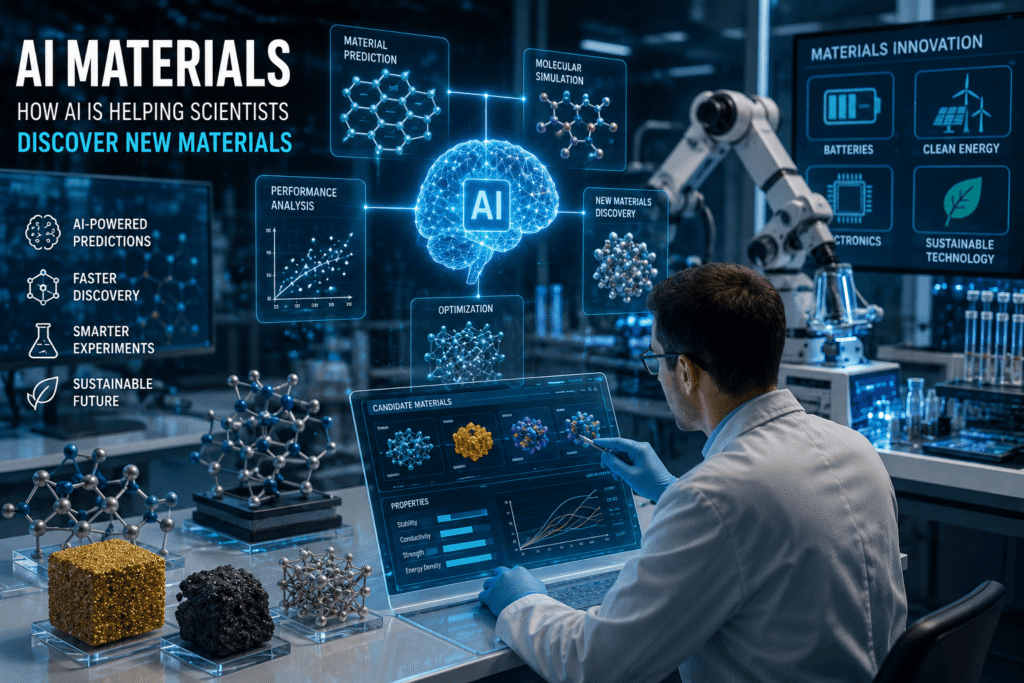
The search for new materials has traditionally required years of experiments, simulations, testing, and refinement. Scientists may need to examine countless chemical combinations before finding a material with the right properties. Today, AI Materials research is helping change that process.
Artificial intelligence can analyze large scientific datasets, recognize complex patterns, predict material properties, and identify promising candidates before researchers spend time creating them in a laboratory. As a result, AI is becoming an increasingly valuable tool in the search for better batteries, advanced electronics, clean-energy technologies, catalysts, and other materials that could shape the future.
AI does not replace materials scientists. Instead, it helps them explore a much larger scientific search space and focus their expertise on the most promising possibilities.
Table of Contents
1. Why AI Materials Matter
2. What Are AI Materials?
3. How Scientists Discover New Materials
4. How AI Helps Discover New Materials
5. The AI Materials Discovery Process
6. Real-World Applications of AI Materials
7. Benefits of AI Materials
8. Challenges and Limitations
9. Best Practices for AI Materials Research
10. Common Mistakes to Avoid
11. Practical Checklist
12.The Future of AI Materials
13. FAQ
14. Conclusion
Why AI Materials Matter
Modern life depends on advanced materials.
Smartphones require specialized semiconductors. Electric vehicles depend on high-performance batteries. Solar panels need materials capable of converting sunlight into electricity. Medical devices, aerospace systems, computers, and clean-energy infrastructure all rely on carefully designed materials.
The problem is that discovering a useful material can be extremely slow.
Scientists must consider chemical composition, atomic structure, stability, manufacturing conditions, cost, safety, and real-world performance. Even a small change in composition can produce very different results.
AI can help researchers reduce this complexity by predicting which possibilities deserve further investigation.
The potential impact is significant. The U.S. Department of Energy is currently pursuing physics-aware AI, generative AI, and agentic AI approaches designed to connect prediction, synthesis, characterization, and analysis into closed-loop materials discovery systems. The Department of Energy’s
What Are AI Materials?
The term AI Materials describes the use of artificial intelligence to support the discovery, design, prediction, and optimization of materials.
A material can have many important properties, including:
- Chemical composition
- Atomic structure
- Electrical conductivity
- Thermal stability
- Strength
- Magnetic behavior
- Optical properties
- Energy-storage potential
AI models can study large collections of existing materials and learn relationships between their structures and properties.
For example, if researchers need a material that remains stable at high temperatures while conducting electricity efficiently, AI can screen large numbers of candidates and estimate which ones may meet those requirements.
The final material still requires scientific verification. However, AI can make the search process more focused.
How Scientists Discover New Materials
Traditional materials discovery usually involves a cycle of hypothesis, simulation, synthesis, testing, and refinement.
A researcher might begin with an idea based on existing scientific knowledge. They then create a candidate material or model it computationally. After that, they measure its properties and decide whether it is worth further investigation.
This process has produced many of the technologies we use today. Nevertheless, it can involve substantial trial and error.
Computational materials science improved the process by allowing researchers to model candidates before manufacturing them. AI builds on this approach by learning patterns from scientific data and making predictions at a much larger scale.
The key difference is speed and prioritization.
Instead of asking, “Can we test every possible material?” AI helps researchers ask, “Which materials should we test first?”
How AI Helps Discover New Materials
AI Organizes Scientific Data
Materials research produces enormous amounts of information from experiments, simulations, scientific papers, and databases.
AI can help researchers organize and analyze this information.
The Materials Project, supported by the U.S. Department of Energy and managed at Berkeley Lab, provides open computational data and tools that support data-driven materials research. In 2026, Berkeley Lab described its curated datasets as important infrastructure for AI-powered materials design and for connecting computational predictions with autonomous experiments. ([Berkeley Lab News Center][2])
AI Predicts Material Properties
Machine-learning models can estimate whether a material may have useful properties before it is physically created.
Researchers can use AI to investigate questions such as:
- Is this structure likely to be stable?
- Could it store electrical energy?
- Might it work as a semiconductor?
- Can it tolerate extreme temperatures?
- Does it have promising magnetic properties?
These predictions can help scientists narrow a massive number of possibilities.
AI Generates New Candidates
AI can also suggest material structures that scientists have not previously investigated.
A major example is Google DeepMind’s GNoME project. The system predicted 2.2 million new crystal structures, including approximately 380,000 predicted to be stable and potentially useful for future technologies. DeepMind also reported that hundreds of these predicted structures had been independently realized experimentally.
AI Helps Plan Experiments
Prediction is only part of the challenge.
A material may appear promising in a computer model but still be difficult to synthesize.
AI can help scientists analyze previous experiments and identify potentially useful synthesis conditions. This is especially important because successful discovery requires connecting computational predictions to physical reality
The AI Materials Discovery Process
AI-assisted materials discovery can be understood as a step-by-step process.
Step 1: Define the Scientific Problem
Scientists first decide what type of material they need.
For example:
A research team may need a battery material that stores more energy, uses less expensive ingredients, and remains stable during repeated charging.
A clear objective helps guide the search.
Step 2: Collect Relevant Data
Researchers gather information from:
- Materials databases
- Laboratory experiments
- Scientific literature
- Computer simulations
- Imaging and measurement systems
The quality of this data is extremely important. AI cannot reliably compensate for poor or incomplete scientific information.
Step3: Train or Select an AI Model
Scientists use machine-learning models that can identify relationships between a material’s composition, structure, and properties.
Different models may be used depending on the problem.
For example, graph neural networks are particularly useful for crystalline materials because atoms and their relationships can be represented as connected structures.
Step 4: Screen or Generate Candidates
AI then analyzes large numbers of possible materials.
Some systems screen existing candidates, while generative approaches can suggest entirely new compositions or structures.
Step 5: Rank the Best Possibilities
Scientists can prioritize candidates according to their predicted properties.
For example, battery research may focus on materials with:
- High energy-storage potential
- Good stability
- Suitable electrical performance
- Lower-cost elements
- Better safety characteristics
Step 6: Verify the Predictions
Promising candidates require more detailed verification.
Researchers may use advanced simulations, physical calculations, or other scientific techniques before moving into the laboratory.
Step 7: Test the Material
The most promising candidates are synthesized and tested.
This is a critical step because a computer prediction is not the same as a working material.
Step 8: Learn From the Results
Experimental results can be fed back into the research process.
This creates a feedback loop:
Prediction → Experiment → Measurement → Learning → Better Prediction
This closed-loop approach is a major direction in modern materials science. Berkeley Lab’s autonomous laboratory research combines AI guidance, robotic synthesis, and characterization to accelerate this cycle.
Real-World Applications of AI Materials
Better Batteries
One of the most important applications is battery research.
Demand for improved batteries continues to grow because of electric vehicles, renewable-energy storage, portable electronics, and power-grid needs.
Scientists are searching for materials that can improve:
- Energy density
- Charging speed
Safety
Battery lifespan
Manufacturing efficiency
AI can help screen possible electrode and electrolyte materials before expensive laboratory testing begins.
Current Berkeley Lab initiatives are also using AI and high-performance computing to accelerate research into materials for batteries, semiconductors, and other energy technologies.
Cleaner Energy
AI Materials research could help develop improved materials for solar energy, hydrogen production, catalysts, and energy storage.
Catalysts are particularly important because they can help make chemical reactions more efficient.
Better materials could potentially reduce energy use, improve industrial processes, and support cleaner technologies.
Advanced Electronics
Modern electronics depend on highly specialized materials.
AI can help scientists search for materials with specific electrical, optical, and magnetic properties.
Potential applications include:
- Faster computer chips
- Advanced sensors
- Photonic devices
- Flexible electronics
- Quantum technologies
Sustainable Materials
Scientists are also interested in materials that use more abundant or environmentally responsible ingredients.
AI can help compare large numbers of candidates and identify alternatives to scarce or expensive materials.
This could become increasingly important for clean energy, manufacturing, and critical technology supply chains.
Autonomous Laboratories
One of the most exciting developments is the combination of AI with robotics.
In an autonomous laboratory, AI can help decide which experiment should happen next while robotic systems perform parts of the physical work.
The results are measured and analyzed, and the next experiment is selected based on what has been learned.
Berkeley Lab’s A-Lab demonstrates this direction by using AI-guided robotics to accelerate the synthesis and testing of new materials.
Benefits of AI Materials
AI offers several important advantages for materials science.
Faster Discovery
AI can screen far more candidates than traditional trial-and-error methods.
This does not guarantee that every prediction will work, but it can help researchers focus their time.
Lower Research Costs
Laboratory experiments and high-performance simulations can be expensive.
By eliminating weaker candidates earlier, AI may reduce wasted resources.
Larger Search Spaces
Scientists can investigate combinations that would be difficult to explore manually.
This expands the range of possible discoveries.
Better Research Prioritization
AI can help identify promising directions and rank candidates according to specific goals.
Stronger Connection Between Data and Experiments
AI can bring together information from databases, simulations, scientific literature, and laboratory measurements.
This is especially useful in complex scientific fields where no single researcher can manually analyze all available information.
Challenges and Limitations
AI Materials research is powerful, but it has important limitations.
AI Is Only as Good as Its Data
Incomplete or inaccurate datasets can produce unreliable predictions.
Some materials have been studied far more extensively than others, which can create gaps in training data.
Predictions Are Not Proof
A material predicted to be stable or useful still needs verification.
It may be difficult to synthesize, too expensive to manufacture, or unsuitable for real-world conditions.
Scientific Interpretability Matters
Scientists need to understand why a model produces a recommendation.
A highly accurate prediction is useful, but researchers also need confidence that the result is scientifically meaningful.
Computing Resources Can Be Expensive
Large AI models and advanced simulations may require substantial computing power.
Human Expertise Remains Essential
AI can identify patterns, but scientists provide the questions, interpret results, design experiments, and evaluate whether discoveries matter.
The strongest model is collaboration between AI systems and human researchers.
Best Practices for AI Materials Research
Organizations and researchers can improve AI-assisted discovery by following several principles.
Start With a Clear Scientific Goal
Do not use AI simply because it is available.
Define the material properties or scientific problem first.
Use High-Quality Data
Data should be carefully documented, validated, and maintained.
Where possible, researchers should understand the limitations of the datasets they use.
Combine AI With Physics and Chemistry
Purely data-driven predictions can be useful, but scientific knowledge remains important.
Physics-informed and chemistry-aware approaches can help make models more reliable.
Validate Important Results
Promising AI predictions should be checked through simulations and laboratory experiments.
Measure Uncertainty
Researchers should not treat every AI prediction as equally reliable.
Understanding uncertainty can help scientists decide which candidates deserve further investigation.
Keep Humans in the Loop
AI should support scientific judgment rather than replace it.
Common Mistakes to Avoid
Mistake 1: Trusting AI Predictions Without Testing
A predicted material is not automatically a usable material.
Laboratory validation remains essential.
Mistake 2: Using Poor-Quality Data
Bad data can create misleading results.
Data quality should be considered before model complexity.
Mistake 3: Optimizing Only One Property
A material may perform well in one area but fail in another.
For example, a highly conductive material may also be unstable or too expensive.
Mistake 4: Ignoring Manufacturing
A material must eventually be produced reliably and economically.
Discovery alone is not enough.
Mistake 5: Treating AI as a Replacement for Scientists
AI can accelerate research, but scientific expertise is necessary to define problems and evaluate discoveries
Practical Checklist for AI Materials Research
Before using AI in a materials research workflow, consider:
- Is the scientific problem clearly defined?
- Is the available data reliable and relevant?
- Are important data limitations understood?
- Is the AI model appropriate for the research problem?
- Have predictions been ranked by usefulness and uncertainty?
- Will promising candidates be independently verified?
- Can the material be realistically synthesized?
- Have cost and scalability been considered?
- Are environmental and safety factors included?
- Is human scientific oversight maintained throughout the process?
The Future of AI Materials
https://futurescienceai.com/blog/artificial-intelligence/electronic-skin-robots/
The future of materials science may involve increasingly connected research systems.
AI models could analyze scientific literature, search materials databases, run simulations, suggest experiments, and work with robotic laboratories to test hypotheses.
This direction is already visible in current U.S. Department of Energy and Berkeley Lab initiatives. Berkeley Lab’s FORUM-AI project, announced in 2026, aims to connect AI agents with literature, simulations, experiments, and analysis across energy materials research. The broader goal is to reduce the time between scientific ideas and useful technologies.
DOE has described the potential for tighter AI integration to shorten materials development timelines significantly, particularly for technologies involving batteries, energy systems, and advanced structural or functional materials.
The future could therefore move from isolated experiments toward more intelligent, iterative research systems.
Scientists will still play a central role.
However, they may increasingly work with AI tools that can search enormous scientific spaces and robotic laboratories that can test ideas around the clock.
CTA: Explore the Future of AI and Science
Artificial intelligence is becoming one of the most powerful tools available to modern science.
From discovering advanced materials to accelerating energy research and improving scientific analysis, AI is helping researchers explore possibilities that were once too large or complex to investigate efficiently.
Explore more science, artificial intelligence, quantum technology, space, and future innovation guides on FutureScienceAI.
Frequently Asked Questions
1. What are AI Materials?
AI Materials refers to the use of artificial intelligence and machine learning to discover, predict, design, or optimize materials with useful properties.
2. How does AI help discover new materials?
AI analyzes scientific data, identifies patterns, predicts material properties, generates potential candidates, and helps scientists prioritize experiments.
3. Can AI create completely new materials?
AI can propose new chemical compositions or atomic structures that scientists may not have previously investigated. However, these predictions still require scientific validation and laboratory testing.
4. What industries can benefit from AI Materials?
AI Materials research can support industries including clean energy, batteries, electronics, manufacturing, aerospace, healthcare, and quantum technology.
5. Will AI replace materials scientists?
No. AI can automate parts of the discovery process, but scientists remain essential for defining research problems, interpreting results, designing experiments, and validating discoveries.
Conclusion
Materials research is changing how scientists search for the building blocks of future technology.
Instead of relying entirely on slow trial and error, researchers can use AI to analyze huge datasets, predict useful properties, generate new candidates, and identify the most promising experiments.
The potential applications are enormous. Better batteries, cleaner energy systems, advanced electronics, new catalysts, and more sustainable technologies may all benefit from faster materials discovery.
However, AI predictions are only the beginning.
The most important discoveries will continue to depend on high-quality data, scientific expertise, laboratory validation, and careful engineering.
The future of AI Materials is therefore not about machines replacing scientists. It is about giving scientists more powerful tools to explore ideas, test hypotheses, and discover the materials that could shape the next generation of technology