
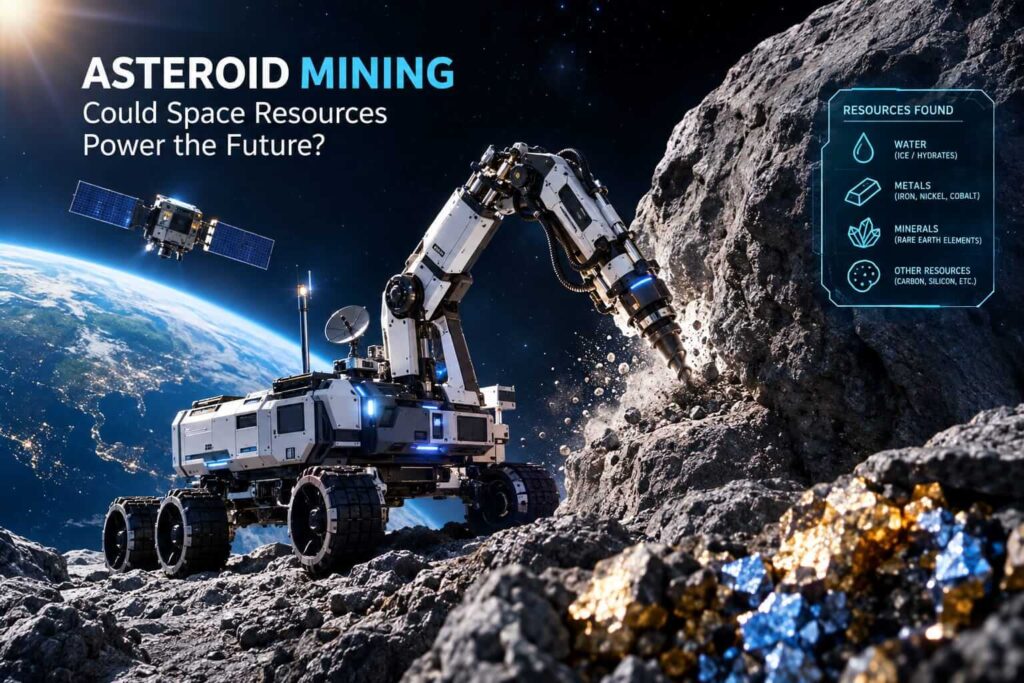
Asteroid Mining: Could Space Resources Power the Future?
Introduction
Asteroid Mining sounds like science fiction, but the idea is increasingly connected to real space exploration, robotics, engineering, and resource planning. Asteroids contain rocks, metals, minerals, and, in some cases, water-bearing materials that could become useful to future space missions.
The biggest opportunity may not be bringing enormous quantities of metal back to Earth. Instead, future missions could use resources in space to produce water, fuel, construction materials, and other supplies. That could reduce the amount of material that spacecraft need to launch from Earth.
NASA’s asteroid missions have already demonstrated that spacecraft can reach, study, and collect material from asteroids. For example, OSIRIS-REx successfully returned a sample from asteroid Bennu to Earth in 2023. Meanwhile, NASA’s Psyche mission is traveling toward a metal-rich asteroid that it is expected to begin exploring in 2029.
So, could asteroid resources really power the future of space exploration?
The answer depends on technology, economics, energy, transportation, and international rules. However, the potential is significant.
Table of Contents
1. What Is Asteroid Mining?
2. Why Asteroid Mining Matters
3. What Resources Are Found on Asteroids?
4. How Asteroid Mining Could Work
5. Benefits of Asteroid Mining
6. The Role of AI and Robotics
7. Major Challenges
8. Is Asteroid Mining Economically Practical?
9. What Current Missions Can Teach Us
10. Best Practices for Future Space Mining
11. Common Mistakes and Misconceptions
12. Practical Checklist
13. FAQ
14. CTA
15. Conclusion
What Is Asteroid Mining?
Asteroid Mining refers to the concept of identifying, reaching, extracting, processing, and using resources found on asteroids.
Unlike traditional mining on Earth, asteroid mining would operate in an environment with almost no atmosphere, extremely low gravity, intense radiation, and huge distances between objects.
Asteroids are also extremely diverse.
Some contain large amounts of rock and carbon-rich material. Others may contain metals such as iron and nickel. Certain asteroids may also contain water or hydrated minerals.
That diversity makes asteroid resource identification one of the first major steps toward future space mining.
NASA’s Psyche mission is particularly interesting because the target asteroid appears to be rich in metal. NASA says Psyche may represent part or all of the iron-rich core of an early planetary body.
Why Asteroid Mining Matters
https://k-mine.com/articles/mining-beyond-earth-transforming-space-exploration/
Launching material from Earth is expensive and technically demanding.
Every kilogram of equipment sent into space requires energy, propulsion, spacecraft infrastructure, and careful mission planning.
This creates an interesting possibility.
Instead of transporting every resource from Earth, future space infrastructure could potentially obtain some materials from asteroids.
For example, water extracted from a suitable asteroid could potentially be processed into hydrogen and oxygen. Those substances can serve as components of rocket propellant.
Water could also support astronauts and future space habitats.
Therefore, the real value of asteroid mining may be using space resources where they are found.
What Resources Are Found on Asteroids?
Not every asteroid contains the same resources. Scientists must first determine an asteroid’s composition before deciding whether it is technically interesting.
Water and Volatile Materials
Water is one of the most valuable potential resources.
It could support human missions, life-support systems, agriculture, and fuel production.
However, finding water does not automatically mean that extracting it will be practical. The resource must exist in a usable form, and the energy required to extract and process it must be reasonable.
Metals
Some asteroids contain metals such as iron and nickel.
Other elements may also be present depending on the asteroid’s composition.
Metal-rich asteroids have attracted attention because processed material could potentially be used for manufacturing structures in space.
NASA’s Psyche mission is studying a particularly unusual metal-rich asteroid to better understand its composition and history. The spacecraft launched in 2023 and is expected to reach Psyche in 2029.
Construction Materials
Future space industries could potentially use asteroid-derived material for:
· Space station components
· Radiation shielding
· Structural materials
· Manufacturing
· Storage facilities
· Large orbital infrastructure
This could eventually reduce dependence on Earth-based launches.
How Asteroid Mining Could Work
Actual asteroid mining would require several highly coordinated stages.
1. Identify a Suitable Asteroid
First, scientists and engineers would search for asteroids with useful characteristics.
They would examine factors such as:
· Composition
· Size
· Rotation
· Orbit
· Distance from Earth
· Accessibility
· Estimated resource concentration
· Energy requirements
Not every resource-rich asteroid would be economically useful.
A nearby asteroid with fewer resources could potentially be more attractive than a distant asteroid containing much more material.
1. Send a Robotic Mission
A robotic spacecraft would travel to the selected asteroid.
Because communication delays and operating conditions make human intervention difficult, autonomous systems would become extremely important.
1. Survey the Surface
The spacecraft would map the asteroid and study its physical and chemical properties.
Sensors could identify promising areas for extraction.
1. Extract the Material
Mining systems could potentially use drills, scoops, anchors, robotic arms, or other mechanisms.
The exact method would depend heavily on the asteroid’s surface.
An asteroid’s extremely low gravity creates an unusual problem: pushing against the surface could cause equipment to move away from the asteroid instead of digging into it.
1. Process the Resources
Raw material would need to be separated and processed.
For example, water-bearing material could potentially be heated to release water. Metals could require different extraction and refining methods.
1. Use or Transport the Resources
Finally, the extracted resources could potentially be used near the asteroid, transported to another location in space, or, in some cases, returned to Earth.
The most practical destination will depend on economics and mission requirements.
Benefits of Asteroid Mining
Reduced Dependence on Earth
If useful resources can be produced in space, future missions may not need to launch every kilogram from Earth.
That could change how space infrastructure is designed.
Support for Long-Distance Missions
Water and fuel resources could be particularly important for missions operating farther from Earth.
Instead of carrying all supplies from the beginning of a mission, spacecraft might eventually obtain some resources during their journey.
New Space Industries
Asteroid mining could create demand for new technologies and services.
Potential industries include:
· Robotic mining
· Autonomous spacecraft
· Space manufacturing
· Resource mapping
· Propulsion
· Orbital logistics
· Space-based construction
· Advanced communications
This could create opportunities for engineers, software developers, scientists, robotics specialists, and space businesses.
Scientific Discovery
Asteroid mining technology would also improve our scientific understanding of the solar system.
NASA’s OSIRIS-REx mission demonstrated the value of directly collecting asteroid material. The spacecraft returned 121.6 grams of rocks and dust from Bennu in 2023. It was the first U.S. mission to return an asteroid sample to Earth.
The Role of AI and Robotics in Asteroid Mining
Artificial intelligence could become one of the most important technologies supporting future asteroid mining.
A mining spacecraft cannot depend entirely on continuous human control from Earth.
Instead, autonomous systems could help spacecraft make decisions based on local conditions.
AI Could Help With:
· Identifying useful geological areas
· Mapping asteroid surfaces
· Navigation
· Collision avoidance
· Equipment monitoring
· Resource classification
· Mission planning
· Predictive maintenance
· Robotic movement
Machine learning could also help analyze huge quantities of images and sensor measurements.
For example, an AI system could compare geological patterns and identify areas that deserve closer examination.
However, AI would not eliminate the need for human expertise. Engineers and scientists would still need to design the systems, establish safety limits, validate decisions, and respond to unexpected situations.
Major Challenges of Asteroid Mining
Asteroid mining faces serious technical and economic challenges.
Extreme Distance
Some asteroids are millions of kilometers away.
Traveling there requires careful trajectory planning, propulsion, communication, and energy management.
NASA’s Psyche spacecraft, for example, is making a long journey to the main asteroid belt and is using solar-electric propulsion as part of its mission.
Low Gravity
Asteroids have extremely weak gravity.
Mining equipment must therefore be designed to avoid pushing itself away from the surface.
Resource Processing
Finding a resource is only the beginning.
Engineers must develop reliable methods to extract, separate, store, and transport it.
High Development Costs
Mining spacecraft would require advanced robotics, autonomous systems, propulsion, power generation, communication systems, and mining equipment.
Developing all of this technology could require substantial investment.
Legal and Regulatory Questions
Space-resource activities also raise important legal questions.
The Artemis Accords provide principles for civil exploration and use of space resources and emphasize that resource utilization should be consistent with the Outer Space Treaty and conducted for peaceful purposes.
As commercial activity grows, countries and international organizations will continue to face questions about resource rights, safety, environmental responsibility, and coordination.
Is Asteroid Mining Economically Practical?
This is one of the biggest unanswered questions.
It is easy to calculate the theoretical value of metals on an asteroid. It is much harder to calculate the cost of actually extracting and transporting those materials.
A successful business would need to consider:
Resource value + extraction cost + processing cost + transportation cost + infrastructure cost + risk
A huge quantity of metal does not automatically mean a profitable mining operation.
For that reason, future companies may initially focus on resources that provide direct value in space rather than attempting to return large quantities of metals to Earth.
Water is a good example.
If water can be produced economically in space, it could become useful for life support and propellant production.
That could create a market without requiring valuable materials to travel all the way back to Earth
What Current Missions Can Teach Us
Current asteroid missions are not commercial mining operations, but they provide important technological and scientific foundations.
NASA’s OSIRIS-REx successfully approached Bennu, collected a sample, and returned it to Earth. The spacecraft was then renamed OSIRIS-APEX and assigned an extended mission to study asteroid Apophis during its 2029 encounter.
Meanwhile, NASA’s Psyche mission is investigating a metal-rich asteroid.
In May 2026, the spacecraft completed a Mars gravity assist that adjusted its trajectory toward Psyche. NASA expects the spacecraft to begin its main asteroid investigation in August 2029.
These missions do not prove that commercial asteroid mining is ready.
Instead, they demonstrate how scientists and engineers are gradually developing the knowledge required to operate around small bodies in space.
Best Practices for Future Space Mining
Companies and research organizations exploring asteroid mining should focus on several principles.
Start With Resource Mapping
Before attempting extraction, missions should establish accurate information about the target asteroid.
Design for Autonomy
Communication delays mean spacecraft should be able to handle many routine decisions independently.
Prioritize In-Space Use
Using resources where they are extracted may be more practical than immediately transporting them to Earth.
Build Modular Systems
Mining equipment should ideally be repairable, replaceable, and adaptable to different asteroid environments.
Plan for Safety
Space operations should minimize collision risks, debris generation, and interference with other spacecraft.
Work Within International Frameworks
Responsible resource use will require transparency, coordination, and compliance with applicable international and national rules.
Common Mistakes and Misconceptions
“Asteroid Mining Will Make Everyone Rich”
The theoretical value of asteroid resources should not be confused with guaranteed economic value.
Extraction and transportation are extremely difficult.
“We Can Mine Any Asteroid”
Different asteroids have different compositions, shapes, orbits, and accessibility.
A suitable target must be carefully selected.
“Mining Will Start Tomorrow”
Although asteroid exploration is active, commercial-scale asteroid mining remains a developing concept.
Current missions are still helping scientists understand these objects and test relevant technologies.
“All Asteroid Mining Means Bringing Metals to Earth”
Not necessarily.
Using resources in space may ultimately be more strategically important than returning bulk materials to Earth.
Practical Asteroid Mining Checklist
Before evaluating a future asteroid-mining project, consider:
- Is the asteroid accessible?
- What resources does it contain?
- How confidently have those resources been identified?
- Can autonomous robots operate there?
- How will material be extracted?
- How will resources be processed?
- Where will the resources be used?
- What propulsion system is required?
- What are the communication requirements?
- What are the total development and operating costs?
- What legal and safety rules apply?
- Can the system operate sustainably?
This checklist highlights an important reality: asteroid mining is not simply a mining problem. It combines space science, robotics, AI, materials engineering, energy, economics, and international policy.
FAQ: Asteroid Mining
What is Asteroid Mining?
Asteroid Mining is the process of exploring asteroids and potentially extracting useful resources such as water, metals, minerals, or other materials for use in space or, potentially, on Earth.
Why is Asteroid Mining important?
Asteroid Mining could provide resources for future space missions. Water, in particular, could potentially support astronauts and help produce rocket propellant.
Is Asteroid Mining happening now?
Scientists and space agencies are currently exploring and studying asteroids, but large-scale commercial asteroid mining is still an emerging field. NASA’s OSIRIS-REx mission successfully returned material from Bennu, while the Psyche mission is studying a metal-rich asteroid.
Could asteroids provide metals for Earth?
In theory, asteroids can contain significant amounts of metals. However, transporting large quantities back to Earth would require major advances in extraction, processing, transportation, and economics.
Will AI be used in Asteroid Mining
AI and autonomous robotics could help future mining spacecraft with navigation, surface mapping, resource identification, equipment monitoring, and mission decision-making.
Explore the Future of Space Resources
The future of asteroid mining will not be decided by one breakthrough.
Instead, it will depend on many technologies improving together.
Better rockets can reduce transportation costs. AI can improve autonomous operations. Robotics can perform dangerous tasks. Advanced materials can make spacecraft lighter and stronger.
Conclusion
https://futurescienceai.com/blog/space-astronomy/future-of-space-exploration-future-science-ai/
Asteroid Mining represents one of the most ambitious ideas in modern space technology.
Asteroids could contain water, metals, and other materials that may eventually support a growing space economy. However, reaching an asteroid is only the first challenge. Extracting resources, processing them, operating autonomous machines, controlling costs, and establishing responsible rules will all require significant technological progress.
Current missions are providing valuable building blocks. OSIRIS-REx demonstrated successful asteroid sample collection and return, while NASA’s Psyche mission is preparing to study a unique metal-rich asteroid in 2029.
The most important question may therefore not be whether asteroids contain valuable resources. They do.
The bigger question is whether humanity can develop the technology and infrastructure needed to use those resources safely and economically.
If that happens, asteroids could become more than distant objects in the night sky. They could become part of the infrastructure supporting the next era of space exploration.