
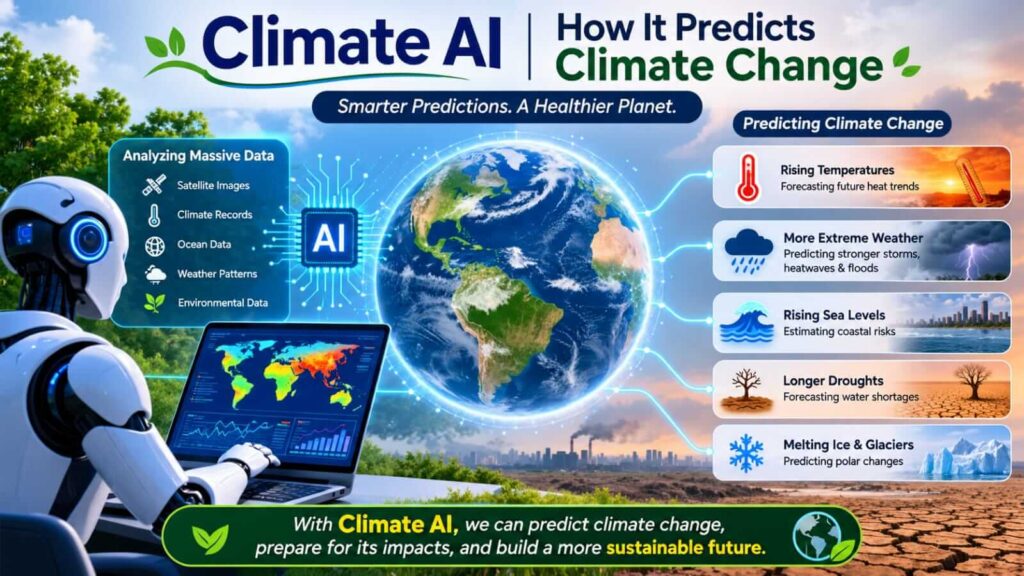
Climate AI: How Artificial Intelligence Predicts Climate Change
Introduction
Climate change is transforming our planet in ways that affect agriculture, energy, water resources, wildlife, and human health. Rising temperatures, melting glaciers, changing rainfall patterns, and extreme heat are creating new challenges for communities worldwide. Scientists need better tools to understand these changes and prepare for the future. Climate AI is emerging as a powerful technology that can help researchers analyze environmental data and improve our understanding of a changing planet.
Artificial intelligence can process enormous amounts of information collected from satellites, weather stations, oceans, and climate research. By identifying patterns in these datasets, AI systems can help scientists investigate long-term warming trends, examine environmental risks, and improve certain climate-related predictions.
Traditional climate models remain essential because they simulate the physical processes that govern Earth’s climate. However, some simulations require substantial computing power. AI can complement these models by accelerating selected calculations and helping researchers explore different climate scenarios.
From helping cities prepare for extreme heat to supporting renewable energy planning, climate-related AI applications have considerable potential.
But how does this technology work? Can artificial intelligence predict climate change accurately? And what does it mean for the future of environmental science?
Let’s explore how climate AI works, where it is being used, and what challenges researchers still need to overcome.
Table of Contents
1. What Is Climate AI?
2. How AI Predicts Climate Change
3. Why Climate AI Matters
4. Real-World Applications
5. Benefits of Climate AI
6. Limitations and Challenges
7. How to Use Climate Predictions Responsibly
8. The Future of Climate AI
9. Frequently Asked Questions
10. Conclusion
What Is Climate AI?
Climate AI refers to the use of artificial intelligence and machine learning to analyze climate data, identify environmental patterns, and support predictions or simulations of future climate conditions.
Earth’s climate is influenced by interconnected systems, including the atmosphere, oceans, land, ice, and living organisms. These systems constantly exchange heat, moisture, and energy. Understanding their interactions requires scientists to study large amounts of data collected over many years.
Traditional climate models use mathematical equations based on physical laws to simulate these interactions. AI models take a different approach by learning statistical relationships from historical observations and existing simulations.
For example, a machine learning system might analyze temperature records, rainfall measurements, and atmospheric conditions to identify patterns associated with changing regional climates.
Researchers can then test whether those patterns help explain observed changes or improve particular predictions.
However, AI is not a magic tool that knows exactly what will happen decades from now. Its performance depends on the quality of its data, the methods used to train it, and the environmental conditions it is designed to study.
The most effective approach often combines AI with established climate science.
How AI Predicts Climate Change
1. Collecting Climate Data
The first step is gathering reliable environmental information.
Scientists use satellites, weather stations, ocean buoys, research aircraft, and other monitoring systems to collect measurements of temperature, rainfall, humidity, wind, sea levels, and ice cover.
Historical records are particularly valuable because they allow researchers to investigate how climate conditions have changed over time.
Climate simulations also provide useful training data for some AI applications. Before using these datasets, researchers must check for missing observations, measurement errors, and inconsistencies.
Reliable data is essential because poor-quality information can lead to misleading results.
2. Using Machine Learning to Find Patterns
After collecting and preparing the data, researchers train AI models to recognize relationships between environmental variables.
For example, a model might examine how ocean temperatures and atmospheric conditions relate to rainfall patterns in a particular region.
Deep learning systems can process complex datasets and identify relationships that may be difficult to detect through conventional analysis alone.
Nevertheless, patterns learned from historical data do not always remain reliable under unprecedented future conditions. Scientists must evaluate AI results carefully before using them in climate research.
3. Simulating Different Climate Scenarios
Climate projections often examine alternative greenhouse gas emissions pathways.
One scenario might involve rapid reductions in emissions, while another could involve continued high emissions. These different assumptions can lead to different estimates of future warming and environmental impacts.
AI can help researchers analyze these scenarios and accelerate selected calculations.The resulting projections help decision-makers understand possible outcomes and prepare for different risks. They do not guarantee that one particular future will occur.
4. Improving Regional Climate Predictions
Global climate models provide valuable information, but local communities often need more detailed estimates.
AI-based downscaling can help translate large-scale climate projections into finer regional information.
Researchers may use these methods to study potential changes in temperature, rainfall, or heat exposure.For example, a city could use regional climate projections to investigate whether its drainage systems may need improvements under future rainfall conditions.
However, more detailed predictions are not automatically more accurate. Scientists must validate regional estimates using observations and established scientific methods.
5. Testing and Validating the Results
Before relying on AI predictions, researchers compare model outputs with independent observations and established scientific models.
They examine whether the system performs well in different regions, reproduces important climate patterns, and communicates uncertainty appropriately.
This process helps identify weaknesses and reduces the risk of making decisions based on unreliable predictions.
Why Climate AI Matters
Climate change affects different parts of the world in different ways.
In the United States, communities may need to prepare for extreme heat, wildfires, drought, and coastal flooding. Canada faces risks associated with Arctic warming, changing precipitation, and wildfire conditions. Across the UK and Europe, heatwaves, heavy rainfall, and water shortages create challenges for communities and infrastructure.
Climate AI can help scientists analyze these risks and explore how environmental conditions may change over time.
For example, city planners could combine climate projections with information about buildings, roads, drainage systems, and green spaces. This analysis could help identify neighborhoods that may need additional protection from extreme heat or flooding.
Similarly, agricultural researchers could examine how changing temperature and rainfall patterns might affect crop production.
The goal is not to predict every future event perfectly. Instead, AI helps researchers develop useful evidence that supports better planning and informed decisions.
Real-World Applications
Agriculture and Food Security
Agriculture depends heavily on temperature, rainfall, soil moisture, and seasonal conditions. Climate change can make growing seasons less predictable and increase pressure on water resources.
AI-assisted climate analysis can help researchers investigate changing growing conditions and assess potential agricultural risks.
For example, farmers and agricultural planners could use climate projections to compare crop choices and evaluate water management strategies.
These insights must be combined with local soil data, agricultural knowledge, and reliable weather information.
Renewable Energy Planning
Solar and wind power depend on environmental conditions. Energy providers need reliable forecasts to manage electricity generation and maintain a stable supply.
AI weather forecasting can help estimate short-term wind speeds and solar radiation. Climate projections can also support long-term energy planning by examining changing temperatures and electricity demand.
For example, an electricity provider might assess how hotter summers could increase demand for air conditioning.
Explore our related article on the “future of renewable energy technologies
Flood and Drought Risk
AI can help analyze rainfall records, soil moisture, river measurements, and satellite observations to investigate flood and drought risks.
Authorities can combine these insights with hydrological models and local climate projections to improve preparedness.
However, long-term climate projections cannot identify the exact date of a future flood. Short-term warnings require current weather forecasts and real-time environmental observations.
Cities and Infrastructure
Cities must prepare for changing temperatures, heavy rainfall, and pressure on water and electricity systems.
Climate AI can support planning by helping researchers examine heat exposure, identify vulnerable locations, and compare possible adaptation strategies.
For instance, a local authority could evaluate the potential benefits of additional trees, reflective roofs, and improved drainage systems.
Environmental Protection
AI can analyze satellite imagery and environmental records to monitor vegetation changes, melting ice, and ecosystem disturbances.
These insights can support conservation research and help scientists understand how changing environmental conditions affect wildlife and natural habitats.
Benefits of Climate AI
Climate AI offers several important advantages when used responsibly.
Faster analysis: AI can accelerate selected calculations and help researchers examine more scenarios within available computing resources.
Large-scale data processing: Machine learning can analyze extensive environmental datasets and identify useful relationships.
Improved risk assessment: AI-assisted analysis can help communities and businesses investigate potential exposure to environmental hazards.
Better planning: Climate information can support decisions about infrastructure, agriculture, water resources, and energy systems.
Support for scientific research: AI can help researchers explore patterns and test new approaches to climate prediction.
These benefits depend on the model and the task. AI does not improve every prediction automatically, and scientific validation remains essential.
Limitations and Challenges
Despite its potential, climate AI has several limitations.
First, AI systems depend on reliable training data. If a region has limited observations, predictions for that location may be less reliable.
Second, Earth’s climate is a complex physical system. Historical patterns may not fully represent future conditions, especially when environmental changes become more extreme.
Third, AI can produce detailed-looking results that create a false impression of certainty. Researchers must communicate uncertainty clearly and explain the assumptions behind their projections.
Computing requirements also matter. Although some AI models are efficient during forecasting, training advanced systems can require substantial computing resources.
Finally, AI predictions should not replace scientific expertise. Climate researchers must evaluate whether the results are physically plausible and appropriate for the decision being made.
How to Use Climate Predictions Responsibly
Whether you are a student, business owner, researcher, or policymaker, follow these practical steps when evaluating AI climate information.
1. Define your question. Decide whether you need a weather forecast, a climate projection, or an environmental risk assessment.
2. Choose reliable sources. Consult established organizations such as NASA, NOAA, the IPCC, and ECMWF.
3. Check the data. Review the geographic coverage, time period, and limitations of the information.
4. Compare scenarios. Avoid relying on a single possible future when alternative emissions pathways are available.
5. Examine uncertainty. Understand the range of possible outcomes rather than focusing on one number.
6. Consult experts. Seek qualified advice before making major infrastructure, financial, or environmental decisions.
7. Update your understanding. Review new scientific evidence as better data and models become available.
Following these steps helps ensure that AI supports sound decisions rather than creating unrealistic expectations.
The Future of Climate AI
The future of climate AI will likely involve closer collaboration between artificial intelligence, traditional climate models, satellite observations, and high-performance computing.
One important development is the expansion of AI-based forecasting systems. For example, the European Centre for Medium-Range Weather Forecasts introduced its Artificial Intelligence Forecasting System into operational use in February 2025. It operates alongside the organization’s traditional physics-based forecasting system.
The system demonstrates how machine learning can contribute to weather prediction while established scientific methods remain important. eather forecasting and long-term climate modeling are different tasks, so progress in one field does not automatically solve every challenge in the other. Nevertheless, advances in AI-based Earth science may provide useful tools for future environmental research.
Researchers are also exploring methods to improve regional climate information, evaluate extreme weather risks, and analyze interactions between the atmosphere, oceans, and land.
As these technologies develop, the greatest benefit may come from helping scientists turn complex environmental data into practical information that communities can use.
Frequently Asked Questions
1. What is Climate AI?
Climate AI is the use of artificial intelligence and machine learning to analyze climate information, identify patterns, and support climate simulations and predictions.
2. Can AI predict climate change accurately?
AI can improve certain climate-related calculations and predictions. However, accuracy depends on data quality, model design, scientific validation, and future emissions scenarios. It cannot guarantee exact future conditions.
3. How does AI help scientists study global warming?
AI can analyze temperature records, satellite observations, ocean measurements, and climate simulations. This helps researchers investigate warming trends and assess possible environmental risks.
4. What is the difference between AI weather forecasting and climate modeling?
Weather forecasting estimates atmospheric conditions over hours or days. Climate modeling examines long-term patterns and possible changes over decades. Both can use AI, but they address different questions.
5. Can AI help reduce climate change?
AI cannot stop global warming by itself. However, it can support renewable energy planning, energy efficiency, environmental monitoring, and climate adaptation. Actual emissions reductions depend on decisions and actions taken by governments, businesses, and communities.
Conclusion
Climate AI is creating new opportunities to understand climate change, analyze environmental data, and prepare for future risks. By identifying patterns and accelerating selected calculations, artificial intelligence can help scientists investigate global warming and improve certain climate-related predictions.
Its applications extend across agriculture, renewable energy, water management, infrastructure, and environmental protection. These technologies could help communities make more informed decisions as climate conditions change.
However, AI is not a replacement for traditional climate science. Reliable projections still require high-quality data, physical understanding, independent validation, and transparent communication of uncertainty.
By combining artificial intelligence with established scientific methods, researchers can develop better tools for understanding our planet and preparing for its future.
Explore more science and technology insights at Future Science AI to discover how emerging technologies are shaping our world.