
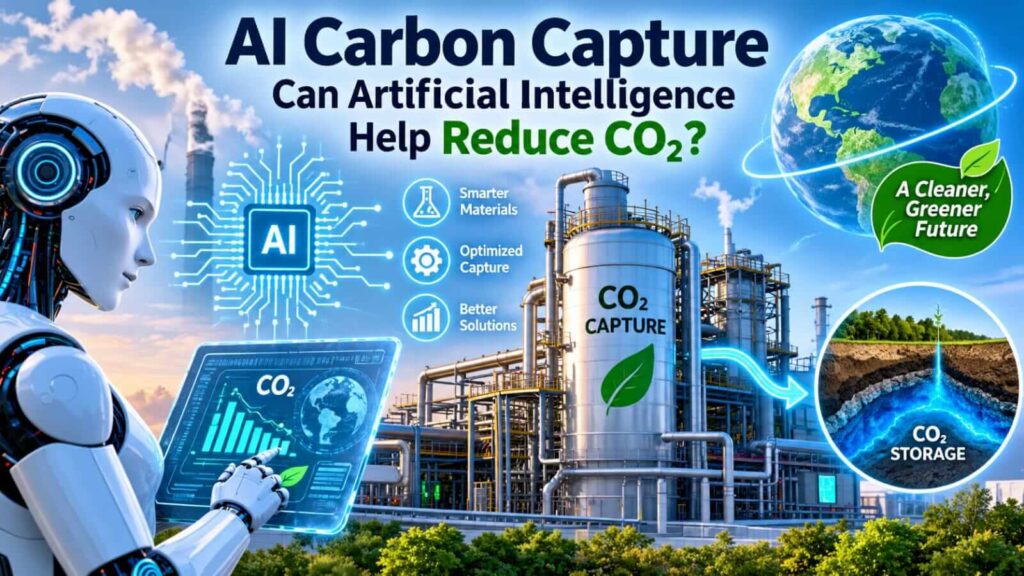
AI Carbon Capture: Can Artificial Intelligence Help Reduce CO2?
https://www.chemcopilot.com/blog/carbon-capture-and-storage-css-and-ai
Introduction
Carbon dioxide is one of the main greenhouse gases contributing to global warming. It enters the atmosphere through activities such as burning fossil fuels, manufacturing cement, producing steel, and generating electricity.
Although switching to cleaner energy and improving energy efficiency can reduce emissions, some industrial activities remain difficult to decarbonize completely. Carbon capture technology offers another option by separating CO2 from industrial gases or removing it directly from the atmosphere.
Artificial intelligence can make these processes smarter. By analyzing operational data, identifying patterns, and predicting performance, AI may help engineers improve capture efficiency and reduce unnecessary costs.
Nevertheless, AI is not a standalone climate solution. Its value comes from helping physical technologies work more effectively alongside broader efforts to cut emissions.
Table of Contents
- Introduction
- Why AI Carbon Capture Matters
- What Is AI Carbon Capture?
- How AI Improves Carbon Capture Technology
- Benefits of AI Carbon Capture
- Step-by-Step Guide to Implementing AI Carbon Capture
- Common Mistakes to Avoid
- Practical Checklist
- Frequently Asked Questions
- Conclusion
What Is AI Carbon Capture?
AI carbon capture refers to the use of artificial intelligence and machine learning to improve processes that capture, separate, monitor, or store carbon dioxide.
AI does not physically absorb CO2 by itself. Instead, it helps researchers and engineers optimize the equipment and scientific processes responsible for carbon management.
Understanding Carbon Capture and Storage
Carbon capture, utilisation and storage (CCUS) typically involves three main stages:
· Capture: Separate CO2 from industrial exhaust gases or other gas mixtures.
· Transport: Move the captured carbon dioxide to a suitable destination.
· Storage or utilisation: Store the gas in appropriate geological formations or use it in selected industrial applications.
Direct air capture is a related technology that removes CO2 directly from the surrounding atmosphere.
Unlike capturing emissions from a factory, direct air capture works with the relatively low concentration of CO2 present in ambient air. Therefore, it can require considerable energy and specialized equipment.
Captured carbon can be stored underground or used in products. However, using CO2 does not automatically prevent it from returning to the atmosphere. The final outcome depends on the application nd how long the carbon remains stored.
How Artificial Intelligence Fits Into the Process
AI can support different stages of carbon management.
For instance, machine learning can help scientists identify promising capture materials. Predictive models can estimate equipment performance, while intelligent control systems can adjust operating conditions.
AI can also help analyze geological data used in carbon storage projects.
The goal is to improve performance, reduce unnecessary energy use, and support safe carbon management.
How AI Improves Carbon Capture Technology
Artificial intelligence can contribute to carbon capture through several practical applications.
1\. Discovering Better Capture Materials
Carbon capture systems may use chemical solvents, solid sorbents, or membranes to separate CO2 from other gases.
Finding effective materials is challenging because researchers must consider several factors, including capture capacity, durability, operating temperature, cost, and the energy required to release the captured gas.
AI can screen candidate materials using their chemical structures and predicted properties.
For example, researchers might train a machine learning model to identify materials that bind CO2 effectively but release it with less heat. The most promising candidates can then undergo laboratory testing.
This approach may reduce the time required to investigate large numbers of potential materials.
However, computer predictions must be confirmed experimentally before a material can be considered suitable for industrial use.
2\. Reducing Energy Consumption
Carbon capture often requires energy to move gases, operate equipment, and regenerate capture materials.
AI can analyze variables such as temperature, pressure, airflow, humidity, and electricity consumption to identify opportunities for improvement.
For example, an AI-assisted control system could adjust operating conditions when a factory’s production level changes. This may help avoid unnecessary energy consumption while maintaining capture performance.
The results depend on the equipment and operating environment. AI does not guarantee energy savings in every installation.
3\. Improving Industrial Carbon Capture
Industries such as cement, steel, and chemical manufacturing face significant challenges in reducing emissions.
AI can help operators identify patterns linking production conditions with capture performance.
A predictive model could estimate how different operating settings affect CO2 capture rates and energy demand. Engineers could then evaluate possible adjustments before changing the physical process.
This approach can support more informed decisions and reduce reliance on costly trial and error.
4\. Monitoring Underground Carbon Storage
Capturing CO2 is only one part of the process. If the carbon is intended for permanent storage, the storage site must be carefully assessed and monitored.
AI can help analyze seismic surveys, pressure measurements, well data, and other geological information.
For example, a model may identify unusual changes in monitoring data that require further investigation. Engineers and geologists can then examine whether those changes indicate a genuine problem.
Nevertheless, AI cannot independently guarantee that underground storage is safe. Qualified specialists and appropriate monitoring systems remain essential.
5\. Using Digital Twins
A digital twin is a virtual representation of a physical system that uses data to model its behavior.
In carbon capture, a digital twin can represent equipment, operating conditions, and interactions between different components.
Engineers can use it to explore how a facility might respond to changes in temperature, pressure, or production levels.
As a result, organizations may be able to test operating strategies virtually before implementing them in a real facility.
Benefits of AI Carbon Capture
When applied appropriately, AI can offer several potential advantages.
Lower Operating Costs
AI-assisted optimization may reduce unnecessary energy consumption, equipment downtime, and material waste. These improvements could lower operating costs over time.
However, the financial benefits depend on implementation costs, system complexity, and the quality of the available data.
Faster Scientific Research
Machine learning can help researchers screen many potential materials and operating conditions. This allows laboratory experiments to focus on promising candidates.
Consequently, AI may accelerate parts of the research process, although physical testing is still necessary.
Better Equipment Reliability
Predictive maintenance models can identify patterns associated with equipment wear or declining performance.
Maintenance teams can use these insights to investigate potential problems before they cause major interruptions.
Improved Monitoring
AI can combine data from sensors, operating records, and monitoring equipment. This may help operators identify unexpected changes and understand how their systems are performing.
Support for Climate Goals
AI-assisted capture systems could help some industries manage emissions that are difficult to eliminate through efficiency improvements alone.
However, the climate benefit depends on the complete process, including the energy used, the amount of CO2 captured, and the final destination of that carbon.
Step-by-Step Guide to Implementing AI Carbon Capture
Businesses and research teams should focus on measurable improvements rather than adopting AI simply because it is a growing technology.
Step 1: Identify the Main Problem
Determine whether the main challenge is high energy consumption, low capture efficiency, equipment downtime, or the cost of capture materials.
A clearly defined objective helps teams choose the right solution.
Step 2: Collect Reliable Data
Gather relevant information from sensors, laboratory tests, maintenance records, and production systems.
Check for missing measurements, inconsistent units, and inaccurate sensor readings before using the data to train an AI model.
Step 3: Choose the Right AI Method
Different problems require different approaches.
· Machine learning can identify patterns in operational data.
· Predictive analytics can estimate equipment performance.
· Optimization algorithms can compare operating conditions.
· Computer vision can help analyze selected images and monitoring information.
The simplest effective method is often preferable to a complicated system that is difficult to maintain.
Step 4: Test the Technology
Evaluate AI predictions against historical data, laboratory results, or controlled experiments.
Where possible, start with a pilot project before deploying the system across an entire facility.
Step 5: Measure Environmental Performance
Track the amount of CO2 captured, energy consumed, operating costs, and emissions associated with the energy supply.
Also, consider what happens to the captured carbon. Permanent storage, temporary product use, and other applications have different climate benefits.
Step 6: Maintain Human Oversight
Engineers and environmental specialists should review important recommendations. Safety systems, regulatory requirements, and independent verification remain essential.
For further information, explore the U.S. Department of Energy’s carbon dioxide removal resources.
Common Mistakes to Avoid
AI can improve carbon capture, but several mistakes may reduce its effectiveness.
· Expecting AI to capture carbon by itself: AI supports physical equipment and scientific processes; it does not replace them.
· Ignoring energy consumption: A capture system may offer limited climate benefits if its energy supply generates substantial emissions.
· Trusting predictions without testing: Model outputs should be checked against real measurements and experiments.
· Overlooking storage safety: Carbon intended for permanent storage requires suitable infrastructure and monitoring.
· Confusing capture with removal: Capturing emissions from a factory can prevent CO2 from entering the atmosphere, but it does not necessarily remove previously accumulated atmospheric carbon.
· Making unsupported environmental claims: Businesses should report measured results rather than promising unverified carbon reductions.
Ultimately, effective carbon management requires a complete view of the process, from the original emissions source to the final destination of the captured gas.
Practical Checklist
Use this checklist when evaluating an AI carbon capture project.
· Define a measurable carbon capture objective.
· Collect reliable scientific and operational data.
· Evaluate energy requirements and operating costs.
· Test AI predictions against real-world measurements.
· Verify the destination of captured CO2.
· Establish appropriate storage and safety monitoring.
· Calculate net environmental benefits.
· Review results regularly with qualified specialists.
This checklist can help businesses, researchers, and decision-makers evaluate potential projects more systematically.
Frequently Asked Questions
1. What is AI carbon capture?
AI carbon capture uses artificial intelligence and machine learning to improve carbon dioxide capture, processing, and storage. It can help optimize equipment, identify promising materials, and analyze monitoring data.
2. Can AI remove CO2 from the atmosphere?
AI cannot physically remove carbon dioxide on its own. However, it can help improve direct air capture systems, which extract CO2 from ambient air for storage or selected uses.
3. How does AI make carbon capture more efficient?
AI can analyze operational data to optimize temperature, pressure, airflow, and energy use. It can also help researchers discover capture materials and predict equipment maintenace
4 . Is AI carbon capture affordable?
The cost varies by technology, energy source, location, and storage requirements. AI may help reduce certain operating costs, but carbon capture remains expensive in many applications, particularly direct air capture
5.Can AI carbon capture stop climate change?
No. AI-assisted carbon capture may help reduce industrial emissions and remove some CO2 from the atmosphere, but it cannot replace emissions reductions. Cleaner energy, improved efficiency, and broader climate action remain essential
Take the Next Step: Explore AI Climate Technology
Artificial intelligence is opening new possibilities in climate science, renewable energy, environmental monitoring, and carbon management.
At FutureScienceAI.com, we help readers understand emerging scientific developments and the technologies that could shape the future.
Explore our related articles on AI climate modeling and renewable energy to learn how these innovations may support a more sustainable world.
Visit FutureScienceAI.com to discover more about AI, science, and future technology.
Conclusion
AI carbon capture offers a promising way to improve how carbon dioxide is captured, monitored, and stored. By helping researchers discover advanced materials, optimizing industrial operations, and supporting carbon storage monitoring, artificial intelligence could make carbon management more efficient.
However, its success depends on more than intelligent algorithms. Reliable data, affordable energy, effective engineering, safe storage, and independent performance verification are all essential.
For businesses and researchers, the next step is to evaluate AI-assisted solutions using measurable results rather than relying on predictions alone.
As research progresses, AI may become an increasingly useful tool in the wider effort to reduce emissions and address climate change. The greatest benefits will come when these innovations work alongside renewable energy, energy efficiency, and meaningful reductions in greenhouse gas emissions.