AI Solar Panels: How Smart Technology Is Improving Solar Energy
Introduction
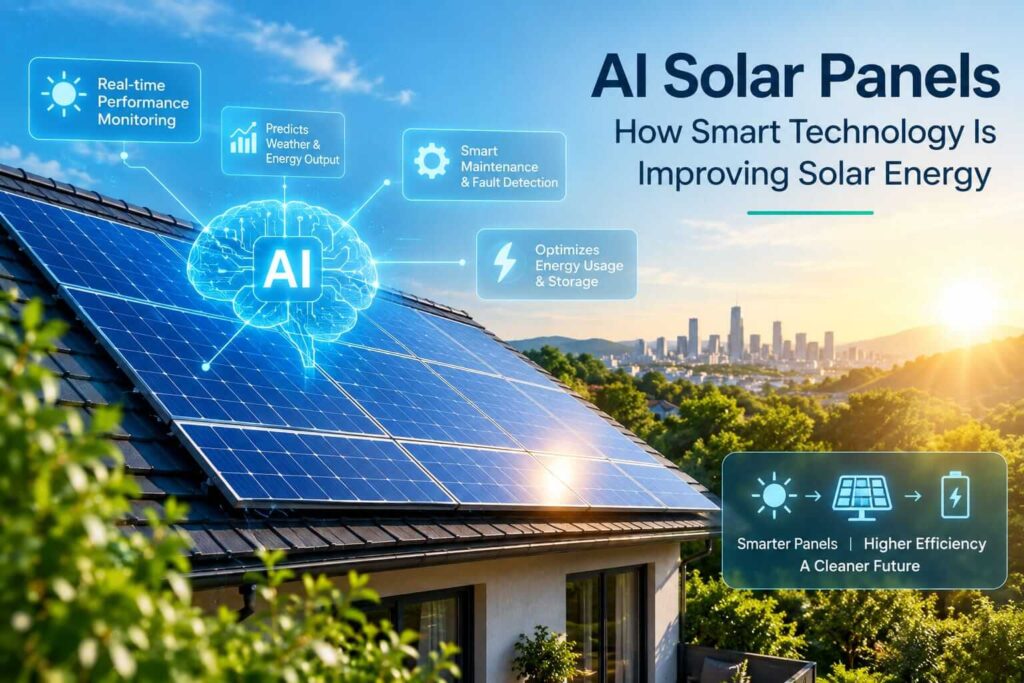
AI solar panels are changing how people produce, monitor, and manage renewable electricity. By combining solar technology with artificial intelligence (AI), machine learning, smart sensors, and weather forecasting, modern solar systems can operate more intelligently and respond to changing conditions.
Traditional solar panels convert sunlight into electricity. However, their performance depends on weather, temperature, shading, equipment condition, and sunlight availability. Artificial intelligence helps analyse these factors, predict energy production, and identify potential problems before they cause significant losses.
From residential rooftops in the United States to large solar farms in Europe and Canada, smart solar technology is creating new opportunities to improve energy management. But how does it work, and is it worth the investment?
In this article, we explore how AI solar panels work, their major benefits, practical applications, limitations, and future possibilities.
Table of Contents
- Introduction
- Why AI Solar Panels Matter
- What Are AI Solar Panels?
- How AI Improves Solar Energy
- Benefits of AI-Powered Solar Panels
- Real-World Applications
- How to Choose an AI Solar System
- Common Mistakes to Avoid
- Frequently Asked Questions
- Conclusion
1. What Are AI Solar Panels?
Solar energy is becoming an important part of the global transition toward cleaner electricity. Homeowners, businesses, and governments are investing in renewable energy to reduce dependence on fossil fuels and improve energy security.
Nevertheless, solar energy comes with challenges. Electricity production changes throughout the day, and cloudy weather can reduce the amount of sunlight reaching solar panels. Equipment faults, dust, shading, and poor maintenance can also affect performance.
This is where artificial intelligence becomes useful.
AI systems can analyse large amounts of operational data, recognise patterns, and estimate what might happen next. Consequently, solar operators can make better decisions about maintenance, energy storage, and electricity consumption.
For example, a commercial building in the UK could use AI-based forecasts to estimate its solar electricity production for the following day. The building manager could then plan certain energy-intensive activities during periods when solar generation is expected to be higher.
Similarly, a solar farm in California could use intelligent monitoring to identify an inverter that performs differently from similar equipment.
The main objective is simple: generate useful insights from solar energy data and use them to improve system management.
1. What Are AI Solar Panels?
AI solar panels are photovoltaic systems that use artificial intelligence or machine learning software to improve energy monitoring, forecasting, maintenance, or electricity management.
Importantly, the solar panels themselves do not necessarily contain AI chips. In many installations, the intelligence comes from connected inverters, sensors, monitoring platforms, and software.
A typical AI-enabled solar installation may include:
· Solar photovoltaic panels that convert sunlight into electricity.
· Smart inverters that manage electricity conversion and provide performance data.
· Sensors that monitor temperature, voltage, current, and other conditions.
· AI software that analyses energy production and detects unusual patterns.
· Weather forecasting tools that estimate future sunlight and solar output.
· Battery storage systems that store excess electricity when installed.
· Monitoring dashboards that display performance information and alerts.
How Does the Technology Work?
AI solar technology generally follows four steps.
Step 1: Data collection
Sensors, inverters, and energy meters collect information about electricity generation, equipment status, temperature, and energy consumption.
Step 2: Data analysis
AI software compares current readings with historical data, expected performance, and relevant environmental conditions.
Step 3: Prediction and detection
The system estimates future solar production or identifies unusual patterns that could indicate a developing problem.
Step 4: Action and monitoring
Depending on the equipment, the software may send alerts, recommend maintenance, adjust compatible settings, or help manage battery charging.
For example, if one section of a solar installation consistently produces less electricity than expected, the system may flag it for inspection. A technician can then investigate possible causes, such as shading, dirt, damaged wiring, or equipment failure.
AI does not automatically fix every problem. Instead, it helps people identify issues and make informed decisions more quickly.
How AI Improves Solar Energy
Artificial intelligence can improve several aspects of solar energy management. Its most useful applications include forecasting, predictive maintenance, performance monitoring, and energy storage.
AI-Powered Solar Energy Forecasting
Solar electricity production depends heavily on weather conditions. Clouds, storms, seasonal changes, and temperature fluctuations can affect the amount of energy a system generates.
AI-powered forecasting tools analyse historical production data alongside weather forecasts and other relevant information. They use these patterns to estimate future electricity generation.
For example, a homeowner in Canada might receive a forecast showing reduced solar production during an approaching cloudy period. With this information, the household can plan its electricity consumption and battery use more effectively.
Similarly, electricity providers can use solar forecasts to anticipate changes in renewable electricity supply.
More accurate forecasts can improve planning, although their reliability depends on data quality, local weather conditions, and the forecasting model.
Predictive Maintenance for Solar Panels
Solar installations require regular monitoring and maintenance. Over time, equipment may develop faults, panels may become dirty, and electrical components may stop operating correctly.
Traditional maintenance often follows a fixed schedule or begins after someone notices a problem. AI-based predictive maintenance offers another approach.
The software analyses equipment data to detect unusual behaviour and identify components that may require attention.
Consider a large solar farm with hundreds of inverters. If one inverter repeatedly produces less electricity than comparable units under similar conditions, the AI system can alert the maintenance team.
As a result, technicians can investigate the issue before it causes prolonged downtime.
However, AI alerts are predictions rather than guaranteed diagnoses. Qualified professionals may still need to inspect the equipment.
Smart Battery Management
Solar panels sometimes generate more electricity than a household or business immediately needs. A compatible battery can store some of that electricity for later use.
AI can help coordinate solar generation, electricity demand, battery charging, and electricity prices.
For instance, a home in California with rooftop solar and battery storage could use forecasting software to estimate its expected generation and evening electricity demand. The system could then develop a charging strategy based on the household’s preferences and electricity tariff.
This approach may help users make better use of their solar electricity.
Nevertheless, actual savings depend on battery costs, storage capacity, charging efficiency, local electricity prices, and consumption patterns.
Improved Solar Panel Performance Monitoring
Solar panels can experience reduced performance because of dirt, shading, ageing, or equipment problems. However, a drop in electricity production does not always indicate a fault. Cloudy weather, for example, can naturally reduce output.
AI monitoring systems compare actual production with expected performance while accounting for available data about sunlight and temperature.
If one group of panels consistently produces less electricity than similar groups, the software can flag the difference for investigation.
Some advanced systems also use thermal images or photographs to help identify hotspots, cracks, and other visible problems.
Consequently, operators can gain a clearer understanding of system performance without relying entirely on manual checks.
Smart Inverters and Grid Integration
An inverter converts the direct current produced by solar panels into alternating current used by most buildings and electricity networks.
Smart inverters provide monitoring and control capabilities. When connected to compatible AI software, they can support fault detection, system optimisation, and coordination with battery storage.
At a larger scale, AI can help electricity operators forecast changing solar generation and balance renewable supply with electricity demand.
This becomes increasingly important as more solar and wind power connect to electricity grids.
However, automated controls must comply with equipment specifications, local grid requirements, and appropriate cybersecurity safeguards.
AI for Better Solar System Design
AI can also support solar planning before installation.
Design tools may analyse roof dimensions, orientation, shading, electricity consumption, and local weather patterns to compare possible system layouts.
For example, a business planning rooftop solar in the UK could evaluate how different panel arrangements might affect estimated annual production.
These tools can help installers and customers compare options. However, their estimates depend on accurate inputs and should be supported by professional site assessments.
Benefits of AI-Powered Solar Panels
AI can help improve the management of solar energy systems. Nevertheless, the benefits vary according to the installation and the technology being used.
Better Operational Efficiency
AI can highlight underperforming equipment and help operators identify avoidable energy losses. This may allow them to respond more quickly to problems.
Reduced Maintenance Waste
Predictive maintenance can help teams prioritise inspections and schedule repairs more effectively. However, additional software and monitoring equipment may increase operating costs.
Improved Energy Planning
Solar forecasts help households and businesses understand when electricity production is likely to be higher or lower. Therefore, users can plan flexible activities around expected generation.
More Effective Energy Storage
When compatible batteries are available, AI can help coordinate charging and discharging according to electricity demand and energy prices.
Remote Monitoring
Cloud-based dashboards allow owners to monitor performance without visiting the installation. This can be particularly useful for businesses managing multiple buildings or solar farms.
Support for Renewable Energy Integration
Better forecasting and equipment monitoring can help electricity providers manage variable renewable energy sources more effectively.
AI Solar Panels vs. Traditional Solar Systems
Feature| Traditional Solar System| AI-Enabled Solar System
Monitoring| Basic production information| Advanced data analysis
Forecasting| Basic estimates may be available| AI-based forecasting may be available
Maintenance| Scheduled or reactive| Potential fault prediction
Battery management| Manual or programmed settings| Intelligent optimisation on compatible systems
Fault detection| Standard alarms and inspections| Pattern-based anomaly detection
System complexity Generally simpler| May require extra software or equipment
Traditional solar panels can still provide excellent value. AI is most useful when its additional capabilities address specific operational problems
Real-World Applications of AI Solar Technology
AI-enabled solar technology can support different types of energy users.
Residential Solar Systems
Homeowners can monitor production, understand electricity consumption, and coordinate compatible solar panels, batteries, and electric vehicle chargers.
For example, a household may schedule electric vehicle charging during periods when solar generation is expected to be high.
Commercial Buildings
Offices, warehouses, schools, and factories can analyse solar output alongside building energy demand.
A warehouse might schedule flexible operations during periods of expected high solar production, helping it make better use of the electricity generated on-site.
Utility-Scale Solar Farms
Large solar farms contain extensive networks of panels, inverters, and monitoring equipment. AI can analyse information from these components to detect unusual patterns and support maintenance planning.
This can help operators manage complex installations more efficiently.
Smart Grids and Energy Storage
Electricity providers can use forecasting tools to anticipate solar generation and changing energy demand. When combined with suitable grid controls and storage, these tools can support better coordination of renewable electricity.
These applications are already technically possible, but the features available to each user depend on their equipment, location, and provider.
How to Choose an AI Solar System
Choosing an AI-enabled solar system requires more than comparing advertised features. You should understand your energy requirements, available equipment, and expected costs.
Step 1: Understand Your Energy Needs
Review your electricity bills and identify your usual consumption patterns.
Ask yourself:
· Do I want to reduce electricity bills?
· Do I need backup power during outages?
· Do I want to monitor several solar installations?
· Would battery management or production forecasting help me?
Your answers will help determine which features are worth paying for.
Step 2: Compare Monitoring Features
Look for a system that provides clear performance reports, useful alerts, historical data, and accessible monitoring.
Ask the supplier which functions genuinely use AI and which are standard monitoring features.
Step 3: Check Equipment Compatibility
Confirm that the software works with your panels, inverter, battery, energy meter, and other connected devices.
Also ask whether additional sensors, an internet connection, or a paid subscription are required.
Step 4: Calculate the Total Cost
Compare the cost of installation, equipment, software, maintenance, and warranties.
Request estimates for a conventional solar system and an AI-enabled option with comparable equipment. This makes it easier to judge whether the extra investment is justified.
Step 5: Check Privacy and Security
Connected solar systems may collect detailed information about energy use and equipment performance.
Ask how information is stored, who can access it, and how remote access and software updates are protected.
Step 6: Request a Realistic Performance Estimate
Ask the installer to explain expected annual generation and the assumptions used in the calculation.
Remember that weather, equipment condition, electricity prices, and household usage can change the final results.
Common Mistakes to Avoid
Avoid these mistakes when investing in AI solar panels:
· Expecting AI to create more sunlight: AI improves management but cannot remove the physical limits of solar energy.
· Ignoring installation quality: Poor positioning, shading, and unsuitable system sizing can reduce performance.
· Trusting every alert without verification: AI can identify unusual patterns, but inspections may be needed to establish the cause.
· Overlooking subscription costs: Software fees and additional equipment can affect long-term value.
· Ignoring compatibility: Not every inverter, battery, or monitoring platform supports the same functions.
· Neglecting cybersecurity: Weak passwords and outdated software can expose connected equipment to unnecessary risks.
· Expecting guaranteed savings: Financial results depend on installation costs, local electricity prices, weather, and energy consumption.
The best approach is to choose reliable solar equipment first and add AI features that solve genuine problems.
Practical Checklist Before Buying
Use this checklist before purchasing or upgrading a solar system.
· Review your electricity bills and consumption patterns.
· Assess roof orientation, shading, and installation conditions.
· Compare conventional monitoring with AI-enabled features.
· Check inverter, battery, and software compatibility.
· Request installation and subscription cost estimates.
· Review warranties, maintenance, privacy, and security policies.
· Ask for realistic energy-generation and savings projections.
· Confirm who will respond to equipment alerts.
Completing these steps can help you make a more informed decision and avoid unnecessary spending.
Frequently Asked Questions
What are AI solar panels?
AI solar panels are photovoltaic systems supported by artificial intelligence software that analyses energy production, forecasts performance, identifies unusual patterns, and helps improve system management. The panels themselves do not necessarily contain AI technology.
Can AI solar panels produce more electricity?
AI can help improve overall system performance by identifying faults, reducing avoidable downtime, and supporting better energy management. However, it cannot guarantee higher production because results depend on sunlight, weather, equipment, and installation conditions.
Are AI-powered solar panels worth the investment?
They may be valuable for commercial buildings, large solar farms, and homes with complex energy needs. Compare additional equipment and software costs with the expected benefits before investing.
How does AI detect solar panel problems?
AI software analyses electricity output, temperature, inverter readings, and historical performance. It can flag unusual patterns that may indicate equipment faults, shading, or reduced performance. A technician may need to confirm the cause.
What is the future of AI in solar energy?
AI is expected to play an important role in solar forecasting, predictive maintenance, battery management, and smart grids. Advances in connected sensors and digital monitoring may also improve the way solar installations are maintained and managed.
Conclusion
AI solar panels represent an important development in the way renewable electricity systems are monitored and managed. By combining artificial intelligence with solar technology, users can gain better insights into energy production, identify potential equipment problems, and make more informed decisions about electricity consumption.
For homeowners, these tools can support smarter battery management and energy planning. For businesses and solar farm operators, AI can help improve maintenance scheduling, monitor equipment performance, and forecast electricity generation.
However, AI is not a replacement for reliable equipment, proper installation, or professional maintenance. IIts value depends on the quality of the data, the capabilities of the software, and the needs of the user.
As renewable energy continues to expand across the United States, Canada, Europe, and the UK, intelligent monitoring and energy management are likely to become increasingly important.
Ready to explore smarter solar energy?
If you are planning a residential or commercial solar installation, request a professional assessment to compare suitable equipment, monitoring features, and potential savings. Choosing technology based on your actual energy needs can help you make a more informed investment.
Explore more articles on FutureScienceAI.com to discover how artificial intelligence is transforming clean energy, climate science, and future technologies.