AI Labs: How AI and Robots Are Automating Scientific Discovery
Introduction
AI Labs are changing how scientists approach research and experimentation. Instead of relying entirely on researchers to manually plan, perform, analyze, and repeat experiments, modern laboratories can combine artificial intelligence, robotics, automation, and advanced scientific instruments.
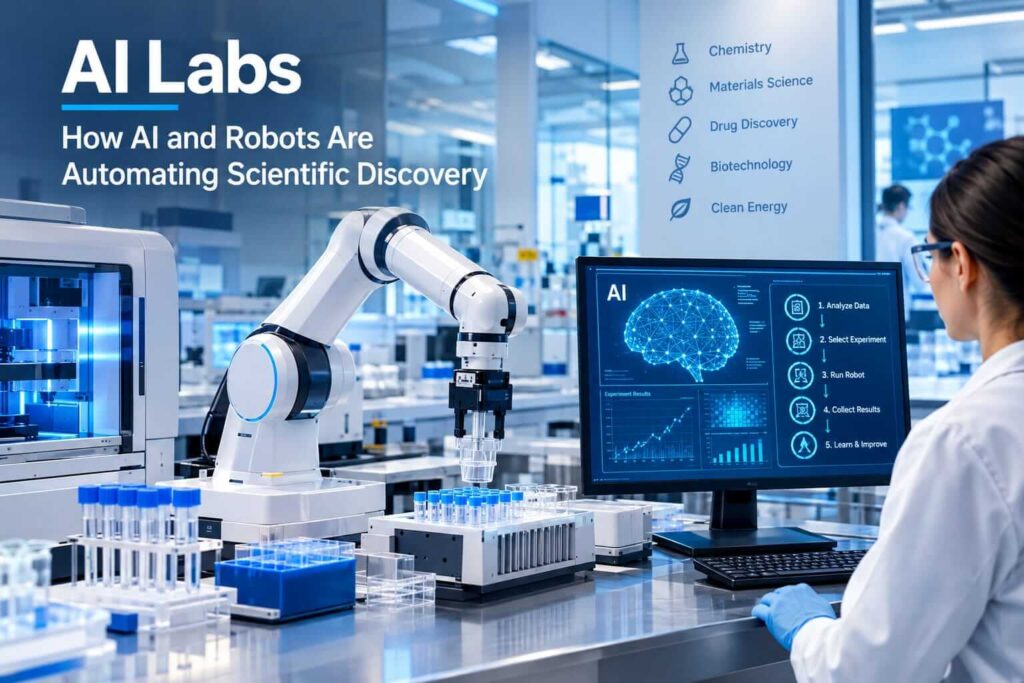
Imagine a laboratory where an AI system studies previous results, selects a promising experiment, and sends instructions to robotic equipment. The robots prepare samples and operate instruments. The resulting data is then analyzed automatically, and the system uses that information to decide what experiment should happen next.
This approach is often associated with self-driving laboratories or autonomous laboratories.
The goal is not simply to make experiments faster. AI Labs can help researchers explore thousands of possibilities, reduce repetitive work, use materials more efficiently, and discover promising solutions in complex scientific problems.
So, how do AI Labs work, and could they change the future of scientific discovery?
Table of Contents
- · What Are AI Labs?
- · Why AI Labs Matter
- · How AI and Robots Work Together
- · How an AI Lab Works Step by Step
- · Where AI Labs Are Being Used
- · Benefits of AI Labs
- · Challenges and Limitations
- · Common Mistakes to Avoid
- · Practical AI Lab Checklist
- · The Future of AI Labs
- · FAQ
- · Conclusion
What Are AI Labs?
AI Labs are research environments that use artificial intelligence alongside laboratory automation, robotics, scientific instruments, and data systems.
They can range from laboratories with a few automated processes to highly autonomous facilities capable of planning and performing experimental cycles with limited human intervention.
Traditional scientific research often follows a familiar process:
1. A scientist develops a hypothesis.
2. An experiment is designed.
3. Samples are prepared.
4. Laboratory equipment performs the experiment.
5. Results are collected.
6. Data is analyzed.
7. The scientist chooses the next experiment.
AI-powered laboratories can connect many of these steps.
An AI system can examine experimental data and recommend what should be tested next. Robotic equipment can then perform the physical work. New results return to the AI system, creating a continuous feedback loop.
This is one of the key ideas behind self-driving laboratories: design, make, test, analyze, and repeat.
NIST describes autonomous laboratories as systems that can use algorithms to select samples and experiments within a feedback loop designed to improve the information gained from experimentation.
Why AI Labs Matter
Scientific discovery can involve enormous numbers of possible combinations.
Consider the development of a new material. Researchers may need to investigate different:
- · Chemical compositions
- · Temperatures
- · Pressures
- · Concentrations
- · Reaction times
- · Manufacturing conditions
- · Processing techniques
Testing every possibility manually could take years.
AI can help researchers narrow the search.
Instead of choosing experiments randomly, machine-learning algorithms can examine existing data and identify experiments that could provide valuable information.
This makes AI Labs particularly interesting for fields where researchers must search through large experimental spaces.
For example, scientists working on batteries may need to investigate many material combinations. Researchers developing catalysts may need to compare numerous chemical conditions. Pharmaceutical scientists may need to evaluate different compounds and experimental conditions.
In these situations, AI can help decide which experiment should come next.
How AI and Robots Work Together
AI is only one component of an autonomous research environment.
The real advantage comes from combining several technologies.
Artificial Intelligence
AI analyzes experimental information and helps identify patterns.
Depending on the system, machine-learning models can:
· Predict experimental outcomes
· Identify promising conditions
· Analyze large datasets
· Optimize experiments
· Recommend the next experiment
· Detect unusual results
Some systems use methods such as Bayesian optimization or active learning to decide which experiment could be most useful.
Robotics
Robots perform physical laboratory tasks.
These can include:
· Moving samples
· Dispensing liquids
· Mixing substances
· Preparing plates
· Transferring materials
· Operating instruments
· Repeating laboratory procedures
Automation is particularly valuable for repetitive tasks that require consistency.
Scientific Instruments
Automated laboratories also depend on instruments that measure experimental results.
Depending on the research area, instruments may measure chemical, physical, biological, optical, electrical, or mechanical properties.
Data Systems
Every experiment produces information.
AI Labs therefore require reliable systems for collecting, storing, organizing, and interpreting data.
Without good data infrastructure, even an advanced AI model can produce unreliable results.
NIST has highlighted interoperability, data management, instrument communication, and sample management as important areas for developing autonomous laboratory systems.
How an AI Lab Works Step by Step
1. Define the Scientific Goal
Everything begins with a clear research objective.
For example:
«Find a material that provides high performance while using less energy and lower-cost components.»
The AI system needs a measurable objective before it can optimize experiments.
2. Provide Initial Data
The system may begin with existing scientific literature, historical experiments, simulations, databases, or a small number of laboratory experiments.
This gives the AI a starting point.
. Select an Experiment
The AI analyzes available information and chooses experimental conditions.
The decision may be based on predicted performance, uncertainty, cost, or the potential amount of new information an experiment could provide.
1. Robots Perform the Experiment
Robotic systems prepare samples and interact with laboratory equipment.
The exact process depends on the scientific application.
1. Collect Experimental Data
Sensors and scientific instruments measure the results.
The data is then transferred to the laboratory’s software system.
1. Analyze the Results
AI models examine the new information and update their understanding of the problem.
An unexpected result can also become valuable information.
1. Select the Next Experiment
The system uses the updated information to choose another experiment.
The process continues as a closed loop:
Plan → Experiment → Measure → Learn → Repeat
That feedback loop is what separates autonomous experimentation from simple laboratory automation
Where AI Labs Are Being Used
Chemistry
Chemistry is one of the most active areas for autonomous experimentation.
AI Labs can investigate reaction conditions and help researchers identify combinations that may improve yield, selectivity, or other desired properties.
This can be useful when a chemical reaction has many variables.
Materials Science
Materials research often involves searching through large design spaces.
AI-powered experimentation can support research into:
· Batteries
· Solar materials
· Catalysts
· Polymers
· Electronics
· Advanced manufacturing materials
Drug Discovery
AI and automation are also being explored in pharmaceutical research.
Automated systems can help researchers evaluate compounds, optimize experimental conditions, and process large amounts of scientific information.
However, AI-generated predictions still require laboratory validation and careful scientific review.
Biotechnology
Biological experiments can involve many variables and large datasets.
Automation can help researchers perform repeatable experimental procedures while AI assists with data analysis and experimental planning.
Clean Energy
Energy research is another promising area.
Researchers developing batteries, solar technologies, fuel cells, and catalysts may need to evaluate large numbers of material combinations.
AI-driven experimentation can help prioritize promising possibilities.
Benefits of AI Labs
Faster Research Cycles
Robots can perform repetitive procedures continuously and consistently.
This can allow laboratories to conduct more experiments within a given period.
More Efficient Use of Resources
Automated systems can perform small-scale experiments and potentially reduce unnecessary use of chemicals, samples, and other materials.
That can be especially valuable when research materials are expensive or difficult to obtain.
Data-Driven Experiment Selection
Traditional research often depends heavily on scientific experience when selecting the next experiment.
AI provides another tool.
It can analyze previous results and identify experimental conditions that deserve further investigation.
Greater Reproducibility
Automation can reduce certain forms of human variation.
For example, a robotic system can dispense the same volume under controlled conditions repeatedly.
However, automation does not automatically guarantee reproducibility. Calibration, experimental design, equipment quality, and data management remain important.
Exploration of Complex Problems
Some scientific problems contain too many possible combinations for humans to test individually.
AI can help researchers search these large experimental spaces more efficiently.
Challenges and Limitations of AI Labs
AI Labs have significant potential, but they also present important challenges.
High Initial Costs
Advanced robotic equipment, laboratory instruments, software, sensors, and integration systems can require substantial investment.
Therefore, organizations need to consider whether automation will provide enough scientific or operational value.
Hardware Integration
Laboratory equipment is often produced by different manufacturers and may use different software systems.
Connecting these instruments can be technically challenging.
Standardization and interoperability are therefore important for scaling autonomous laboratories.
Data Quality
AI depends on reliable data.
If measurements contain errors or experimental procedures are inconsistent, the AI may learn from inaccurate information.
A sophisticated model cannot compensate for fundamentally poor data.
Safety
Autonomous laboratories can potentially handle chemicals, biological materials, high temperatures, pressure, or other hazards.
Safety systems must therefore be integrated into the entire workflow.
Researchers have emphasized the importance of safety considerations as self-driving laboratories become more capable.
Human Oversight
AI Labs do not eliminate the need for scientists.
Researchers still need to define objectives, supervise systems, evaluate unusual findings, interpret results, and make important scientific decisions.
Human oversight is especially important when experiments involve safety risks or unexpected outcomes
Common Mistakes to Avoid
Automating Everything Immediately
Not every laboratory task needs automation.
Start with repetitive, well-defined processes where automation can provide measurable benefits.
Ignoring Data Management
An AI system is only as useful as the information it receives.
Create clear standards for collecting, storing, labeling, and validating experimental data.
Treating AI Predictions as Facts
AI generates predictions.
Those predictions still need experimental validation.
A model can identify a promising possibility, but the laboratory must determine whether the prediction is actually correct.
Removing Human Review
Unexpected results can sometimes lead to important discoveries.
Researchers should remain involved in interpreting unusual or scientifically significant findings.
Measuring Only Speed
A laboratory should not judge success only by the number of experiments completed.
Other factors matter, including:
· Accuracy
· Reproducibility
· Cost
· Safety
· Material consumption
· Scientific value
· Quality of data
Practical AI Lab Checklist
Before introducing AI-powered automation, consider these questions:
- Is the scientific objective clearly defined?
- Can the experimental procedure be standardized?
- Are compatible laboratory instruments available?
- Can the instruments communicate with the software?
- Is experimental data organized consistently?
- Are safety controls available?
- Can experiments be stopped automatically?
- Is human oversight included?
- Can results be independently validated?
- Are success metrics clearly defined?
This checklist can help organizations build an automation strategy based on scientific needs rather than technology alone.
The Future of AI Labs
The future of AI Labs will likely involve deeper integration between artificial intelligence, robotics, scientific databases, simulation tools, and laboratory instruments.
Researchers are already exploring systems that can perform increasingly sophisticated experimental workflows.
Future laboratories may combine:
· AI research agents
· Robotic laboratory equipment
· Computer vision
· Digital twins
· Automated literature analysis
· Scientific databases
· Cloud laboratory platforms
· Simulation and modeling
· Real-time optimization
The result could be a new model of scientific research.
Instead of spending most of their time manually repeating experiments, scientists could increasingly focus on asking important questions, designing research strategies, interpreting unexpected findings, and validating discoveries.
This does not mean machines will independently understand science in the same way humans do.
Rather, AI and robotics can become powerful research partners.
AI Labs and the Future of Scientific Discovery
One of the most interesting possibilities is the ability to connect scientific knowledge with physical experimentation.
An AI system could analyze previous research, identify a scientific gap, propose a hypothesis, and help design an experiment. Robots could then perform the experiment, while instruments collect the results.
The new evidence could return to the AI system and influence the next research step.
This creates a much tighter connection between knowledge, experimentation, and learning.
In the long term, such systems could help researchers investigate scientific problems that are difficult to explore using traditional methods alone.
However, responsible development will be essential.
Safety, transparency, data quality, reproducibility, interoperability, and human oversight should remain central as autonomous laboratory technologies become more advanced.
CTA: Explore the Future of AI and Science
The combination of artificial intelligence, robotics, and laboratory automation is opening a new chapter in scientific research.
Whether you are a researcher, technology professional, student, business owner, or science enthusiast, understanding AI Labs can help you follow one of the most important developments in modern scientific discovery.
Explore Future Science AI for more practical guides on artificial intelligence, robotics, quantum technology, space science, clean energy, and emerging technologies.
Stay curious, keep learning, and discover how AI is helping scientists explore what comes next.
FAQ
Q1.What are AI Labs?
AI Labs are research environments that combine artificial intelligence with laboratory automation, robotics, scientific instruments, and data analysis to improve experimentation and scientific discovery.
Q2.How do AI Labs work?
AI Labs can analyze existing experimental data, select promising experiments, direct robotic equipment to perform them, analyze the results, and use those results to choose subsequent experiments.
Q3.Are AI Labs the same as self-driving laboratories?
The terms can overlap. Self-driving laboratories generally refer to laboratories capable of autonomous experimental cycles. AI Labs is a broader term that can describe research laboratories using AI for experimentation, analysis, automation, or decision-making.
Q4.Can AI Labs replace scientists?
AI Labs are not designed simply to replace scientists. Instead, they can automate repetitive experimental work and assist researchers with data analysis and experiment selection. Scientists remain important for research goals, interpretation, validation, safety, and decision-making.
Q5.Which industries can benefit from AI Labs?
Potential applications include chemistry, materials science, pharmaceuticals, biotechnology, clean energy, catalysis, advanced manufacturing, and other research-intensive fields where many experiments must be evaluated.
Conclusion
AI Labs are transforming the traditional laboratory by connecting artificial intelligence, roboticsautomation, scientific instruments, and data analysis.
Instead of treating every experiment as an isolated task, AI-powered laboratories can create continuous feedback loops in which machines perform experiments, analyze results, learn from new information, and help select what should happen next.
The technology has potential applications across chemistry, materials science, biotechnology, pharmaceuticals, and clean energy. At the same time, challenges involving cost, data qua