The Future of Weather Prediction Using AI
Introduction
AI Weather Prediction is transforming the way scientists forecast weather, monitor climate patterns, and prepare for natural disasters. Traditional forecasting methods have improved significantly over the decades. However, growing climate complexity and extreme weather events require more advanced solutions.
Today, artificial intelligence, machine learning, and predictive analytics are helping meteorologists analyze massive amounts of weather data faster than ever before. As a result, forecasts are becoming more accurate, timely, and reliable.
In this article, we will explore how AI weather prediction works, why it matters, its benefits, challenges, and what the future may hold for weather forecasting around the world.
Table of Contents
1. Introduction
2. Why AI Weather Prediction Matters
3. How AI Weather Prediction Works
4. Technologies Behind AI Forecasting
5. Benefits of AI Weather Prediction
6. Best Practices for AI-Powered Forecasting
7. Common Mistakes to Avoid
8. Practical Checklist
9. Call to Action
10. FAQ Section
11. Conclusion
Why AI Weather Prediction Matters
Weather affects nearly every aspect of life. From agriculture and transportation to energy production and emergency planning, accurate forecasts help people make informed decisions.
However, climate change has increased the frequency of:
- Heatwaves
- Floods
- Hurricanes
- Wildfires
- Severe storms
Consequently, traditional forecasting models often struggle to process the growing volume of environmental data efficiently.
AI helps solve this challenge by identifying patterns that humans and conventional systems may miss.
Growing Need for Accurate Forecasts
Businesses, governments, and communities rely on weather forecasts to reduce risks and improve planning. Therefore, even small improvements in forecast accuracy can save lives and billions of dollars annually.
How AI Weather Prediction Works
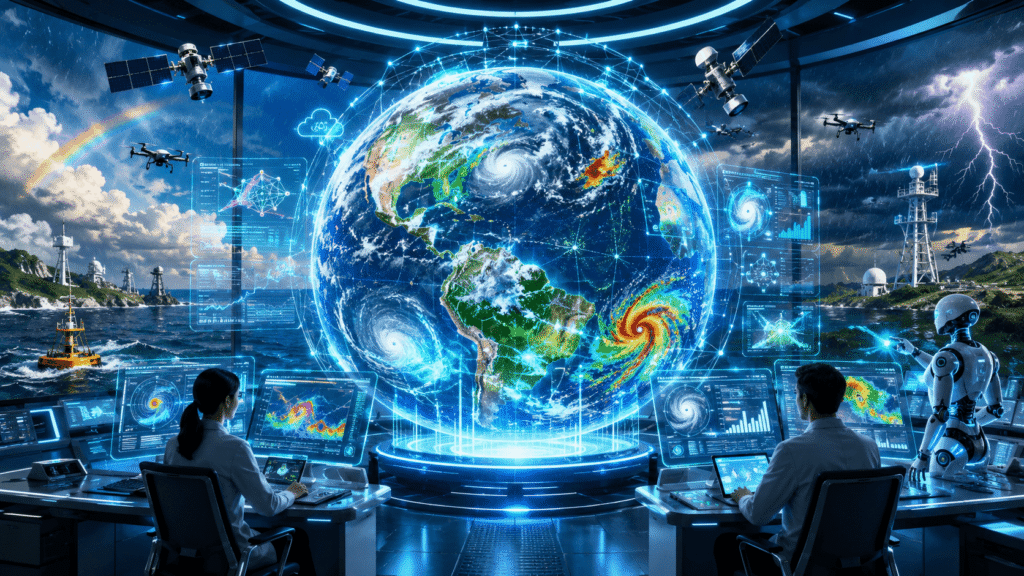
AI weather prediction combines machine learning algorithms, satellite imagery, historical weather records, and real-time sensor data.
Instead of relying solely on physics-based calculations, AI learns from past weather events and continuously improves its predictions.
Data Collection
AI systems gather information from:
- Satellites
- Weather stations
- Ocean buoys
- Aircraft sensors
- Radar systems
- IoT weather devices
This data provides a comprehensive picture of atmospheric conditions.
Pattern Recognition
Machine learning models analyze years of historical weather information.
For example, AI can identify patterns associated with:
- Storm development
- Rainfall intensity
- Temperature shifts
- Wind behavior
As a result, forecasting systems become faster and more adaptive.
Prediction Generation
Once patterns are identified, AI generates weather forecasts based on current environmental conditions.
Modern AI systems can often produce forecasts within minutes rather than hours.
Technologies Powering AI Weather Prediction
Several advanced technologies support AI-driven forecasting systems.
Machine Learning
Machine learning enables computers to learn from historical weather data without being explicitly programmed.
It continuously improves forecast accuracy over time.
Deep Learning
Deep learning models process enormous datasets and recognize highly complex weather relationships.
These models are particularly effective for:
- Storm tracking
- Rainfall forecasting
- Hurricane prediction
Satellite Imaging
AI can analyze millions of satellite images rapidly.
Therefore, meteorologists gain real-time insights into cloud formations and atmospheric changes.
Big Data Analytics
Weather systems generate massive amounts of information daily.
AI-powered analytics platforms process this information efficiently and uncover valuable forecasting insights.
Benefits of AI Weather Prediction
AI is creating significant improvements across multiple industries.
AI Weather PredictionImproved Forecast Accuracy
One of the biggest advantages is higher accuracy.
AI models can detect subtle patterns that traditional systems may overlook.
Therefore, forecasts become more dependable.
AI Weather Prediction Faster Weather Analysis
Traditional models require extensive computing power and time.
AI accelerates the forecasting process and delivers faster results.
Better Disaster Preparedness
Early warnings help communities prepare for:
- Hurricanes
- Floods
- Tornadoes
- Wildfires
As a result, emergency response teams can act sooner.
Support for Agriculture
Farmers use weather forecasts to:
- Schedule irrigation
- Protect crops
- Improve harvest planning
- Accurate predictions reduce financial risks.
Smarter Energy Management
Renewable energy systems depend heavily on weather conditions.
AI helps forecast:
- Solar energy production
- Wind energy output
- Electricity demand
AI Weather Prediction and Climate Change
Climate change introduces new forecasting challenges.
Historical weather patterns are becoming less predictable. Consequently, meteorologists require more adaptive forecasting systems.
AI can analyze:
- Long-term climate trends
- Ocean temperature changes
- Carbon emissions impacts
- Extreme weather behavior
This helps researchers understand future climate risks more effectively.
Supporting Environmental Research
Scientists increasingly use AI to model climate scenarios.
These insights help governments develop sustainability strategies and climate adaptation plans.
This process helps improve model reliability over time.
Common Mistakes to Avoid
Despite its advantages, AI weather prediction is not perfect.
Avoid these common mistakes:
Relying Solely on AI Weather Prediction
Human oversight remains important.
Combining AI insights with expert analysis often delivers the best results.
Ignoring Data Quality Issues
Poor-quality data leads to poor forecasts.
Always verify data sources.
Overestimating Forecast Certainty
Weather remains inherently complex.
Therefore, forecasts should always include confidence levels and uncertainty estimates.
Neglecting Local Conditions
Regional geography can influence weather significantly.
Local expertise should complement AI-generated predictions.
Practical Checklist for AI Weather Prediction
Use this checklist when evaluating AI forecasting solutions:
✔️ Access to real-time weather data
✔️ Machine learning capabilities
✔️ Satellite data integration
✔️ Climate trend analysis
✔️ Forecast accuracy monitoring
✔️ Human expert review
✔️ Continuous model updates
✔️ Disaster warning support
✔️ Scalability for future growth
✔️ Reliable data security measures
Ready to Explore the Future of AI?
Artificial intelligence is rapidly transforming weather forecasting and climate analysis.
If you enjoy learning about emerging technologies, climate science, artificial intelligence, and future innovations, explore more expert articles on Future Science AI.
Stay informed about the technologies shaping tomorrow and discover how AI continues to revolutionize industries around the world.
Frequently Asked Questions
Q1: What is AI Weather Prediction?
AI Weather Prediction uses artificial intelligence and machine learning to analyze weather data and generate more accurate forecasts.
Q2: Is AI more accurate than traditional weather forecasting?
In many situations, AI can improve forecast accuracy by identifying patterns that traditional models may miss.
Q3: How does AI help during natural disasters?
AI provides earlier warnings and better risk assessments for hurricanes, floods, wildfires, and severe storms.
Q4: Can AI predict climate change effects?
AI can analyze climate trends and model future scenarios, helping researchers understand potential environmental impacts.
Q5: Which industries benefit from AI weather forecasting?
Agriculture, transportation, energy, insurance, logistics, aviation, and emergency management all benefit from improved weather forecasts.
Conclusion
The future of AI Weather Prediction looks incredibly promising. As machine learning, deep learning, and big data technologies continue to evolve, weather forecasts will become increasingly accurate and actionable.
Moreover, AI is helping scientists respond to climate challenges, improve disaster preparedness, and support critical industries worldwide. While human expertise remains essential, AI-powered forecasting tools are becoming valuable partners in understanding our changing planet.
Organizations, governments, and individuals who embrace AI weather prediction today will be better prepared for the opportunities and challenges of tomorrow.