
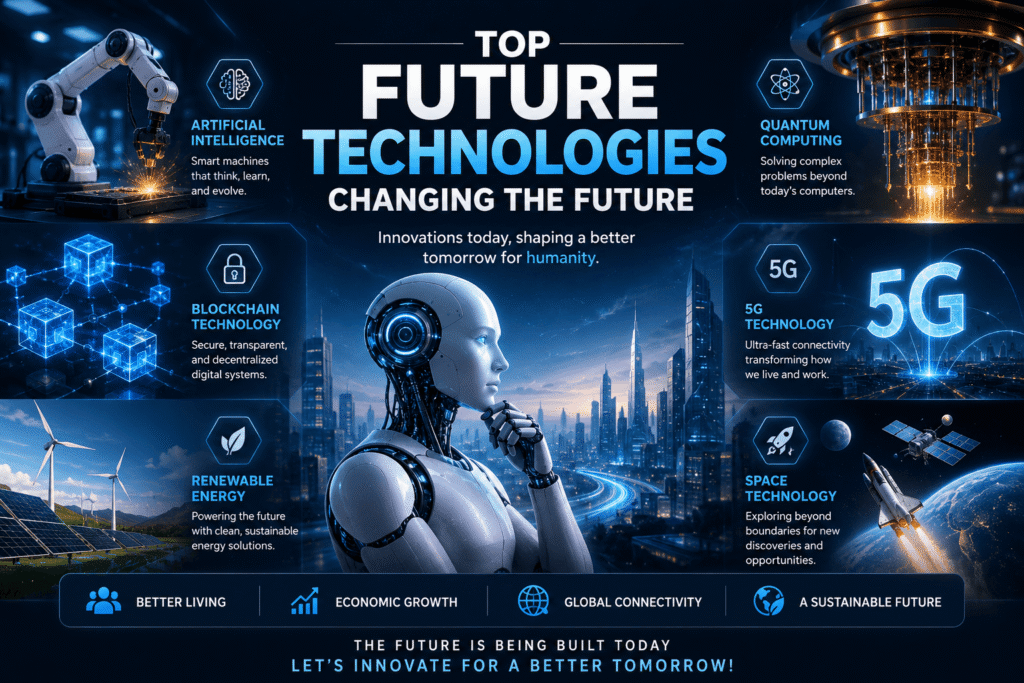
Top Future Technologies That Will Change the World
Introduction
The world is evolving faster than ever, driven by groundbreaking innovations that are reshaping industries, economies, and daily life. From artificial intelligence to quantum computing, the top future technologies are creating opportunities that were once considered science fiction.
Businesses, governments, and individuals are investing heavily in emerging technologies to stay competitive in a rapidly changing digital landscape. Understanding these innovations today can help you prepare for tomorrow’s opportunities and challenges.
Whether you are a student, entrepreneur, business leader, or technology enthusiast, knowing which technologies are expected to transform the future can provide valuable insights into where the world is heading.
Table of Contents
1. Introduction
2. Why Future Technologies Matter
3. Top 10 Future Technologies That Will Change the World
4. Benefits of Emerging Technologies
5. Best Practices for Adopting Future Technologies
6. Common Mistakes to Avoid
7. Practical Future Technology Checklist
8. Call to Action
9. FAQ
10. Conclusion
Why Future Technologies Matter
Technology influences nearly every aspect of modern life. The next generation of innovations will impact healthcare, education, transportation, communication, energy production, and business operations.
Key reasons why future technologies matter include:
- Increased productivity and efficiency
- Improved healthcare outcomes
- Enhanced sustainability efforts
- Better decision-making through data analysis
- New business opportunities and markets
- Improved quality of life
- Organizations that embrace innovation early often gain significant competitive advantages.
Top 10 Future Technologies That Will Change the World
1. Artificial Intelligence (AI)
Artificial Intelligence continues to lead technological transformation worldwide.
AI systems can analyze large datasets, automate repetitive tasks, generate content, assist in customer service, and support complex decision-making.
Examples include:
- AI-powered virtual assistants
- Medical diagnosis tools
- Fraud detection systems
- Autonomous vehicles
- Generative AI platforms
2. Quantum Computing
Quantum computing has the potential to solve complex problems that traditional computers cannot handle efficiently.
Unlike classical computers, quantum computers use qubits, enabling them to process enormous amounts of information simultaneously.
Potential applications include:
- Drug discovery
- Financial modeling
- Climate simulations
- Cybersecurity improvements
3. Internet of Things (IoT)
The Internet of Things connects devices, sensors, and systems through the internet.
Smart devices collect and exchange data in real time, creating more efficient environments.
Examples include:
- Smart homes
- Connected healthcare devices
- Smart factories
- Intelligent transportation systems
4. Biotechnology and Genetic Engineering
Advancements in biotechnology are transforming healthcare and agriculture.
Scientists can now edit genes, develop personalized treatments, and improve crop production through innovative genetic technologies.
Major benefits include:
- Disease prevention
- Precision medicine
- Improved food security
- Faster drug development
5. Renewable Energy Technology
The demand for sustainable energy solutions continues to grow globally.
Future energy innovations include:
- Advanced solar panels
- Offshore wind farms
- Energy storage systems
- Green hydrogen production
These technologies can help reduce carbon emissions and support long-term environmental sustainability.
6. Autonomous Vehicles
Self-driving vehicles use AI, sensors, and machine learning to navigate roads with minimal human intervention.
Potential benefits include:
- Reduced accidents
- Improved traffic management
- Greater accessibility
- Lower transportation costs
While fully autonomous transportation remains under development, significant progress continues worldwide.
7. Augmented Reality (AR) and Virtual Reality (VR)
AR and VR technologies are changing how people learn, work, and interact.
Applications include:
- Virtual training programs
- Remote collaboration
- Gaming and entertainment
- Product visualization
- Education and healthcare simulations
Businesses increasingly use immersive experiences to engage customers and improve workforce training.
8. Smart Cities Technology
Urban populations are growing rapidly, increasing the need for smarter infrastructure.
Smart cities use connected technologies to optimize:
- Traffic management
- Energy consumption
- Waste collection
- Public safety
- Water management
These solutions improve sustainability and enhance residents’ quality of life.
9. Robotics and Automation
Robotics is becoming more sophisticated and capable of handling complex tasks.
Industries benefiting from automation include:
- Manufacturing
- Healthcare
- Logistics
- Agriculture
- Retail
Future robots will increasingly collaborate with humans rather than simply replacing manual labor.
10. Space Technology
The space industry is entering a new era of innovation.
Emerging developments include:
- Commercial space travel
- Satellite internet systems
- Lunar exploration missions
- Space-based manufacturing
Space technology is expected to create new industries and unlock valuable scientific discoveries.
Benefits of Future Technologies
Increased Efficiency
Automation and intelligent systems streamline operations and reduce manual work.
Better Healthcare
Advanced diagnostics, personalized medicine, and remote monitoring improve patient outcomes.
Economic Growth
New technologies create jobs, industries, and investment opportunities.
Environmental Sustainability
Clean energy and smart resource management support environmental goals.
Enhanced User Experiences
Consumers benefit from faster services, personalized recommendations, and improved convenience.
Best Practices for Adopting Future Technologies
- Evaluate Business Needs
- Identify which technologies align with your goals before investing.
- Invest in Skills Development
- Provide training to help teams adapt to new systems.
- Start Small
- Pilot projects allow organizations to test technologies before large-scale deployment.
- Focus on Security
- Protect sensitive data and ensure compliance with regulations.
- Monitor Industry Trends
- Stay informed about emerging innovations and market developments.
Common Mistakes to Avoid
Many organizations struggle with technology implementation because of avoidable errors.
Common mistakes include:
- Adopting technology without a clear strategy
- Ignoring cybersecurity risks
- Underestimating training requirements
- Failing to measure results
- Expecting immediate returns on investment
- Avoiding these pitfalls increases the likelihood of successful technology adoption.
Practical Future Technology Checklist
Use this checklist to prepare for emerging technologies:
- Monitor industry technology trends
- Identify opportunities for innovation
- Develop a digital transformation strategy
- Invest in employee training
- Strengthen cybersecurity measures
- Evaluate technology vendors carefully
- Test solutions before full deployment
- Track performance metrics
- Stay informed about regulations
- Continuously adapt and improve
Ready to Prepare for the Future?
The pace of innovation is accelerating, and organizations that understand future technologies today will be better positioned for tomorrow’s opportunities.
Whether you are exploring artificial intelligence, quantum computing, renewable energy, or smart city innovations, staying informed is essential.
Want to learn more about future technologies and digital innovation? Contact Future Science AI today for expert insights, educational resources, and technology-focused content that helps you stay ahead of the curve.
Frequently Asked Questions (FAQ)
Q1:What are future technologies?
Future technologies are emerging innovations expected to significantly impact industries, society, and daily life in the coming years.
Q2:Which future technology has the biggest potential?
Artificial Intelligence is widely considered one of the most transformative technologies due to its applications across nearly every industry.
Q3:Why is quantum computing important?
Quantum computing can solve highly complex problems much faster than traditional computers, enabling breakthroughs in science and business.
Q4:How will future technologies affect jobs?
Many routine tasks may become automated, but new jobs and industries will also emerge, creating opportunities for skilled workers.
Q5:How can businesses prepare for future technologies?
Businesses should invest in digital transformation, employee training, cybersecurity, and continuous innovation to remain competitive.
Conclusion
The top future technologies discussed in this article are poised to transform industries, redefine economies, and shape the way we live and work. From artificial intelligence and quantum computing to renewable energy and smart cities, these innovations offer enormous potential for growth and progress.
Organizations and individuals who stay informed, develop relevant skills, and embrace innovation will be better equipped to succeed in an increasingly technology-driven world. The future is not just coming—it is already being built today.