AI + Robotics: How Artificial Intelligence Is Transforming Robots
Introduction
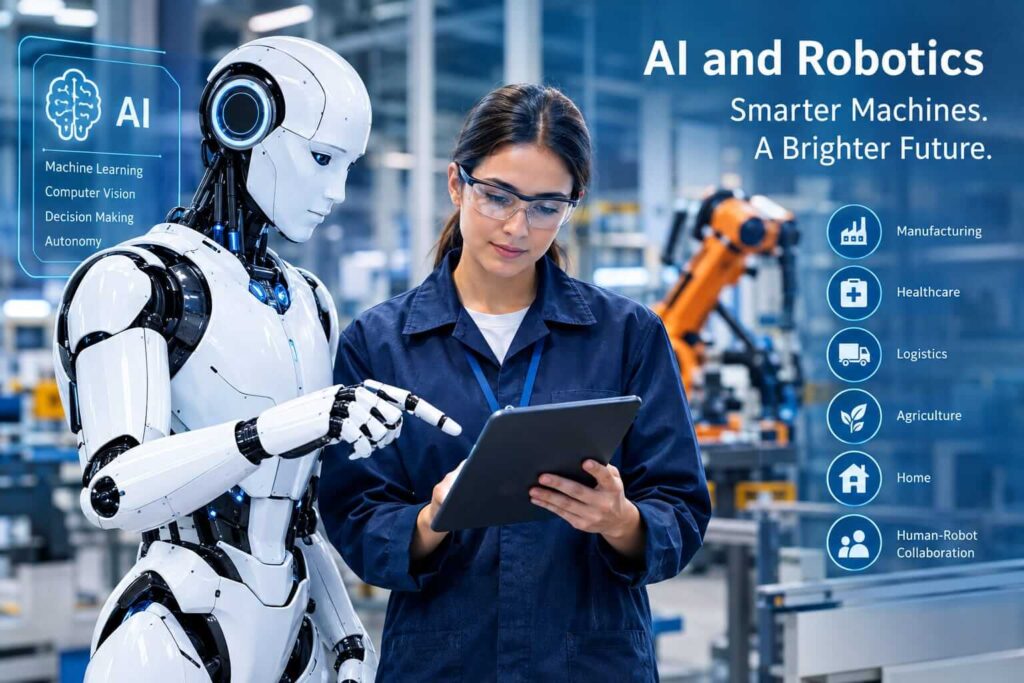
AI and robotics are becoming one of the most important technology combinations of the modern era. Robots were once designed mainly to repeat carefully programmed movements. Today, artificial intelligence can help robots interpret images, understand environments, learn from data, make decisions, and adapt to changing situations.
This shift is creating a new generation of AI-powered robots that can operate in factories, warehouses, hospitals, laboratories, farms, and even homes.
The goal is not simply to make robots move faster. It is to make them more useful, flexible, and capable of working alongside people.
As AI models become more powerful, robotics is moving from fixed automation toward intelligent machines that can perceive their surroundings and respond to real-world situations.
Table of Contents
1. What Is AI and Robotics?
2. Why AI Is Changing Robotics
3. How AI-Powered Robots Work
4. Major Applications of AI and Robotics
5. Benefits of AI in Robotics
6. AI Robotics and the Future of Work
7. Challenges and Risks
8. Best Practices for Adopting AI Robotics
9. Common Mistakes to Avoid
10. Practical AI Robotics Checklist
11. FAQ
12. Conclusion
What Is AI and Robotics?
AI and robotics combine artificial intelligence software with physical machines that can sense, move, interact with, and respond to the world.
Traditional robots generally follow predefined instructions. For example, an industrial robot might move an object from one location to another thousands of times.
An AI-powered robot can go further.
It may use cameras and sensors to identify objects, AI models to understand what it sees, and algorithms to determine what action should happen next.
In simple terms:
Robotics gives AI a physical body, while AI gives robots greater intelligence and adaptability.
This idea is closely related to physical AI and embodied intelligence, where AI systems interact directly with the physical world.
NIST is actively researching physical AI and AI-enabled robotics, including perception, manipulation, performance monitoring, and methods for evaluating real-world robotic systems.
Why AI Is Changing Robotics
For decades, robots were extremely useful but often limited by their programming.
A robot could perform a task accurately when the environment stayed predictable. However, unexpected situations could require human intervention.
AI is helping change this model.
From programmed movements to intelligent decisions
Machine learning allows robots to identify patterns in large amounts of data.
Computer vision can help robots recognize objects, surfaces, people, and changes in their surroundings.
Natural language technologies can help robots understand human instructions.
Meanwhile, newer AI approaches can support planning and more flexible decision-making.
The International Federation of Robotics identified AI and autonomy as a major robotics trend for 2026, highlighting applications such as predictive maintenance, path planning, resource allocation, and more autonomous operation.
This means the future robot may not need every possible situation programmed manually.
Instead, it could use AI to interpret a situation and select an appropriate response.
How AI-Powered Robots Work
An intelligent robot usually combines several technologies.
1. Sensors
Sensors allow robots to collect information about their surroundings.
These can include:
- Cameras
- Depth sensors
- Force sensors
- Touch sensors
- LiDAR
- Microphones
- Position sensors
Without reliable sensing, a robot has limited awareness of the physical environment.
2. Computer Vision
Computer vision allows robots to process visual information.
For example, a warehouse robot could identify a particular package among hundreds of boxes.
In manufacturing, computer vision can help identify defects, inspect products, read labels, and guide robotic movements. The International Federation of Robotics specifically highlights computer vision and deep learning as important technologies for AI-enabled industrial robotics.
3. Machine Learning
Machine learning enables systems to identify patterns from data.
A robot could use previous information to improve tasks such as object recognition, navigation, inspection, or predictive maintenance.
4. AI Planning
A robot needs more than perception. It must also decide what to do.
AI planning can help a robot determine which actions are necessary to complete a task.
For example, instead of simply being told to “move this box,” an intelligent system could determine how to locate the box, approach it, grasp it, transport it, and place it safely.
5. Actuators and Control Systems
Finally, the robot must physically perform the selected action.
Motors, robotic arms, wheels, grippers, and other mechanisms turn AI decisions into physical movement.
The complete system therefore works like a loop:
Sense → Understand → Plan → Act → Evaluate
This cycle is one of the foundations of intelligent robotics.
Major Applications of AI and Robotics
AI robotics is not limited to humanoid robots. It is already relevant to many industries.
AI Robotics in Manufacturing
Factories are among the most important applications.
AI-powered robotic systems can support:
- Assembly
- Quality inspection
- Machine tending
- Material handling
- Predictive maintenance
- Packaging
- Welding
- Sorting
NIST notes that modern manufacturing automation can improve productivity, consistency, safety, and production capacity while allowing workers to focus on higher-value activities.
AI Robotics in Warehouses
Modern warehouses increasingly depend on automation.
Robots can move inventory, sort products, transport packages, and support order fulfillment.
AI makes these systems more flexible because robots can respond to changing layouts, traffic, inventory requirements, and operational conditions.
AI in Healthcare Robotics
Healthcare is another promising area.
Robotic systems can support:
- Rehabilitation
- Medical logistics
- Laboratory automation
- Assistive technologies
- Surgical systems
- Patient-support applications
However, healthcare robotics requires particularly strong testing, reliability, cybersecurity, and human oversight.
AI Robotics in Agriculture
Agricultural robots could help farmers monitor crops, identify weeds, inspect plants, and perform repetitive field tasks.
Computer vision can identify differences between healthy and unhealthy plants, while autonomous systems can navigate agricultural environments.
AI Robots in Homes
Consumer robotics is also developing.
Future household robots could potentially assist with:
- Cleaning
- Object retrieval
- Home monitoring
- Elderly assistance
- Routine household tasks
However, general-purpose home robots remain technically challenging because homes are unpredictable environments.
Benefits of AI and Robotics
The combination of AI and robotics can provide several important advantages.
Greater Productivity
Robots can operate for long periods and perform repetitive tasks consistently.
AI can make those robots more adaptable.
Improved Accuracy
Computer vision and sensor-based systems can help robots perform precise inspections and movements.
Better Workplace Safety
Robots can take on certain dangerous, repetitive, or physically demanding tasks.
This can reduce exposure to hazardous environments.
Greater Flexibility
Traditional automation can struggle when products or environments change.
AI can potentially make robotic systems easier to adapt.
Better Decision-Making
AI can analyze large amounts of operational information and help robotic systems respond to changing conditions.
However, these benefits depend on good system design, reliable data, appropriate testing, and effective human oversight.
AI and Robotics: The Future of Work
https://eleks.com/expert-opinion/future-ai-robotics/
One of the biggest questions is whether robots will replace humans.
The reality is more complicated.
In many workplaces, AI robotics is more likely to change jobs than simply eliminate every human role.
For example, a worker who previously spent hours moving heavy materials could instead supervise automated systems, solve problems, maintain equipment, or manage quality.
This creates demand for new skills.
Workers may increasingly need knowledge of:
- Robotics operation
- AI system monitoring
- Data analysis
- Automation
- Equipment maintenance
- Safety procedures
- Human-machine collaboration
The future workplace could therefore involve humans and robots working as teams.
NIST research specifically focuses on making robots adaptable, easier to task, and safer when operating alongside people
Challenges of AI Robotics
Despite rapid progress, intelligent robots still face major challenges.
Safety
A physical AI system can affect the real world.
A mistake made by software can therefore become a physical accident.
Robots operating around humans need careful testing and safety mechanisms.
Reliability
AI systems can make incorrect predictions or interpretations.
Robotic systems must therefore be designed to handle uncertainty.
Data Requirements
Machine learning systems often require large amounts of useful data.
Collecting high-quality physical-world data can be expensive and difficult.
Cost
Advanced robots can require significant investment in hardware, software, integration, maintenance, and training.
Cybersecurity
Connected robots can become potential cybersecurity targets.
Organizations must protect robotic systems, networks, software, and operational data.
Human Trust
People need to understand when and why an intelligent robot makes decisions.
This becomes particularly important in healthcare, manufacturing, transportation, and other high-stakes environments.
NIST emphasizes that trustworthy, explainable, reliable, and safe AI operation remains an important challenge for smart manufacturing.
Best Practices for Adopting AI Robotics
https://futurescienceai.com/blog/artificial-intelligence/ai-agents-vs-traditional-ai/
Businesses considering robotic automation should avoid rushing directly into expensive technology.
Step 1: Identify the Problem
Start with a specific business problem.
For example:
“Employees spend too much time moving materials.”
This is more useful than simply saying:
“We need an AI robot.”
Step 2: Measure the Current Process
Record:
- Time required
- Labor requirements
- Error rates
- Safety concerns
- Production volume
- Maintenance costs
Step 3: Select the Right Robot
Different tasks require different robotic systems.
A warehouse may need mobile robots, while a factory may need robotic arms or collaborative robots.
Step 4: Test Before Scaling
Begin with a controlled pilot.
Measure whether the system actually improves the process.
Step 5: Keep Humans Involved
Human supervision remains important, especially for systems operating in unpredictable environments.
Step 6: Monitor Performance
Track accuracy, reliability, safety, downtime, and productivity after deployment.
NIST’s robotics research emphasizes measurement and validation because successful deployment depends on evaluating the performance of integrated robotic systems rather than looking at individual components alone.
Common Mistakes to Avoid
Businesses can make several mistakes when adopting AI robotics.
Mistake 1: Buying technology without a clear objective
A robot should solve a measurable problem.
Mistake 2: Ignoring integration
Robots must often connect with existing machines, software, databases, and workflows.
Mistake 3: Underestimating safety
Physical systems require proper risk assessment and testing.
Mistake 4: Expecting instant autonomy
Real-world environments are complex. AI robots may need supervision and gradual deployment.
Mistake 5: Ignoring employees
Workers should be trained to use and supervise new technology.
Mistake 6: Focusing only on the initial price
Businesses should consider installation, maintenance, training, software, upgrades, and long-term operating costs.
Practical AI Robotics Checklist
Before adopting an AI-powered robot, ask:
- What specific problem will it solve?
- Can the task actually be automated?
- What sensors are required?
- Does the robot need computer vision?
- How much data will the AI require?
- Can it work safely around people?
- How will performance be measured?
- What happens if the AI makes a mistake?
- Who will monitor the system?
- What training will employees need?
- How will cybersecurity be handled?
- What is the expected return on investment?
A clear checklist can prevent organizations from investing in technology simply because it is fashionable.
CTA: Explore the Future of AI
AI and robotics are moving from research laboratories into real-world applications.
Whether you are a technology enthusiast, student, business owner, or decision-maker, understanding these developments can help you prepare for the next generation of intelligent technology.
Want to explore more emerging technologies and practical AI developments? Visit Future Science AI and discover our latest articles on artificial intelligence, robotics, quantum technology, space, clean energy, and future innovation
Frequently Asked Questions
1. What is AI and robotics?
AI and robotics combine artificial intelligence with physical robotic systems. AI helps robots perceive their environment, process information, make decisions, and perform tasks more intelligently.
2. How is AI used in robotics?
AI can be used for computer vision, object recognition, navigation, planning, predictive maintenance, speech or language interaction, quality inspection, and autonomous decision-making.
3. Will AI robots replace human workers?
AI robots may automate some repetitive or dangerous tasks, but they are also likely to create new roles involving robot supervision, maintenance, programming, data analysis, and system management.
4. What are AI-powered robots used for?
AI-powered robots are used in manufacturing, warehouses, logistics, healthcare, agriculture, research, inspection, and other environments where machines need to interact with physical surroundings.
5. What is the future of AI and robotics?
The future of AI and robotics is likely to involve more autonomous, adaptable, and collaborative machines. Humanoid robots, autonomous mobile robots, industrial robots, and physical AI systems could become increasingly capable as AI models, sensors, hardware, and safety technologies improve
Conclusion
AI and robotics are changing the meaning of automation. Robots are no longer limited to repeating a small number of precisely programmed movements. With AI, they can increasingly perceive their surroundings, analyze information, learn patterns, plan actions, and adapt to changing situations.
The biggest opportunity may not be robots replacing humans. Instead, it may be humans and intelligent machines working together.
Manufacturing, logistics, healthcare, agriculture, research, and other industries could benefit from this combination. At the same time, safety, reliability, cybersecurity, cost, data quality, and human oversight will remain essential.
The technology is still developing. However, the direction is clear: AI and robotics are bringing intelligence into the physical world.
As AI models become more capable and robotic hardware becomes more flexible, intelligent machines could become an increasingly important part of everyday life and the global economy.
For anyone interested in the future of technology, AI robotics is a field worth watching closely.