The Future of Artificial Intelligence: Opportunities, Challenges, and Innovations
Introduction
Future of Artificial Intelligence is one of the most discussed topics in technology today.Future of Artificial Intelligence (AI) is no longer limited to research laboratories or large technology companies. It is becoming a core part of healthcare, education, finance, manufacturing, transportation, and everyday life.
As AI systems continue to evolve, they are creating new opportunities for businesses, improving productivity, and enabling innovations that were once considered impossible. At the same time, concerns about ethics, privacy, job displacement, and regulation continue to grow.
Understanding where AI is headed can help individuals, businesses, and decision-makers prepare for the future and make informed choices in a rapidly changing world.
Table of Contents
1. Introduction
2. Why the Future of Artificial Intelligence Matters
3. Understanding Modern AI Innovations
4. Key Opportunities Created by AI
5. Major Challenges Facing AI Development
6. Best Practices for Adopting AI
7. Common Mistakes to Avoid
8. Practical AI Readiness Checklist
9. Call to Action
10. Frequently Asked Questions
11. Conclusion
Why the Future of Artificial Intelligence Matters
Artificial Intelligence is influencing nearly every industry across the USA, Canada, Europe, and the UK. Organizations are investing heavily in AI because it can automate repetitive tasks, improve decision-making, and uncover valuable insights from data.
Several factors make AI particularly important today:
- Increasing digital transformation
- Rising demand for automation
- Growth of cloud computing
- Advances in machine learning
- Expansion of generative AI tools
- Greater availability of data
Businesses that understand and adopt AI responsibly may gain significant competitive advantages in the coming years.
The Future of Artificial Intelligence and Emerging Innovations
The future of AI will be shaped by continuous innovation across multiple domains.
Generative AI
Generative AI can create text, images, videos, software code, and other digital content. Businesses are already using these systems to streamline workflows and improve customer experiences.
Examples include:
- Content creation
- Customer support automation
- Marketing campaigns
- Software development assistance
H3: AI-Powered Healthcare
Healthcare is expected to benefit significantly from AI advancements.
Applications include:
- Medical imaging analysis
- Early disease detection
- Drug discovery
- Personalized treatment recommendations
AI can help healthcare professionals make faster and more accurate decisions while improving patient outcomes.
H3: Autonomous Systems
Autonomous technologies continue to advance.
Examples include:
- Self-driving vehicles
- Smart manufacturing systems
- Warehouse robotics
- Agricultural automation
These technologies may improve efficiency while reducing operational costs.
AI and Scientific Research
Researchers are increasingly using AI to solve complex scientific problems.
AI is helping scientists:
- Analyze large datasets
- Accelerate discoveries
- Model climate patterns
- Explore advanced physics concepts
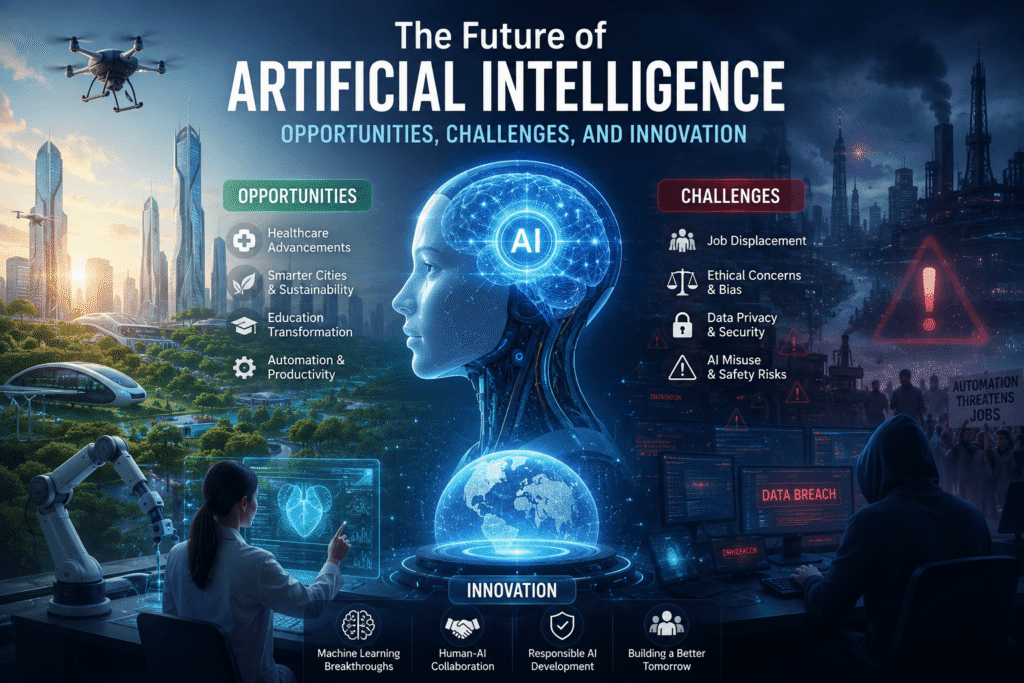
Key Opportunities Created by Artificial Intelligence
The future of artificial intelligence presents substantial opportunities for organizations and society.
Increased Productivity
AI can automate repetitive tasks, allowing employees to focus on strategic and creative work.
Benefits include:
- Faster workflows
- Reduced manual effort
- Improved efficiency
- Lower operational costs
Better Business Decisions
AI-driven analytics can identify patterns and trends that humans may overlook.
Organizations can use AI to:
- Forecast demand
- Optimize pricing
- Improve customer service
- Reduce risks
Enhanced Customer Experiences
AI enables personalized recommendations and support.
Examples include:
- Product recommendations
- Virtual assistants
- Personalized learning platforms
- Smart customer service systems
New Economic Growth
AI is expected to create entirely new industries and job categories focused on:
- AI development
- Data science
- AI governance
- Human-AI collaboration
Major Challenges Facing AI Development
While opportunities are significant, AI also presents important challenges.
Ethical Concerns
Questions surrounding fairness, accountability, and transparency remain critical.
Organizations must address:
- Algorithmic bias
- Discrimination risks
- Fair decision-making
- Responsible deployment
Data Privacy
AI systems often rely on large amounts of data.
Key concerns include:
- User privacy
- Data protection
- Regulatory compliance
- Cybersecurity risks
Workforce Disruption
Automation may replace some repetitive tasks and job roles.
However, new opportunities may emerge through reskilling and workforce adaptation.
Businesses should invest in:
- Employee training
- Digital skills development
- AI literacy programs
Regulatory Complexity
Governments worldwide are developing AI regulations.
Organizations must stay informed about:
- Compliance requirements
- Industry standards
- Risk management frameworks
- Ethical AI guidelines
Best Practices for Adopting AI Successfully
Organizations planning to implement AI should follow a structured approach.
Step 1: Define Clear Objectives
Identify specific business challenges that AI can help solve.
Examples include:
- Improving customer service
- Increasing productivity
- Enhancing data analysis
Step 2: Assess Data Quality
AI systems require accurate and reliable data.
Organizations should:
- Clean datasets
- Remove duplicates
- Ensure consistency
Step 3: Start Small
Pilot projects can help validate AI initiatives before large-scale implementation.
Step 4: Prioritize Ethics
Responsible AI practices should be integrated from the beginning.
Focus on:
- Transparency
- Fairness
- Accountability
Step 5: Continuously Monitor Results
AI models require ongoing evaluation and improvement.
Track:
- Accuracy
- Performance
- Business outcomes
- Compliance requirements
Common Mistakes to Avoid
Many organizations struggle with AI adoption because of avoidable mistakes.
Mistake 1: Implementing AI Without a Strategy
Technology alone cannot solve business problems.
Mistake 2: Ignoring Data Quality
Poor-quality data often leads to poor outcomes.
Mistake 3: Overlooking Ethical Risks
Ignoring ethical concerns can damage trust and reputation.
Mistake 4: Expecting Instant Results
Successful AI implementation requires planning, testing, and optimization.
Mistake 5: Neglecting Employee Training
Human expertise remains essential even in highly automated environments.
Practical AI Readiness Checklist
Use this checklist before adopting AI solutions:
✓ Clear business goals defined
✓ Reliable data available
✓ Data governance policies established
✓ Ethical AI guidelines implemented
✓ Security measures in place
✓ Team training completed
✓ Compliance requirements reviewed
✓ Performance metrics identified
✓ Pilot project tested
✓ Long-term monitoring plan established
Ready to Explore the Future of AI?
Artificial Intelligence is transforming industries faster than ever before. Whether you are a business owner, entrepreneur, researcher, or technology enthusiast, understanding AI today can help you prepare for tomorrow’s opportunities.
If you want to stay informed about emerging technologies, AI innovations, scientific discoveries, and future trends, explore more expert content on Future Science AI.
Contact us today, subscribe to our updates, or explore our latest technology resources to stay ahead in the age of Artificial Intelligence.
Frequently Asked Questions
Q1: What is the future of artificial intelligence?
The future of artificial intelligence involves smarter systems, increased automation, improved decision-making, and wider adoption across industries such as healthcare, finance, education, and manufacturing.
Q2: Will AI replace human jobs?
AI may automate some repetitive tasks, but it is also expected to create new job opportunities in technology, data science, AI management, and digital innovation.
Q3: What are the biggest challenges of AI?
Major challenges include ethical concerns, data privacy, bias, security risks, workforce adaptation, and regulatory compliance.
Q4: How can businesses prepare for AI adoption?
Businesses should define clear goals, improve data quality, train employees, establish ethical guidelines, and start with small pilot projects.
Q5: Why is responsible AI important?
Responsible AI helps ensure fairness, transparency, accountability, and trust while reducing potential risks associated with AI deployment.
Conclusion
The Future of Artificial Intelligence offers remarkable opportunities for innovation, economic growth, scientific discovery, and business transformation. From healthcare and education to automation and research, AI is becoming a powerful force that will shape the next generation of technology.
However, successful adoption requires more than implementing advanced tools. Organizations must focus on ethical practices, data quality, workforce development, and responsible governance.
By embracing innovation while addressing challenges thoughtfully, businesses and individuals can position themselves to thrive in the evolving AI-driven future.