Brain-Computer Interfaces Explained: Connecting Minds and Machines
Introduction
Brain-Computer Interfaces (BCIs) are among the most exciting technological breakthroughs of the 21st century. Once considered science fiction, Brain-Computer Interfaces are now helping people control computers, communicate without speaking, and even regain mobility after severe injuries.
As artificial intelligence, neuroscience, and computing continue to advance, Brain-Computer Interfaces are creating new possibilities for healthcare, communication, education, and business. The idea of connecting the human brain directly to machines is no longer a distant dream—it is becoming a reality.
In this guide, you’ll learn how BCIs work, why they matter, their benefits, challenges, and what the future may hold for this revolutionary technology.
Table of Contents
- Introduction
- Why BCIs Matter
- What Are Brain-Computer Interfaces?
- How Brain-Computer Interfaces Work
- Types of Brain-Computer Interfaces
- Benefits of Brain-Computer Interfaces
- Real-World Applications
- Best Practices for Understanding BCI Technology
- Common Mistakes and Misconceptions
- Practical Checklist
- CTA Section
- FAQ Section
- Conclusion
Why Brain-Computer Interfaces Matter
Technology has transformed how people interact with devices. We moved from keyboards to touchscreens and then to voice assistants. Brain-Computer Interfaces represent the next major leap in human-computer interaction.
- The importance of Brain-Computer Interfaces includes:
- Improving quality of life for people with disabilities
- Enabling faster communication
- Supporting advanced medical treatments
- Enhancing human-machine collaboration
- Driving innovation in AI and neuroscience
For businesses and researchers, BCIs could unlock entirely new industries and opportunities over the coming decades.
What Are Brain-Computer Interfaces?
BCIs are systems that create a direct communication pathway between the human brain and external devices. Instead of using traditional methods such as keyboards, mice, or touchscreens, BCIs interpret neural signals and convert them into actionable commands.
The primary goal of Brain-Computer Interfaces is to enable seamless interaction between humans and machines, improving accessibility, communication, and productivit
Brain-Computer Interfaces Explained: How They Work
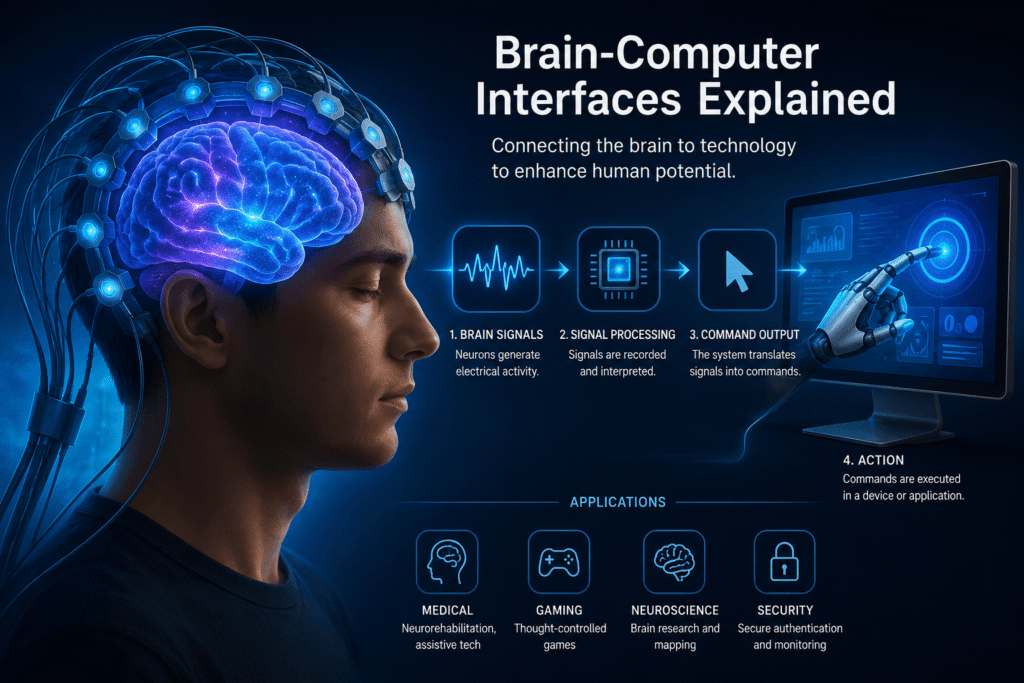
Understanding how BCIs work becomes easier when broken into four key steps.
1. Brain Signal Collection
The brain constantly produces electrical signals.
BCIs systems collect these signals through:
- Electroencephalography (EEG) headsets
- Sensors placed on the scalp
- Implanted electrodes in certain medical applications
2. Signal Processing
Raw brain signals are complex and noisy.
Advanced software filters and cleans the signals to identify meaningful patterns.
3. Signal Interpretation
Artificial intelligence and machine learning algorithms analyze the processed signals.
The system determines the user’s intended action, such as:
- Moving a cursor
- Selecting a letter
- Controlling a wheelchair
- Operating a robotic arm
4. Device Response
- The interpreted command is sent to an external device.
- The device then performs the desired action.
- This process can occur in milliseconds, creating a near real-time experience.
Types of Brain-Computer Interfaces
Non-Invasive BCIs
These systems do not require surgery.
Examples include:
- EEG headsets
- Wearable neural sensors
Advantages:
- Safer
- More affordable
- Easier to use
Limitations:
- Lower signal accuracy
- More interference
Invasive BCIs
These involve implanting electrodes directly into the brain.
Advantages:
- High precision
- Strong signal quality
Limitations:
- Surgical risks
- Higher costs
Semi-Invasive Brain-Computer Interfaces
- These systems are placed inside the skull but outside brain tissue.
- They offer a balance between safety and performance.
Benefits of Brain-Computer Interfaces
Improved Healthcare
Healthcare is currently the most promising BCIs application.
Patients may benefit from:
- Restored communication abilities
- Enhanced mobility
- Better rehabilitation outcomes
- Assistive technologies
Better Accessibility
People with disabilities can gain greater independence through BCIs enabled devices.
Examples include:
- Wheelchair control
- Communication tools
- Smart home management
Enhanced Learning
Future educational systems could use neural feedback to improve learning experiences and personalize instruction.
Faster Human-Computer Interaction
BCIs may eventually reduce reliance on keyboards, touchscreens, and traditional input devices.
Innovation and Economic Growth
Entire industries focused on neurotechnology, AI, and human enhancement could emerge as BCIs adoption grows.
Real-World Applications of Brain-Computer Interfaces
Medical Rehabilitation
Patients recovering from strokes or spinal cord injuries may use Brain-Computer Interfaces to regain movement and communication abilities.
Communication Systems
Researchers are developing systems that allow users to generate text directly from neural activity.
This could significantly benefit individuals with speech impairments.
Prosthetic Control
Advanced prosthetic limbs can respond to brain signals, creating more natural movement.
Gaming and Entertainment
Gaming companies are exploring thought-controlled experiences that could redefine immersive entertainment.
Military and Defense Research
Some organizations are investigating cognitive technologies that improve communication and situational awareness.
Workplace Productivity
Future professionals may interact with software more efficiently using neural interfaces integrated with AI systems.
Best Practices for Understanding Brain-Computer Interfaces Technology
Focus on Realistic Expectations
- BCIs are advancing rapidly, but widespread adoption will take time.
- Avoid assuming that every science fiction concept is immediately achievable.
Follow Trusted Sources
Stay informed through credible organizations and research institutions.
Understand Privacy Concerns
Brain data is highly sensitive.
Future regulations will likely play a critical role in protecting users.
Learn About AI Integration
Artificial intelligence is essential for interpreting complex neural signals.
Common Mistakes and Misconceptions
- Believing BCIs Can Read Every Thought
- Current BCIs do not function like mind-reading machines.
- They identify specific neural patterns related to particular tasks.
- Assuming BCIs Are Only for Healthcare
- While healthcare remains a major application, BCIs may impact education, gaming, communication, and business.
- Ignoring Ethical Issues
- Privacy, consent, and data ownership remain important concerns.
- Expecting Immediate Mass Adoption
The technology is still evolving and requires further development before becoming mainstream.
Practical Checklist
Use this checklist when evaluating Brain-Computer Interface developments:
- Understand the type of BCIs being discussed
- Verify claims using trusted sources
- Consider privacy implications
- Evaluate real-world applications
- Follow developments in AI and neuroscience
- Monitor regulatory changes
- Stay updated on emerging neurotechnology trends
Ready to Explore the Future of Technology?
The future is being shaped by innovations that once seemed impossible. At Future Science AI, we help readers stay informed about artificial intelligence, quantum computing, robotics, neurotechnology, and emerging innovations.
Explore our latest articles, discover breakthrough technologies, and stay ahead of the trends that will define tomorrow’s world.
Brain-Computer Interfaces Frequently Asked Questions
Q1:What is a BCIs?
A Brain-Computer Interface is a technology that enables direct communication between the human brain and an external device without relying on traditional physical actions.
Q2:How do BCIs work?
BCIs collect brain signals, process them using software and AI, interpret user intentions, and send commands to connected devices.
Q3:Are BCIs safe?
Non-invasive BCIs are generally considered safe. Invasive systems involve surgery and require medical oversight.
Q4:What are the main uses of BCIs?
Common applications include healthcare, prosthetics, communication systems, rehabilitation, gaming, and accessibility technologies.
Q5:What is the future of BCIs?
Experts expect BCIs to become more accurate, accessible, and integrated with AI, opening new possibilities across many industries.
Conclusion
BCIs are transforming the relationship between humans and technology. By creating direct communication pathways between the brain and machines, BCIs have the potential to improve healthcare, accessibility, communication, and productivity.
Although challenges related to privacy, ethics, and adoption remain, ongoing innovation continues to push the boundaries of what is possible. As artificial intelligence and neuroscience evolve together, Brain-Computer Interfaces may become one of the most influential technologies of the future.
For businesses, researchers, and technology enthusiasts, understanding Brain-Computer Interfaces today provides valuable insight into the innovations that could reshape society tomorrow.