
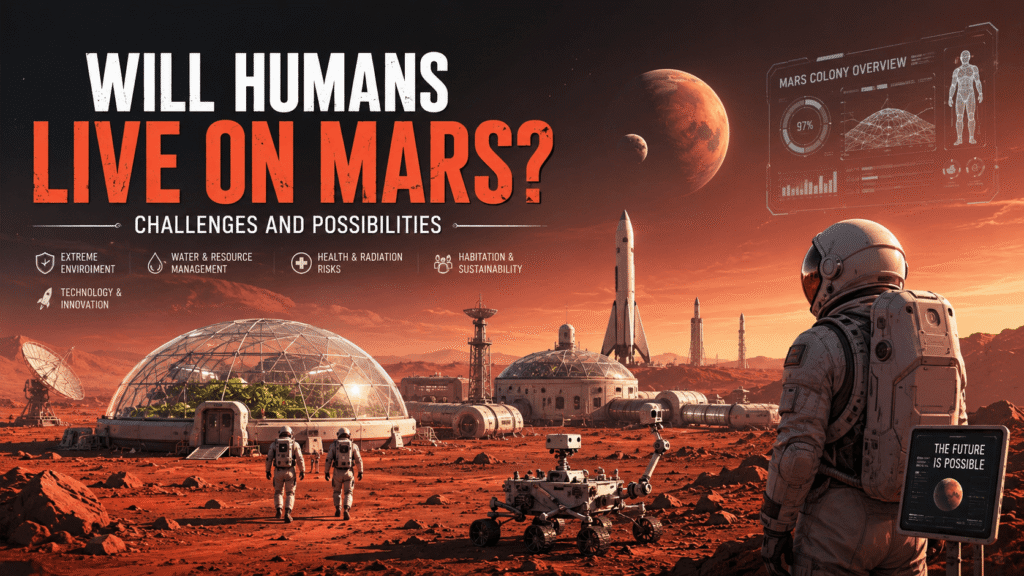
Will Humans Live on Mars? Challenges and Possibilities
Introduction
For centuries, humans have looked toward the stars and imagined life beyond Earth. They thin Will Humans Live on Mars. Today, Mars stands out as the most promising destination for long-term human settlement. Unlike many other planets, Mars has water ice, seasonal changes, and a day length similar to Earth’s.
The question is no longer whether we can send humans to Mars. Instead, scientists are asking whether we can build a sustainable future there. Understanding the challenges and possibilities of Mars colonization helps us prepare for the next chapter of human exploration.
Table of Contents
1. Introduction
2. Why This Topic Matters
3. Understanding Mars as a Future Home
4. Challenges of Living on Mars
5. Technologies Making Mars Colonization Possible
6. Benefits of Human Settlement on Mars
7. Best Practices for Future Mars Missions
8. Common Mistakes and Misconceptions
9. Practical Mars Colonization Checklist
10. Call to Action
11. Frequently Asked Questions
12. Conclusion
Why This Topic Matters
Mars colonization is more than a scientific achievement. It represents a major step in humanity’s future.
- Several reasons make this topic important:
- Expanding human civilization beyond Earth
- Encouraging technological innovation
- Advancing scientific discovery
- Inspiring future generations
- Improving Earth’s sustainability through new technologies
Many innovations developed for space exploration eventually improve life on Earth. Water purification systems, advanced medical technologies, and communication tools all benefited from space research
Understanding Mars as a Future Home
What Makes Mars Attractive?
Mars offers several characteristics that make it a potential candidate for human settlement:
- A day lasts approximately 24 hours and 37 minutes
- Water ice exists beneath the surface
- The planet experiences seasons
- Gravity is present, though weaker than Earth’s
- Plenty of space for future habitats
These features make Mars more suitable for colonization than other planets in our solar system.
How Mars Differs from Earth
Despite its similarities, Mars remains a hostile environment.
Key differences include:
- Extremely thin atmosphere
- High levels of radiation
- Very cold temperatures
- Frequent dust storms
- Limited oxygen
Humans cannot survive on the Martian surface without specialized equipment and protective habitats.
Will Humans Live on Mars? The Biggest Challenges
Radiation Exposure
One of the most serious obstacles is radiation.
Earth is protected by a strong magnetic field and atmosphere. Mars lacks both.
As a result:
- Cosmic rays reach the surface
- Solar radiation can damage human cells
- Long-term health risks increase
Future settlements may require underground habitats or advanced shielding materials.
Food Production
Transporting food from Earth indefinitely is not practical.
Future colonists will need:
- Hydroponic farming
- Vertical agriculture
- Controlled-environment greenhouses
- Water recycling systems
Producing food locally will be essential for long-term survival.
Water Availability
Water supports:
- Drinking
- Agriculture
- Hygiene
- Oxygen production
Scientists have discovered evidence of water ice on Mars, which could become a valuable resource for future settlers.
Psychological Challenges
Living millions of miles away from Earth could affect mental health.
Potential issues include:
- Isolation
- Stress
- Homesickness
- Limited social interaction
Future missions must include strong psychological support systems.
Medical Emergencies
A medical emergency on Mars cannot be solved with a quick return trip to Earth.
Future settlements will require:
- Advanced medical facilities
- Remote healthcare technologies
- AI-assisted diagnostics
Technologies Making Mars Colonization Possible
Reusable Rockets
Modern reusable spacecraft significantly reduce launch costs.
This technology allows:
- More frequent missions
- Greater cargo transportation
- Lower operational expenses
Companies like SpaceX are leading this transformation.
Artificial Intelligence
Artificial intelligence will play a crucial role in Mars exploration.
Applications include:
- Habitat management
- Predictive maintenance
- Scientific research
- Autonomous navigation
Advanced Robotics
Robots may prepare Mars for human arrival.
They can:
- Construct buildings
- Extract resources
- Perform maintenance
- Conduct scientific experiments
3D Printing
Transporting construction materials from Earth is expensive.
Future habitats may be built using local Martian materials through advanced 3D printing technologies.
This approach can:
- Reduce costs
- Improve sustainability
- Accelerate construction
Benefits of Human Settlement on Mars
Expanding Human Civilization
A second human settlement would reduce humanity’s dependence on a single planet.
This could improve long-term survival prospects.
Scientific Discoveries
Living on Mars would allow researchers to study:
- Planetary evolution
- Climate history
- Potential signs of past life
Technological Innovation
Mars missions drive innovation in:
- Energy systems
- Healthcare
- Robotics
- Artificial intelligence
Economic Opportunities
Future industries may include:
- Space tourism
- Resource extraction
- Space manufacturing
- Interplanetary transportation
Best Practices for Future Mars Missions
Develop Sustainable Habitats
Future colonies should prioritize:
- Energy efficiency
- Resource recycling
- Radiation protection
- Scalability
Utilize Local Resources
Using Martian resources will reduce dependence on Earth.
This strategy is known as In-Situ Resource Utilization (ISRU).
Encourage International Collaboration
Mars colonization will require cooperation among:
- Governments
- Space agencies
- Universities
- Private companies
Invest in Long-Term Research
Continuous testing and innovation are essential before establishing permanent settlements.
Common Mistakes and Misconceptions
Many people misunderstand the realities of Mars colonization.
Misconception 1: Humans Will Move to Mars Soon
While progress is impressive, permanent settlement will likely take decades.
Misconception 2: Mars Can Easily Become Another Earth
Terraforming Mars remains highly theoretical and technologically challenging.
Misconception 3: Existing Technology Solves Every Problem
Many critical systems still require development and testing.
Misconception 4: Mars Exploration Only Benefits Space Science
The technologies developed often improve life on Earth as well.
Practical Mars Colonization Checklist
Before humans can permanently live on Mars, the following milestones must be achieved:
✔️ Reliable transportation systems
✔️ Sustainable food production
✔️ Water extraction technology
✔️ Oxygen generation systems
✔️ Radiation protection
✔️ Medical support infrastructure
✔️ Energy generation systems
✔️ Habitat construction technology
✔️ Psychological support programs
✔️ Long-term economic sustainability
Ready to Explore the Future of Space?
The future of science and technology is advancing faster than ever. Understanding topics like Mars colonization helps individuals, students, researchers, and business leaders prepare for tomorrow’s opportunities.
Stay ahead of emerging innovations by exploring more articles on Future Science AI. Subscribe for updates, discover breakthrough technologies, and learn how science is shaping the future of humanity.
Frequently Asked Questions
Q1:Will humans live on Mars in the future?
Most experts believe human settlement on Mars is possible. However, significant technological and environmental challenges must still be overcome.
Q2:Why is Mars considered the best planet for colonization?
Mars has water ice, a similar day length to Earth, and conditions that make long-term settlement more realistic than other planets.
Q3:What is the biggest challenge of living on Mars?
Radiation exposure is one of the most significant challenges because Mars lacks Earth’s protective magnetic field.
Q4:How will people grow food on Mars?
Future settlers may use hydroponic farming, vertical agriculture, and controlled-environment greenhouses.
Q5:Which organizations are working on Mars colonization?
Organizations including NASA, ESA, and SpaceX are actively developing technologies and missions related to Mars exploration
Conclusion
The question, Will Humans Live on Mars, remains one of the most exciting topics in modern science. While enormous challenges exist, advances in space technology, artificial intelligence, robotics, and sustainable resource management continue to bring humanity closer to this goal.
Mars colonization will not happen overnight. It will require decades of innovation, testing, and international collaboration. Yet the potential rewards are extraordinary. From scientific discoveries to technological breakthroughs, living on Mars could transform the future of civilization.
As humanity continues to explore the cosmos, Mars stands as a symbol of what is possible when curiosity, ambition, and innovation come together.