Can AI Predict Earthquakes Before They Happen?
Earthquakes can strike with little warning, causing injuries, structural damage, landslides, fires, and major disruption. This raises an exciting question: Can AI predict earthquakes before they happen?
Artificial intelligence is becoming increasingly useful in seismology. Machine-learning systems can process enormous amounts of seismic information, identify subtle patterns, detect earthquakes rapidly, and improve forecasts of earthquake activity. However, there is an important distinction between predicting an earthquake and detecting or forecasting its risk.
Today, scientists still cannot reliably state the exact time, location, and magnitude of a major earthquake before it happens. The USGS confirms that no scientifically proven method currently provides those three elements of a true earthquake prediction.
Nevertheless, AI could become an important part of the future of earthquake science.
Table of Contents
1. Why Earthquake Prediction Matters
2. Can AI Predict Earthquakes?
3. How AI Analyzes Earthquake Data
4. AI Earthquake Prediction vs. Early Warning
5. What AI Can Do Today
6. Benefits of AI for Earthquake Science
7. How AI Earthquake Detection Works
8. Challenges and Limitations
9. Common Mistakes to Avoid
10. Practical Earthquake Technology Checklist
11. The Future of AI and Earthquake Prediction
12. Frequently Asked Questions
13. Conclusion
Why Earthquake Prediction Matters
Earthquakes are among the most difficult natural hazards to predict because they result from complex processes deep beneath Earth’s surface.
Tectonic plates constantly move. Stress accumulates along faults, and eventually rocks can rupture and release enormous amounts of energy.
For communities located near active faults, even a few seconds of warning can be valuable.
An earthquake can damage:
- Homes and offices
- Roads and bridges
- Railways
- Power networks
- Water systems
- Hospitals
- Communication infrastructure
- Industrial facilities
The economic consequences can also be enormous. Businesses may experience supply-chain interruptions, equipment damage, data loss, and prolonged downtime.
Therefore, better earthquake monitoring is not simply a scientific goal. It is also an important part of public safety and infrastructure resilience.
For example, Canada now operates an Earthquake Early Warning system in western British Columbia, eastern Ontario, and Quebec. The system can provide seconds to tens of seconds of warning when potentially damaging shaking is detected.
Can AI Predict Earthquakes?
The short answer is not yet—not in the way people usually mean by “prediction.”
A true earthquake prediction would need to identify:
1. Where the earthquake will happen
2. When it will happen
3. How large it will be
According to the USGS, scientists cannot currently make reliable predictions that provide all three details for a major earthquake.
However, AI can help scientists analyze earthquake-related information much faster.
This distinction is important.
AI may be able to:
- Detect seismic activity quickly
- Recognize patterns in earthquake data
- Estimate earthquake characteristics
- Improve earthquake forecasting
- Identify aftershock patterns
- Support hazard mapping
- Help improve early-warning systems
- Analyze large historical earthquake datasets
So, rather than asking whether AI can magically “see” an earthquake coming days in advance, a better question is:
How can AI improve our ability to understand, detect, and respond to earthquakes?
That is where the technology becomes particularly promising.
How AI Analyzes Earthquake Data
Modern seismology generates enormous quantities of information.
Seismic stations continuously record vibrations in the ground. These recordings contain signals from earthquakes as well as noise from vehicles, construction, machinery, weather, and other sources.
Traditional analysis can require considerable processing.
AI, particularly machine learning, can examine large datasets and learn patterns associated with seismic events.
Detecting Seismic Signals
When an earthquake begins, it produces seismic waves that travel through the Earth.
The first waves detected are generally P-waves, followed by slower S-waves and other surface waves.
AI systems can be trained to distinguish earthquake signals from background noise.
This can help automated systems identify an event quickly.
Identifying Patterns
Machine-learning models can examine historical seismic records and search for relationships that might be difficult to identify manually.
For example, researchers can train algorithms using information such as:
- Seismic waveforms
- Earthquake locations
- Magnitudes
- Fault characteristics
- Historical earthquake activity
- Aftershock sequences
- Ground-motion measurements
The goal is not to give AI a crystal ball.Instead, scientists use AI to extract useful information from extremely complicated datasets.
AI Earthquake Prediction vs. Earthquake Early Warning
One of the biggest misconceptions about AI and earthquakes is confusing prediction with early warning.
They are not the same.
Earthquake Prediction
Prediction means determining before the earthquake occurs:
- Its time
- Its location
- Its magnitude
Science cannot currently do this reliably.
Earthquake Early Warning
Early warning works differently.
An earthquake has already started. Sensors detect the initial seismic waves, computers rapidly estimate the event, and an alert can be sent to locations where stronger shaking has not yet arrived.
The USGS describes earthquake early warning as a notification issued after an earthquake starts but potentially before strong shaking reaches a particular location.
That difference can be just a few seconds.
However, those seconds can matter.
Natural Resources Canada explains that its earthquake early-warning system uses seismic sensors and automated processing to estimate an earthquake and its expected shaking before stronger waves arrive at some locations
What Can AI Do Today?
Although AI cannot reliably predict the exact moment of a future earthquake, it already has several useful applications in earthquake science.
1. Faster Earthquake Detection
AI can automatically analyze seismic signals and identify earthquakes rapidly.
This reduces the amount of manual work required from scientists.
2. Better Earthquake Classification
Machine-learning algorithms can help distinguish different seismic events.
For example, a system may classify signals as earthquakes, aftershocks, or non-earthquake noise.
3. Aftershock Forecasting
After a large earthquake, hundreds or thousands of smaller earthquakes may follow.
Scientists can use statistical and computational models to estimate the probability of aftershocks.
The USGS already produces aftershock forecasts that describe the probability and expected number of aftershocks following large earthquakes.
AI could potentially improve these systems by analyzing more variables and larger datasets.
4. Improved Hazard Mapping
AI can help process geological and seismic information to improve understanding of earthquake-prone regions.
This information can support:
- Building codes
- Infrastructure planning
- Emergency management
- Insurance risk assessment
- Urban development
5. Faster Emergency Response
AI-powered systems could eventually help emergency agencies prioritize affected locations by combining seismic information with maps, infrastructure data, satellite imagery, and population information.
Benefits of AI for Earthquake Science
AI has several advantages when applied responsibly to earthquake research.
Speed
Computers can analyze massive datasets much faster than humans.
Scale
AI can process information from thousands of sensors and historical records.
Pattern Recognition
Machine-learning models can detect complex relationships within data.
Automation
Once properly designed and tested, AI systems can continuously monitor seismic information.
Better Decision Support
AI-generated information can help scientists and emergency managers make faster, evidence-based decisions.
For example, a future system could combine real-time seismic data with information about buildings, bridges, roads, hospitals, and population density to estimate where the strongest effects may occur.
That would not necessarily predict an earthquake before it begins. Instead, it could improve the speed and quality of the response once an earthquake is detected.
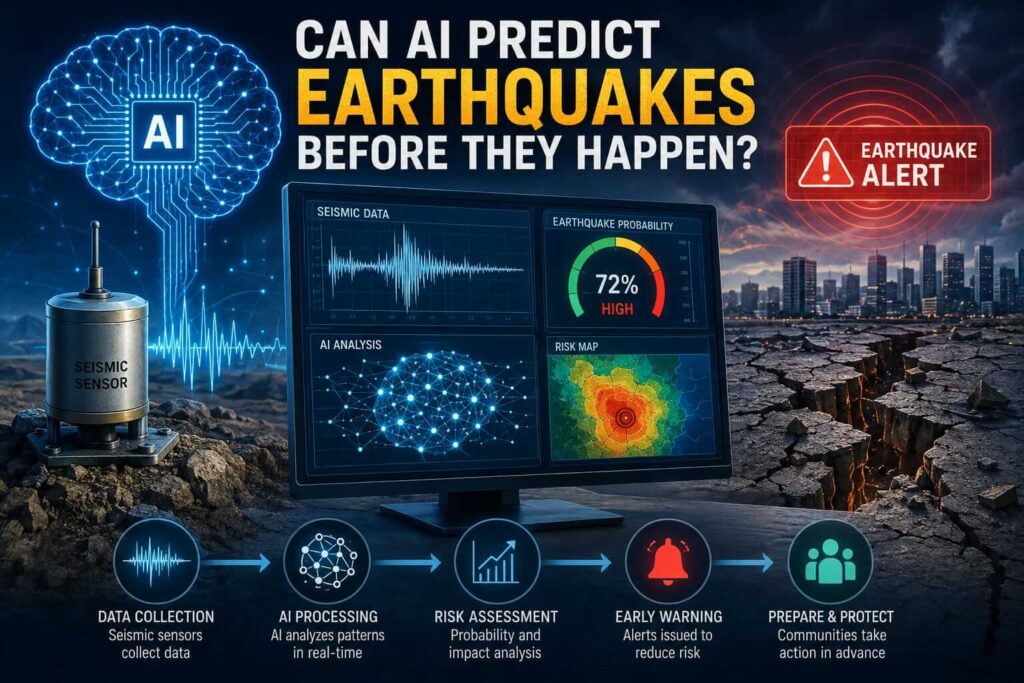
How AI Earthquake Detection Works: Step by Step
A simplified AI-powered earthquake monitoring system could work like this:
Step 1: Sensors Collect Data
Seismic sensors continuously measure ground movement.
Step 2: Data Is Transmitted
The measurements are sent to computers or cloud-based processing systems.
Step 3: AI Filters Noise
Machine-learning algorithms distinguish potentially meaningful seismic signals from background noise.
Step 4: The Event Is Classified
The system estimates whether the signal represents an earthquake and may calculate characteristics such as location and magnitude.
Step 5: Ground Shaking Is Estimated
The system assesses which areas could experience stronger shaking.
Step 6: Alerts Are Delivered
If an earthquake early-warning system determines that strong shaking is approaching a particular location, an alert may be issued.
Step 7: Automated Systems Respond
In advanced applications, alerts could trigger actions such as slowing trains, managing elevators, or protecting critical infrastructure.
USGS ShakeAlert technology, for example, is designed to provide alerts when significant earthquakes are detected and strong shaking is expected imminently.
Common Mistakes to Avoid
As AI earthquake technology becomes more popular, misinformation can also spread.
Mistake 1: Assuming AI Can Predict Any Earthquake
AI is powerful, but it does not eliminate the fundamental scientific challenges of earthquake prediction.
Mistake 2: Confusing Early Warning With Prediction
An early-warning alert happens after an earthquake begins.
It is not a prediction days or weeks beforehand.
Mistake 3: Trusting Viral “Earthquake Prediction” Posts
Online posts may claim that an earthquake will happen on a specific date.
Such claims should be treated cautiously unless supported by credible scientific evidence.
Mistake 4: Ignoring Uncertainty
AI models produce estimates and probabilities. They can make errors.
Scientists therefore need to test models against independent datasets and understand their limitations.
Mistake 5: Treating AI as a Replacement for Scientists
AI is a tool.
Geologists, seismologists, engineers, emergency planners, and other specialists remain essential for interpreting results and making decisions
Practical Earthquake Technology Checklist
If you live or work in an earthquake-prone region, technology should complement—not replace—basic preparation.
- Learn whether your area has earthquake early-warning services.
- Enable relevant emergency alerts on compatible devices.
- Prepare an emergency kit.
- Secure heavy furniture and objects.
- Learn “Drop, Cover and Hold On.”
- Create a household emergency plan.
- Protect important business and digital data.
- Understand your building’s earthquake risks.
- Follow official emergency-management guidance.
- Do not rely on social-media earthquake predictions.
Canada’s official earthquake-preparedness guidance similarly emphasizes preparation because earthquakes cannot currently be predicted.
The Future of AI and Earthquake Prediction
The future is promising, but realistic expectations are important.
AI researchers and earthquake scientists are exploring increasingly sophisticated ways to analyze seismic information.
Future systems could combine:
- Seismic sensors
- Satellite observations
- GPS measurements
- Geological maps
- Historical earthquake databases
- Ground-motion models
- Artificial intelligence
- Cloud computing
- Real-time infrastructure information
The result could be much more advanced earthquake intelligence.
For example, instead of simply sending an alert saying an earthquake has been detected, a future system could potentially estimate which neighborhoods are most likely to experience severe shaking and help emergency teams prioritize resources.
AI could also make earthquake monitoring more accessible by automatically processing information from large networks of sensors.
However, the scientific challenge remains substantial. Earthquakes are complex physical events, and a model that performs well on historical data does not automatically prove that it can predict future earthquakes.
Therefore, researchers need rigorous testing, transparent evaluation, and independent validation.
The most realistic future is not necessarily an AI system announcing an earthquake days before it happens.
Instead, it may be a network of intelligent systems that continuously monitors Earth’s movements, improves risk estimates, detects earthquakes faster, and gives people more time to respond
CTA: Explore the Future of AI and Science
Artificial intelligence is changing how scientists study some of Earth’s most difficult problems.
Earthquake prediction may still be beyond today’s technology, but AI is already helping researchers analyze seismic data, improve detection, strengthen early-warning systems, and understand earthquake risks.
Want to discover more breakthroughs at the intersection of AI, science, and future technology?
Explore more Future Science AI articles and stay informed about the technologies shaping tomorrow.
Frequently Asked Questions
Q1: Can AI predict earthquakes before they happen?
AI cannot currently predict major earthquakes with reliable information about the exact time, location, and magnitude. However, it can analyze seismic data, identify patterns, support forecasting, and improve earthquake early-warning systems.
Q2: How does AI detect earthquakes?
AI can analyze signals from seismic sensors and distinguish earthquake-related patterns from background noise. It can then help estimate characteristics such as an earthquake’s location, size, and expected shaking.
Q3: What is the difference between earthquake prediction and early warning?
Earthquake prediction would identify an earthquake before it occurs. Early warning happens after an earthquake has started but can alert people before stronger shaking reaches their location.
Q3: Can AI predict aftershocks?
AI and statistical models can help scientists estimate the probability of aftershocks. These forecasts are probabilistic rather than guaranteed predictions. The USGS already provides aftershock forecasts following significant earthquakes.
Q4: Will AI ever be able to predict earthquakes accurately?
It is possible that future AI and scientific discoveries could improve earthquake forecasting substantially. However, there is currently no reliable technology that can accurately predict every major earthquake’s exact time, location, and magnitude
Conclusion
So, can AI predict earthquakes before they happen?
Not reliably—not yet.
Current science cannot accurately provide the exact time, location, and magnitude of a major earthquake before it occurs. However, that does not mean AI has little to offer.
Quite the opposite.
AI can process enormous volumes of seismic information, detect earthquakes rapidly, identify patterns, support aftershock forecasting, improve hazard analysis, and strengthen earthquake early-warning systems.
The distinction between prediction and early warning is especially important. Early-warning technology can detect an earthquake after it begins and, in some locations, provide valuable seconds before stronger shaking arrives.
As sensors become more sophisticated and AI models become better at interpreting complex Earth data, the future of earthquake monitoring could become significantly smarter.
The goal may not be a machine that tells us exactly when an earthquake