Smart Contact Lenses: How Technology Could Put Computers in Your Eyes
Introduction
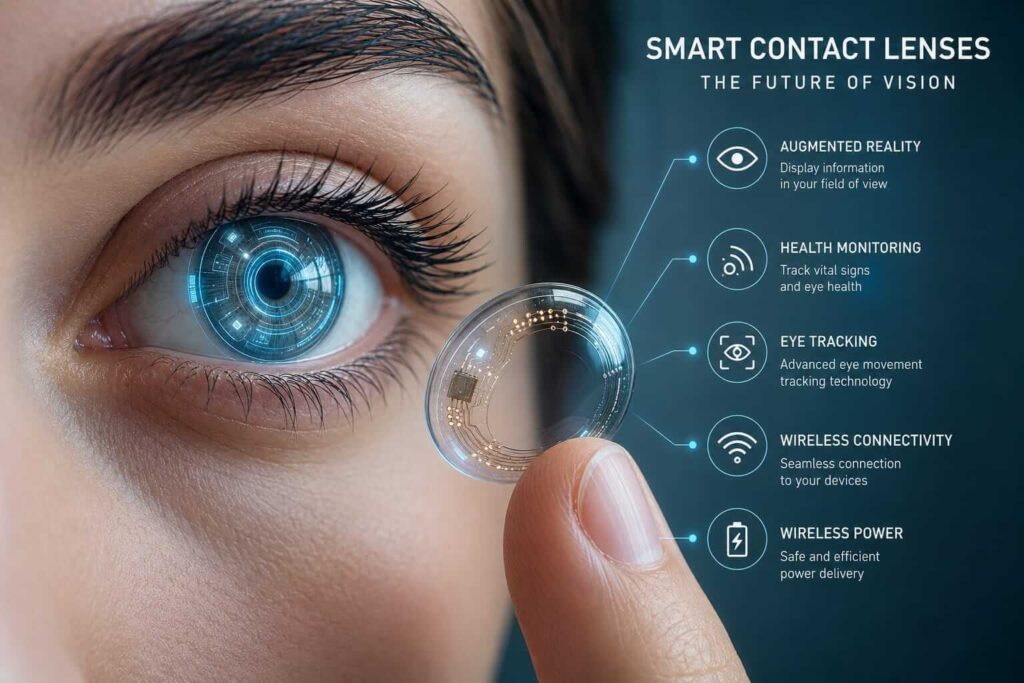
Smart Contact Lenses are emerging as one of the most fascinating ideas in wearable technology. Instead of simply correcting vision, future lenses could potentially display information, track eye movements, monitor biological signals, and interact with digital systems.
Imagine looking at a street and seeing navigation information without checking your phone. A doctor could potentially examine health information through a tiny wearable display, while an industrial worker might receive hands-free instructions directly within their field of view.
However, smart contact lenses are not yet ordinary consumer products that can simply replace smartphones or smart glasses. Researchers still face major challenges involving power, heat, comfort, biocompatibility, data privacy, display technology, and medical validation.
So, how close are we to putting computers in our eyes? Let’s explore the science, applications, benefits, limitations, and future of this remarkable technology.
Table of Contents
1. What Are Smart Contact Lenses?
2. Why Smart Contact Lenses Matter
3. How Do Smart Contact Lenses Work?
4. What Can Smart Contact Lenses Do?
5. Smart Contact Lenses in Healthcare
6. Smart Contact Lenses and Augmented Reality
7. Benefits of Smart Contact Lenses
8. Major Challenges and Risks
9. Common Mistakes and Misconceptions
10. Practical Checklist
11. The Future of Smart Contact Lenses
12. CTA
13. Frequently Asked Questions
14. Conclusion
What Are Smart Contact Lenses?
Traditional contact lenses are designed primarily to correct vision. Smart contact lenses take the concept much further by integrating miniature electronic or sensing components into, around, or alongside a lens.
Depending on the design, a smart lens could contain:
- Miniature sensors
- Wireless communication components
- Microelectronics
- Tiny displays
- Antennas
- Biosensors
- Eye-tracking technology
- Wireless power systems
- Drug-delivery mechanisms
Researchers are investigating these technologies for healthcare, augmented reality, human-computer interaction, and other applications. Recent reviews describe smart lenses as multifunctional platforms capable of combining sensing, diagnosis, displays, and even drug delivery.
The important point is that a smart contact lens is not necessarily a tiny smartphone. Different research projects focus on different capabilities. Some are designed for health monitoring, while others explore displays or eye tracking.
Why Smart Contact Lenses Matter
We already carry smartphones, smartwatches and wireless earbuds. Yet these devices require us to look away from the world around us.
Smart Contact Lenses could offer a different approach.
Instead of holding a device, users could potentially interact with information through their vision or eye movements.
For example, imagine a tourist visiting London. Instead of repeatedly checking a phone for directions, a future augmented reality lens could potentially provide visual navigation cues while the person continues looking at the street.
Similarly, a technician repairing equipment could receive instructions without holding a tablet.
This hands-free approach could make wearable computing more natural.
At the same time, healthcare may become one of the most important applications. Researchers are investigating lenses that can detect physiological signals from tears or monitor properties of the eye. A 2026 review highlights ongoing work involving biomarkers, glucose monitoring, intraocular pressure, drug delivery, and personalized healthcare, while also noting that large-scale validation is still needed.
How Do Smart Contact Lenses Work?
The technology behind smart contact lenses is surprisingly complex.
A lens must remain thin, lightweight, flexible, comfortable, and safe while potentially carrying electronics.
1. Sensors
Sensors can collect information from the eye or its surrounding environment.
Depending on the design, researchers may investigate sensors for:
- Chemical biomarkers
- Temperature
- Pressure
- Eye movement
- Tear-fluid components
- Other physiological signals
Tears are particularly interesting because they contain biochemical information. However, measuring useful biomarkers accurately through tears can be difficult because concentrations and sampling conditions can vary.
2. Wireless Communication
A smart lens may need to communicate with an external device.
Wireless communication could allow information collected by the lens to travel to a smartphone, computer, or another processing system.
This is important because putting a powerful processor directly onto a tiny lens creates serious engineering problems.
3. Power
Power is one of the biggest obstacles.
A conventional contact lens does not need a battery. A smart lens with sensors, wireless communication, or a display does.
Researchers therefore investigate methods such as wireless power transfer and extremely low-power electronics.
One published prototype demonstrated wireless circuits, sensors and display pixels integrated into a soft contact lens, showing how researchers are trying to combine several functions without creating an excessively bulky device.
4. Displays
The idea of displaying information directly on a contact lens is particularly challenging.
Researchers have explored miniature display technologies, including micro-LED and liquid-crystal approaches. A 2024 study demonstrated a 3 × 3 mini-LED array packaged for smart contact lens applications, with the design also addressing wireless energy transfer and compact integration.
However, a laboratory display is very different from a comfortable, high-resolution consumer products
What Can Smart Contact Lenses Do?
The potential applications are broad.
Augmented Reality
The most futuristic possibility is augmented reality.
A smart lens could potentially place digital information within a person’s natural field of view.
Possible applications include:
- Navigation
- Real-time translations
- Notifications
- Object identification
- Training instructions
- Sports information
- Accessibility features
Instead of looking down at a phone, information could appear where it is needed.
Eye Tracking
Smart Contact Lenses could also understand eye movements.
Researchers have already demonstrated miniature Smart Contact Lenses systems for eye tracking and wireless human-machine interaction. A 2024 Nature Communications study described a biocompatibleSmart Contact Lenses designed for in-situ eye tracking and wireless interaction.
This could eventually make eye movements another way to control computers.
For someone unable to use a conventional touchscreen, that could be particularly valuable.
Health Monitoring
Healthcare may ultimately become one of the most practical applications.
Researchers are exploring Smart Contact Lenses capable of monitoring biological information associated with the eye and tear fluid. Potential applications include monitoring certain biomarkers, intraocular pressure and other physiological signals.
However, it is important not to confuse experimental technology with clinically proven medical devices. A sensor producing a measurement in a laboratory does not automatically mean that the technology can diagnose disease safely in everyday patients.
Smart Contact Lenses in Healthcare
Healthcare could benefit from smart lenses because the eye provides a convenient location for continuous sensing.
For example, researchers are studying ways to use tear fluid as a source of biological information. Smart Contact Lenses could potentially collect information over time rather than relying entirely on occasional measurements.
Another potential application is drug delivery.
Instead of conventional eye drops quickly leaving the eye through natural drainage, researchers are investigating contact-lens-based systems that could improve the delivery of certain medications. Recent reviews identify drug delivery as one of the important directions in smart contact lens research.
The long-term vision is therefore bigger than simply displaying notifications. Smart Contact Lenses could become miniature health-monitoring platforms.
Benefits of Smart Contact Lenses
Hands-Free Information
Users could potentially access digital information without holding a phone.
Continuous Monitoring
Medical versions may eventually monitor selected biomarkers or eye-related measurements over longer periods.
Natural Human-Computer Interaction
Eye movement could become an intuitive way to interact with digital systems.
Accessibility
Smart Contact Lenses could potentially assist people who have difficulty interacting with conventional screens.
Compact Wearable Design
Unlike smartphones and tablets, a contact lens is designed to sit directly on the eye.
This could make wearable computing less visually intrusive than some conventional devices.
Major Challenges and Risks
The futuristic potential should not hide the real engineering and medical challenges.
Power and Battery Life
A battery must be extremely small, safe and lightweight. At the same time, it must provide enough energy for sensors or displays.
Heat
Electronics generate heat. Because a contact lens sits directly on the eye, managing temperature is especially important.
Comfort
A successful smart lens must feel like a contact lens, not like an electronic device attached to the eye.
Researchers therefore need to balance electronics with flexibility, oxygen permeability, moisture and mechanical properties. These factors are specifically highlighted in recent research on smart contact lenses.
Eye Safety
This is perhaps the most important issue.
Ordinary contact lenses already require proper care. The FDA warns that contact lens problems can include serious infections and corneal ulcers, which in rare cases can lead to blindness.
Adding electronics creates additional questions about long-term safety, materials, heat, mechanical irritation and reliable operation.
Privacy
Imagine a lens that knows where you are looking.
That information could become extremely sensitive.
Eye-tracking data might reveal what attracts a person’s attention, how they interact with advertisements, or potentially information about their behavior.
Therefore, future smart lenses will need strong privacy protections, transparent data policies and secure communication.
Smart Contact Lenses vs. Smart Glasses
Smart Contact Lenses and smart glasses may eventually serve similar markets, but they have different advantages.
Smart glasses have more physical space for batteries, processors, cameras and speakers. They are therefore easier to develop with today’s technology.
Smart Contact Lenses, on the other hand, could be much less noticeable and potentially offer a more direct visual interface.
That is why smart lenses remain so interesting despite their engineering challenges.
The technology does not necessarily have to replace smart glasses. In the future, both could exist for different purposes.
Common Mistakes and Misconceptions
Mistake 1: Assuming Smart Contact LensesAre Already Mainstream
Most advanced Smart Contact Lenses concepts remain in research and development.
For example, Mojo Vision previously developed its Mojo Lens augmented-reality concept, but the company announced in 2023 that it was slowing work on the lens and shifting its focus toward micro-LED technology.
So, headlines about futuristic lenses should be interpreted carefully.
Mistake 2: Thinking They Are Tiny Smartphones
A smart lens will probably not contain everything a smartphone does.
More realistic designs may rely on external computing and wireless connections.
Mistake 3: Ignoring Eye Safety
Technology should never come before eye health.
Smart Contact Lenses require professional fitting and responsible use. The FDA recommends following eye-care instructions and seeking professional advice if irritation, redness, pain or vision changes occur.
Mistake 4: Assuming Every Sensor Is a Medical Test
A prototype sensor does not automatically become a medically approved diagnostic device.
Clinical validation, reliability and regulatory approval are essential.
Practical Checklist: What Would a Good Smart Lens Need?
Before Smart Contact Lenses become widely available, developers will need to solve several problems:
- Safe, biocompatible materials
- Comfortable long-term wear
- Reliable wireless communication
- Efficient power delivery
- Minimal heat generation
- High-quality sensing
- Accurate data interpretation
- Secure personal data
- Strong privacy protections
- Clinical validation for medical applications
- Appropriate regulatory approval
- Affordable manufacturing
This checklist shows why turning a laboratory prototype into a mass-market product is difficult.
The Future of Smart Contact Lenses
The future may not arrive as a single revolutionary product.
Instead, Smart Contact Lenses are likely to develop gradually.
Early systems may focus on specific medical applications, sensing or eye tracking. Later generations could combine sensing, communication and visual interfaces.
Artificial intelligence could also become an important component.
A future smart lens might collect information while an external AI system analyzes it. The lens could then provide only the most relevant information to the user.
For example, instead of displaying dozens of notifications, an AI system could determine which information matters most at that moment.
This could make wearable technology more useful—and less distracting.
However, the industry will need to solve the fundamental problems of power, safety, comfort, privacy and regulation before widespread adoption becomes realistic.
Recent academic reviews continue to describe smart contact lenses as promising but emphasize challenges surrounding clinical validation, patient adherence, cost, regulatory issues and practical integration.
Ready for the Next Generation of Technology?
Smart Contact Lenses represent a fascinating intersection of artificial intelligence, wearable technology, medical science, sensors and augmented reality.
For businesses, researchers and technology professionals, understanding these developments early can help identify future opportunities.
Want to explore how emerging technologies could influence your business or digital strategy? Contact Future Science AI to discuss the possibilities and discover the technologies shaping tomorrow.
Frequently Asked Questions
https://futurescienceai.com/blog/future-tech/future-of-renewable-energy-technologies-whats-next/
1. What are Smart Contact Lenses?
Smart Contact Lenses are advanced contact lenses that incorporate technologies such as sensors, wireless communication, displays or other electronic components to provide functions beyond ordinary vision correction.
2. Can Smart Contact Lenses display information?
Potentially, yes. Researchers have demonstrated miniature display technologies designed for Smart Contact Lenses. However, practical consumer-ready displays remain technically challenging because of power, size, safety and comfort requirements.
3. Can Smart Contact Lenses monitor health?
Researchers are investigating Smart Contact Lenses for monitoring biological signals and eye-related measurements. Potential applications include biomarker monitoring and intraocular pressure sensing. However, many applications remain under development and require further clinical validation.
4. Are Smart Contact Lenses
Not in the futuristic form commonly shown in movies. Many advanced smart contact lens technologies are still experimental or under development. Consumers should not assume that a research prototype is an approved medical or commercial product.
5. Are Smart Contact Lenses safe?
Safety depends on the specific product and its regulatory status. Contact lenses already carry risks when used improperly, including serious eye infections. Future electronic lenses will require rigorous testing for materials, comfort, electronics, power systems and long-term eye safety.
Conclusion
https://www.allaboutvision.com/medtech/smart-contacts/
Smart Contact Lenses could eventually transform the way humans interact with computers.
Instead of reaching for a smartphone or looking at a separate screen, people may one day receive useful information directly within their field of vision. Healthcare applications could be even more significant, with researchers exploring continuous sensing, eye monitoring, drug delivery and personalized medical technologies.
Nevertheless, the journey from laboratory prototype to everyday wearable device is long. Power consumption, heat, comfort.