Physical AI: How AI Is Moving Into the Real World
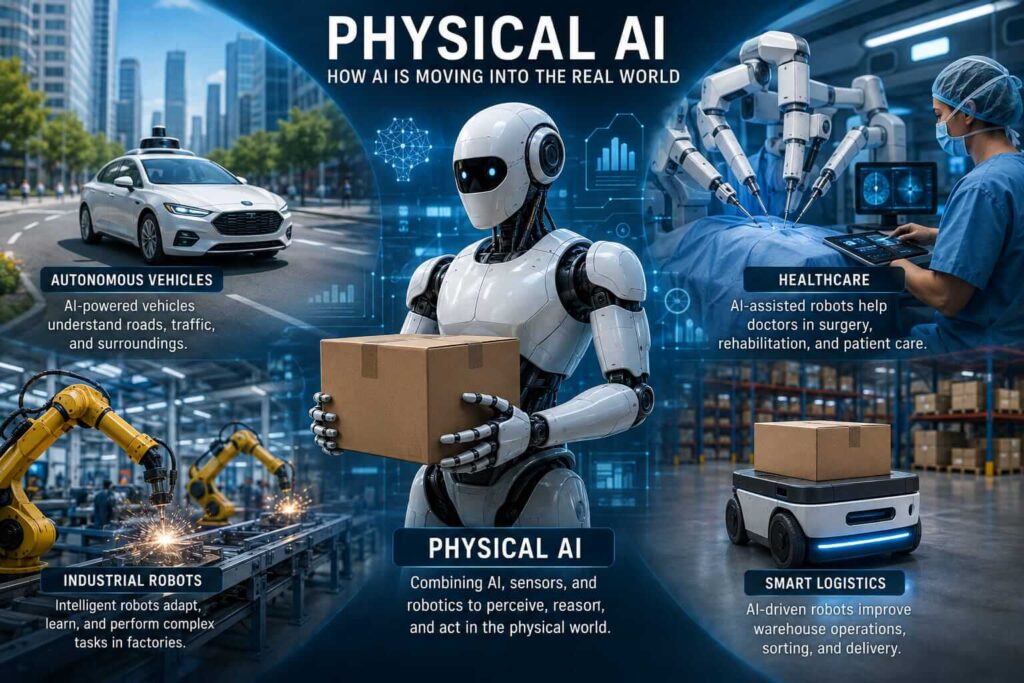
Artificial intelligence is no longer limited to chatbots, websites, and computer screens. Physical AI is taking the next major step by giving intelligent systems the ability to understand and interact with the real world. Robots can now use cameras and sensors to recognize objects, autonomous vehicles can interpret roads and traffic, and intelligent machines can make decisions based on changing physical environments.
This shift could transform manufacturing, healthcare, transportation, logistics, agriculture, construction, and even our homes. Instead of simply generating information, AI is increasingly being designed to see, reason, move, and act.
But what exactly is Physical AI, how does it work, and why is it becoming so important?
Let’s explore the technology and its potential future.
Table of Contents
1. What Is Physical AI?
2. Why Does Physical AI Matter?
3. How Does Physical AI Work?
4. Physical AI vs Traditional AI
5. Real-World Applications of Physical AI
6. Benefits of Physical AI
7. Challenges and Limitations
8. Best Practices for Businesses
9. Common Mistakes to Avoid
10. Physical AI Practical Checklist
11. Frequently Asked Questions
12. Take the Next Step
13. Conclusion
What Is Physical AI?
Physical AI refers to artificial intelligence systems that can perceive, understand, and interact with the physical environment.
Traditional AI generally works inside a digital environment. For example, a chatbot can answer a question, an image generator can create a picture, and a recommendation system can suggest a product.
Physical AI goes further.
It connects AI intelligence with physical machines such as:
- Robots
- Autonomous vehicles
- Drones
- Industrial machines
- Smart cameras
- Warehouse systems
- Medical robots
- Agricultural equipment
These systems combine AI models with sensors, cameras, actuators, processors, and control systems.
IBM describes Physical AI as AI that operates and interacts with physical environments by combining models with sensors, actuators, and control systems.
In simple terms, Physical AI gives machines a way to understand what is happening around them and respond to it.
Why Does Physical AI Matter?
For decades, robots have been excellent at repeating specific tasks. However, many traditional robots work best in controlled environments where everything is predictable.
A factory robot might repeatedly move the same component from one location to another. But what happens when the component moves, another object blocks its path, or a human worker enters the area?
This is where Physical AI becomes important.
Instead of following only fixed instructions, intelligent machines can potentially:
- Understand changing environments
- Recognize different objects
- Follow natural-language instructions
- Plan multiple steps
- Adjust their movements
- Learn from data and experience
- Respond to unexpected situations
The goal is not simply to build robots that move.
The goal is to build machines that can understand the physical world and act intelligently within it.
Recent developments show how quickly this field is advancing. Google DeepMind’s robotics models, for example, are designed to combine visual understanding, reasoning, language, and physical action.
How Does Physical AI Work?
Physical AI requires several technologies working together.
1. Sensors and Cameras
A machine first needs information about its surroundings.
Cameras can provide visual information, while other sensors can detect things such as:
- Distance
- Temperature
- Pressure
- Movement
- Position
- Force
- Sound
For example, a warehouse robot may use cameras and depth sensors to identify shelves, packages, people, and obstacles.
2. AI Perception
The system then processes the information.
Computer vision can help the machine identify objects and understand its surroundings.
For instance, an intelligent robot could distinguish between a cup, a box, a person, and an open doorway.
3. Reasoning and Planning
After understanding its environment, the AI needs to decide what to do.
Suppose someone tells a robot:
“Pick up the package and place it on the table.”
The robot may need to identify the package, locate the table, determine a safe route, approach the object, grasp it, move around obstacles, and release it at the correct location.
This requires planning rather than simple automation.
4. Physical Action
The final stage is action.
Motors, robotic arms, wheels, grippers, and other mechanical components allow the system to interact with the environment.
This creates a continuous cycle:
Perceive → Understand → Plan → Act → Observe → Adjust
That feedback loop is one of the key ideas behind intelligent physical systems.
Physical AI vs Traditional AI
Although both technologies use artificial intelligence, their environments are very different.
Traditional AI| Physical AI
Mainly operates digitally| Operates in the physical world
Produces text, images, predictions, or data| Produces physical actions
Works mainly with digital inputs| Uses cameras and physical sensors
Lower physical risk| Physical safety is important
Examples: chatbots and recommendation engines| Examples: robots and autonomous vehicles
For example, a chatbot can tell you how to make coffee.
A Physical AI-powered robot could potentially recognize a coffee machine, locate a cup, prepare ingredients, and physically perform parts of the process.
That difference is enormous.
Real-World Applications of Physical AI
Physical AI is already being explored across multiple industries.
Manufacturing
Factories are one of the most promising areas.
AI-powered robots can assist with inspection, assembly, material handling, packaging, and other industrial processes.
Instead of programming every movement manually, future systems may become more adaptable to changing production requirements.
Manufacturing is particularly important because companies in the USA, Canada, Europe, and the UK are looking for ways to improve productivity while addressing workforce and skills challenges.
Autonomous Vehicles
Self-driving vehicles are another major example.
An autonomous vehicle needs to understand:
- Roads
- Pedestrians
- Traffic signs
- Other vehicles
- Weather
- Road conditions
- Unexpected obstacles
It then needs to make decisions and physically control the vehicle.
This is a clear example of AI moving from digital prediction into physical action.
Healthcare
Physical AI could also influence healthcare.
Robotic systems may assist with rehabilitation, hospital logistics, surgery, patient support, and laboratory automation.
However, healthcare applications require particularly strong safety testing and human oversight.
Warehouses and Logistics
Modern warehouses already use automated systems to move products.
The next generation of intelligent robots could become more flexible, allowing machines to identify unfamiliar objects, navigate changing environments, and cooperate with human workers.
Agriculture
Farm robots and autonomous agricultural machines could help with:
- Crop monitoring
- Weed detection
- Precision spraying
- Harvesting
- Soil analysis
- Autonomous equipment
This could make agricultural operations more data-driven while reducing repetitive manual work.
Homes and Everyday Life
One of the most exciting possibilities is domestic robotics.
Imagine telling a home robot:
“Please clean the kitchen before our guests arrive.”
Instead of following one fixed routine, a more advanced Physical AI system could identify objects, understand the environment, prioritize tasks, and adapt when something changes.
This remains a difficult technological challenge, but research is moving toward more general-purpose robots.
Benefits of Physical AI
Greater Automation
Physical AI could automate tasks that previously required continuous human involvement.
Improved Productivity
Machines can perform repetitive operations consistently and potentially operate for long periods.
Better Adaptability
Traditional automation can struggle when conditions change. AI-powered systems can potentially adapt their behavior based on new information.
Safer Work Environments
Robots can potentially perform dangerous tasks in environments involving extreme temperatures, hazardous materials, heavy machinery, or unstable structures.
New Business Opportunities
Physical AI may create opportunities for companies developing:
- Robotics solutions
- AI software
- Sensors
- Simulation platforms
- Autonomous systems
- Industrial automation
- AI training services
The economic opportunity is significant, although widespread adoption will depend on cost, reliability, safety, and proven business value.
What Are the Challenges of Physical AI?
Physical AI is promising, but it is far from perfect.
Safety
A software error may produce a wrong answer. A physical AI error could cause an accident.
Therefore, robots need multiple layers of safety controls.
Google DeepMind has highlighted the importance of safety mechanisms alongside AI models when deploying robotics systems in physical environments.
High Costs
Advanced robots require expensive hardware, sensors, computing systems, maintenance, and training.
For many small businesses, the investment may currently be difficult to justify.
Limited Real-World Understanding
The physical world is unpredictable.
Objects can fall. Lighting can change. People can behave unexpectedly. Surfaces can be slippery. Weather can affect sensors.
Teaching AI to handle all these situations is extremely challenging.
Training Data
AI models need large amounts of useful data.
Physical AI requires information about movement, environments, objects, forces, failures, and successful actions.
Simulation can help generate training experiences without exposing real machines or people to unnecessary risk. NVIDIA, for example, emphasizes simulation and digital environments as important components of Physical AI development.
Employment Concerns
Automation may change the nature of some jobs.
Some repetitive roles could become increasingly automated. At the same time, new opportunities may emerge in robotics maintenance, AI engineering, system supervision, safety, data management, and other technical fields.
The long-term impact will likely depend on how quickly businesses adopt the technology and how effectively workers are trained for changing roles.
How Businesses Can Prepare for Physical AI
Companies should not adopt Physical AI simply because it is a popular technology trend.
Instead, businesses should begin with a clear problem.
Step 1 — Identify Repetitive Tasks
Look for tasks that are:
- Repetitive
- Physically demanding
- Time-consuming
- Dangerous
- Expensive to perform manually
Step 2 — Measure the Current Process
Record costs, time requirements, error rates, safety incidents, and productivity.
Without a baseline, it is difficult to measure whether automation actually creates value.
Step 3 — Start Small
A pilot project is usually safer than attempting a complete transformation.
Test one workflow first.
Step 4 — Evaluate Safety
Consider workers, customers, equipment, cybersecurity, data, and physical environments.
Step 5 — Keep Humans in the Loop
Human oversight remains important, especially for high-risk applications.
Step 6 — Scale Gradually
If the pilot produces measurable benefits, the system can gradually expand to additional workflows
Common Physical AI Mistakes to Avoid
Businesses and technology enthusiasts should avoid several common mistakes.
Mistake 1: Expecting robots to behave like humans immediately.
Physical environments are significantly harder for AI than digital environments.
Mistake 2: Ignoring hardware limitations.
A powerful AI model cannot compensate for poor sensors, weak motors, or inadequate mechanical design.
Mistake 3: Focusing only on demonstrations.
A robot completing one impressive demonstration does not automatically mean it is ready for commercial deployment.
Mistake 4: Ignoring safety.
Physical AI must be designed with safety controls from the beginning.
Mistake 5: Automating without measuring ROI.
Businesses should compare the cost of implementation with measurable improvements in productivity, quality, safety, or operating expenses.
Physical AI Practical Checklist
Before exploring a Physical AI project, ask:
- What physical problem are we trying to solve?
- Can the task realistically be automated?
- What sensors are required?
- Does the system need cameras or depth perception?
- What happens if the AI makes a mistake?
- Is human supervision required?
- What data will be needed?
- Can simulation reduce testing costs?
- What are the hardware and maintenance costs?
- How will success be measured?
- Can the system scale after a successful pilot?
This checklist can help organizations separate genuine business opportunities from technology hype.
Frequently Asked Questions About Physical AI
https://futurescienceai.com/blog/ai-in-education/ai-tutors-vs-human-teachers/
Q1.What is Physical AI in simple words?
Physical AI is artificial intelligence that can understand and interact with the physical world. It combines AI with machines, sensors, cameras, and control systems so machines can perceive and perform physical actions.
Q2.Is Physical AI the same as robotics?
Not exactly. Robotics focuses on designing and controlling physical machines, while Physical AI adds advanced AI capabilities that can help those machines understand environments, make decisions, and adapt to situations.
Q3.What are examples of Physical AI?
Examples include autonomous vehicles, intelligent robots, warehouse robots, drones, industrial machines, agricultural robots, and other autonomous systems that perceive and act in physical environments.
Q4.Why is Physical AI important?
Physical AI is important because it could allow machines to perform more flexible and complex tasks. Instead of following only fixed instructions, intelligent machines can potentially respond to changing environments and natural-language commands.
Q5. Will Physical AI replace human workers?
Physical AI is likely to automate some tasks rather than simply replace every worker. It may reduce repetitive or dangerous work while creating demand for new skills in robotics, AI, engineering, maintenance, supervision, and system management.
Take the Next Step With Future Technology
https://futurescienceai.com/blog/artificial-intelligence/humanoid-robots-everyday-life/
Physical AI is moving AI beyond screens and into factories, roads, warehouses, hospitals, farms, and potentially our homes.
For businesses, the biggest opportunity is not simply owning an intelligent robot. It is identifying where intelligent automation can solve a real problem.
Whether you are exploring AI automation, robotics, autonomous systems, or the next generation of intelligent technology, understanding Physical AI today can help you prepare for tomorrow.
Want to stay ahead of emerging technology? Explore more Future Science AI articles, follow the latest developments in artificial intelligence and robotics, and discover how today’s innovations could shape the world of tomorrow.
Conclusion
https://www.ibm.com/think/topics/physical-ai
Physical AI represents an important evolution in artificial intelligence. Instead of remaining inside computers and digital applications, AI is increasingly gaining the ability to perceive physical environments, reason about them, and take action.
From autonomous vehicles and industrial robots to healthcare machines and future home assistants, the potential applications are enormous.
However, the technology still faces major challenges involving safety, cost, training data, reliability, and real-world adaptability.
The future will not simply belong to machines that can think. It will increasingly belong to systems that can think, perceive, move, and interact responsibly with the physical world.
As Physical AI continues to develop, the boundary between artificial intelligence and robotics may become increasingly difficult to separate. For businesses, researchers, and everyday users, now is the time to understand this emerging technology and consider what it could mean for the future.