Fusion Energy: Could Nuclear Fusion Power the Future?
Introduction
Fusion energy is one of the most ambitious ideas in modern science. Instead of burning coal, oil, or gas, fusion attempts to reproduce the nuclear reaction that powers the Sun and other stars. If engineers can make the process work reliably on Earth, it could provide enormous amounts of low-carbon energy from relatively small quantities of fuel.
The idea sounds almost futuristic, but fusion research has moved from theory toward increasingly impressive laboratory demonstrations. Large international projects such as ITER are being developed to study burning plasma, while laser-based experiments at the National Ignition Facility have repeatedly demonstrated fusion ignition.
However, an important question remains: Can fusion become a practical source of electricity for homes, businesses, data centres, factories, and national power grids?
The answer is not yet certain. Fusion has extraordinary potential, but scientists and engineers still face major challenges involving plasma control, materials, fuel, cost, maintenance, and continuous electricity production.
Table of Contents
1. Why Fusion Energy Matters
2. What Is Nuclear Fusion?
3. How Does Fusion Energy Work?
4. Main Fusion Technologies
5. What Is ITER?
6. Benefits of Fusion Energy
7. The Biggest Challenges
8. Could Fusion Replace Renewable Energy?
9. Step-by-Step Path to Commercial Fusion
10. Common Mistakes and Misconceptions
11. Practical Fusion Energy Checklist
12. Frequently Asked Questions
13. The Future of Fusion Energy
14. Conclusion
Why Fusion Energy Matters
The world’s demand for electricity continues to grow as economies become more digital and electrified.
Electric vehicles, artificial intelligence, cloud computing, advanced manufacturing, heating systems, and data centres all require reliable electricity. At the same time, governments are trying to reduce greenhouse-gas emissions while maintaining energy security.
Solar and wind power are already important parts of the clean-energy transition. However, their output depends on weather conditions and the availability of suitable locations. Batteries, transmission networks, hydropower, and other technologies can help manage these challenges.
Fusion is being investigated for a different reason: it could potentially provide high-density, low-carbon, reliable power.
The U.S. Department of Energy describes fusion as a potential long-term energy source and notes that fusion does not produce greenhouse gases during the fusion reaction itself.
What Is Nuclear Fusion?
Nuclear fusion happens when two light atomic nuclei combine to create a heavier nucleus.
The most widely studied reaction for future fusion power uses two hydrogen isotopes:
- Deuterium
- Tritium
When deuterium and tritium fuse, they produce helium, a neutron, and a large amount of energy. The energy comes from a small difference in mass between the original particles and the resulting products, consistent with Einstein’s famous mass-energy relationship, E=mc².
The Sun uses fusion differently because its enormous gravitational pressure creates the conditions required for fusion. On Earth, researchers must recreate suitable conditions using sophisticated machines.
That is the fundamental engineering challenge.
A fusion reactor must create an extremely hot plasma and keep it confined long enough for fusion reactions to occur efficiently.
How Does Fusion Energy Work?
Understanding fusion energy becomes easier when you break the process into several stages.
1. Create the Plasma
First, scientists heat hydrogen isotopes until the gas becomes plasma.
Plasma is an extremely hot state of matter in which electrons separate from atomic nuclei.
For deuterium-tritium fusion, temperatures around 150 million°C are required.
That is much hotter than the core of the Sun. The difference is that the Sun relies on enormous gravitational pressure, while a fusion device must use technology to control the plasma.
2. Confine the Plasma
The next challenge is preventing the plasma from touching the reactor walls.
One leading approach is magnetic confinement.
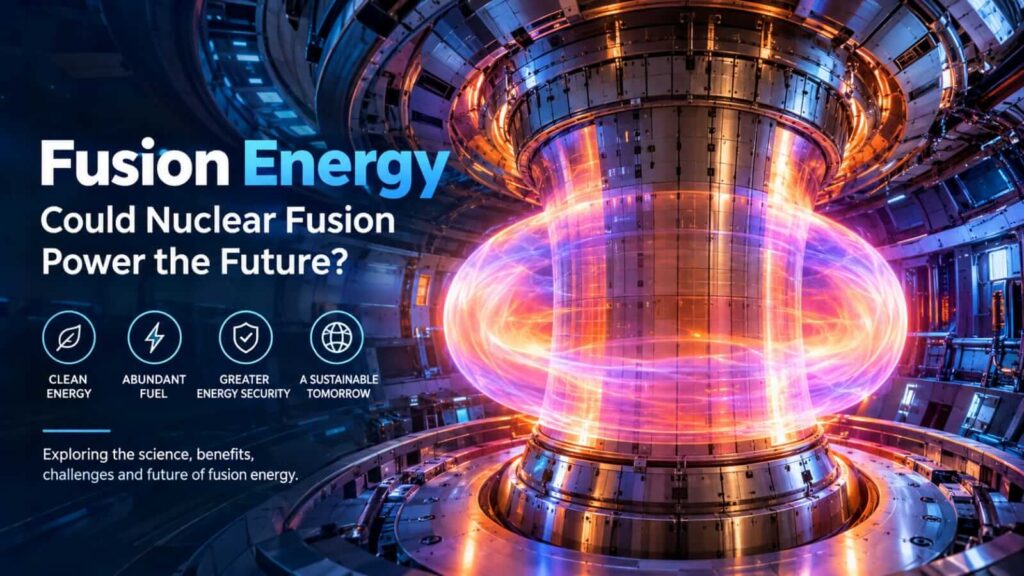
Tokamak machines use powerful magnetic fields to keep the plasma circulating inside a doughnut-shaped chamber.
Superconducting magnets are particularly important because they can create powerful magnetic fields while operating at extremely low temperatures.
3. Trigger Fusion
When the plasma becomes hot and dense enough, deuterium and tritium nuclei can overcome their electrical repulsion and fuse.
The reaction produces helium and a high-energy neutron.
The helium nucleus remains electrically charged and can contribute to heating the plasma, while the neutron carries much of the fusion energy into surrounding structures.
4. Capture the Heat
A commercial fusion power plant would need to capture the energy produced by the fusion reaction.
That heat could eventually be transferred to a coolant system, used to produce steam, and then converted into electricity through turbines—or potentially used through other advanced power-conversion systems.
This is an important distinction: creating fusion is not the same as operating a commercial power plant.
The Main Fusion Technologies
Scientists are exploring multiple approaches rather than relying on one design.
Tokamak Fusion
The tokamak is currently one of the best-known magnetic-confinement designs.
It uses a doughnut-shaped chamber and powerful magnetic fields to control plasma.
ITER is being constructed around this approach and is designed to produce 500 MW of fusion power from 50 MW of heating power, corresponding to a target fusion gain of Q≥10.
Stellarators
Stellarators also use magnetic fields but have a more complex three-dimensional geometry.
Their design could offer advantages for continuous plasma operation because they do not rely on exactly the same current-driven plasma configuration as tokamaks.
However, stellarators also present difficult engineering and manufacturing challenges.
Laser Fusion
Another approach is inertial confinement fusion.
Instead of holding a large plasma inside a magnetic chamber, powerful lasers rapidly compress a tiny fuel target.
The National Ignition Facility in California has achieved repeated ignition experiments. In June 2026, NIF reported an ignition experiment producing 7.9 MJ of fusion yield from a laser shot delivering about 2.05 MJ to the target, with a target gain of approximately 3.8.
These results are scientifically important, although they should not be confused with a commercial power station producing electricity for the grid.
What Is ITER?
https://futurescienceai.com/blog/future-tech/smart-contact-lenses/
ITER, based in southern France, is one of the world’s largest international fusion research projects.
It brings together major partners including the European Union, China, India, Japan, South Korea, Russia, and the United States.
ITER is not designed to sell electricity to the grid. Instead, it is intended to investigate whether a burning plasma can be sustained and to test technologies needed for future fusion power plants.
Its planned performance is remarkable.
ITER aims to generate approximately 500 MW of fusion power from 50 MW of heating power, producing a Q value of at least 10.
However, ITER’s 500 MW figure refers to fusion power generated inside the plasma—not 500 MW of electricity delivered to homes.
This distinction is important when evaluating fusion headlines.
ITER’s current project planning places deuterium-tritium operation around 2039, illustrating that fusion development is a long-term engineering programme rather than an immediate energy solution
Benefits of Fusion Energy
https://www.iter.org/fusion-energy/advantages-fusion
Why are governments, universities, laboratories, and private companies investing billions in fusion research?
1. Extremely High Energy Density
Fusion can release enormous amounts of energy from small quantities of fuel.
The potential energy density is one of the reasons fusion attracts interest as a future large-scale power source.
2. Low Carbon During Operation
Fusion itself does not burn fossil fuels and does not produce carbon dioxide as a direct product of the fusion reaction.
That could make it valuable in long-term decarbonisation strategies.
3. Potentially Abundant Fuel
Deuterium can be extracted from water, while lithium could potentially be used to breed the tritium required by future deuterium-tritium reactors.
However, producing and managing tritium at commercial scale remains a significant challenge.
4. Reliable Power
Unlike solar and wind, a successful fusion power plant could potentially operate independently of sunlight and wind conditions.
This could make fusion particularly interesting for industrial facilities, cities, and electricity grids that require continuous power.
5. No Conventional Chain Reaction
Fusion reactors do not operate through the same sustained fission chain reaction used in conventional nuclear fission reactors.
If fusion conditions are disrupted, the reaction naturally stops because maintaining fusion requires extreme conditions.
Nevertheless, fusion facilities would still need robust nuclear safety systems and careful management of radioactive materials and activated components.
The Biggest Challenges Facing Fusion Energy
Fusion is promising, but it is not yet a commercially proven energy technology.
Plasma Control
Plasma is incredibly difficult to control.
Small instabilities can affect confinement and reduce the efficiency of a fusion reaction.
Researchers therefore need advanced sensors, control systems, magnets, simulations, and artificial intelligence to understand and manage plasma behaviour.
Extreme Materials
The interior components of a fusion reactor could face intense neutron bombardment and enormous heat loads.
Researchers need materials that can survive these conditions for long periods.
The U.S. Department of Energy identifies materials, tritium breeding, superconducting magnets, and heat-management systems as important areas of fusion research.
Tritium Supply
Tritium is radioactive and naturally scarce.
A future commercial reactor may therefore need to produce its own tritium using lithium-containing breeding blankets.
ITER plans to test concepts related to tritium breeding, which is one reason the project is important for future reactor development.
Cost and Commercial Competition
A scientifically successful reactor still needs to make economic sense.
A recent 2026 analysis published in Nature Energy argued that current dominant fusion approaches may struggle to become economically competitive without significant improvements in design and deployment characteristics.
Therefore, the real test is not simply:
“Can we make fusion work?”
It is:
“Can we build fusion plants that produce electricity reliably, affordably, and at commercial scale?”
Could Fusion Replace Renewable Energy?
Probably not.
A more realistic future could involve fusion working alongside renewable energy, energy storage, nuclear fission, hydropower, and other technologies.
Solar and wind can provide low-cost electricity when conditions are favourable. Batteries and grid technologies can help balance supply and demand.
Fusion, if successfully commercialised, could potentially provide another source of dependable low-carbon electricity.
In other words, the future energy system may not have one winner.
Instead, different technologies could perform different jobs.
Step-by-Step Path to Commercial Fusion
For fusion to become a practical energy source, several milestones need to be achieved.
Step 1 — Demonstrate Sustained Fusion
Researchers must maintain fusion conditions for longer periods.
Step 2 — Improve Energy Gain
Fusion systems need to produce significantly more useful energy than the energy required to operate the entire facility.
Step 3 — Develop Durable Materials
Engineers need reactor materials capable of surviving extreme heat and neutron exposure.
Step 4 — Solve Tritium Breeding
Commercial deuterium-tritium reactors will likely need reliable methods for producing their own tritium fuel.
Step 5 — Convert Fusion Heat Into Electricity
A power plant must efficiently transform fusion energy into electricity.
Step 6 — Prove Economic Viability
Finally, fusion must compete with other energy technologies on cost, reliability, construction time, maintenance, and electricity output.
Common Mistakes and Misconceptions
Mistake 1: “Fusion is already powering the electricity grid.”
It is not. Fusion remains a research and development technology.
Mistake 2: “ITER will provide electricity to Europe.”
ITER is an experimental facility and is not designed to generate electricity for commercial distribution.
Mistake 3: “Fusion creates no radioactive material.”
This is too simplistic.
The fusion reaction itself is different from conventional fission, but neutron activation of reactor materials and the handling of tritium create important radioactive-material challenges.
Mistake 4: “One successful ignition experiment means commercial fusion is solved.”
Ignition is a major scientific milestone, but producing a laboratory fusion pulse is very different from running a reliable commercial power station.
Mistake 5: “Fusion will replace every other energy source.”
The future energy system will likely require multiple technologies.
Practical Fusion Energy Checklist
When evaluating a fusion energy claim, ask:
- Is the experiment producing fusion energy or electricity?
- What does the reported Q value actually measure?
- Is the result repeatable?
- How long can the plasma remain stable?
- What fuel is being used?
- How will tritium be supplied?
- Can the reactor materials survive neutron damage?
- How will heat become electricity?
- What is the projected construction cost?
- Can the technology operate continuously?
- How does it compare with renewable energy and other nuclear technologies?
This checklist can help readers distinguish genuine scientific progress from exaggerated headlines.
Frequently Asked Questions About Fusion Energy
1. What is Fusion Energy?
Fusion Energy is energy released when light atomic nuclei combine to form a heavier nucleus. Scientists are developing technologies that could use this reaction to generate electricity.
2. Is Fusion Energy safe?
Fusion Energy has important safety advantages because the reaction requires extremely specific conditions and does not operate like a self-sustaining fission chain reaction. However, fusion facilities still require strict safety controls for tritium, neutron radiation, activated materials, and high-energy equipment.
3. Is nuclear fusion renewable?
Fusion is generally described as a potential long-term or abundant energy source rather than renewable energy in exactly the same sense as solar or wind. Its fuel resources could be extremely large, but commercial fuel cycles still need to be demonstrated.
4. When will Fusion Energy be commercially available?
There is no guaranteed commercial date. Several experimental programmes and private companies are working toward demonstration plants, but significant scientific, engineering, regulatory, and economic challenges remain.
5. Could Fusion Energy replace fossil fuels?
Fusion Energy could eventually help reduce dependence on fossil fuels if commercial plants become reliable and economical. However, it would likely work alongside renewable energy, storage, nuclear fission, and other low-carbon technologies rather than replacing them overnight.
The Future of Fusion Energy
The future of Fusion Energy is both exciting and uncertain.
On one side, recent experiments demonstrate that researchers can achieve increasingly impressive fusion conditions. ITER is designed to investigate burning plasma at a scale far beyond today’s conventional experimental machines, while laser-fusion research continues to produce repeated ignition results.
On the other side, creating a fusion reaction is only one piece of the puzzle.
A commercially useful fusion plant must operate for long periods, withstand extreme environments, breed or obtain its fuel, remove heat efficiently, maintain components, satisfy regulators, and produce electricity at a competitive price.
That means the next stage of fusion research will increasingly focus on engineering, not just physics.
Artificial intelligence, advanced materials, robotics, high-temperature superconductors, digital twins, plasma simulations, and automated control systems could all contribute to solving these problems.
For countries such as the United States, Canada, the UK, and European nations, successful fusion could eventually strengthen energy security while supporting industries that require large quantities of dependable low-carbon electricity
Ready to Explore the Future of Energy?
If you want to understand how artificial intelligence, advanced science, space technology, renewable energy, quantum computing, and emerging technologies could reshape the future, continue exploring Future Science AI.
CTA:
Stay ahead of emerging science and technology. Explore more Future Science AI articles, follow the latest breakthroughs, and share this guide with anyone interested in the future of energy.
Conclusion
Fusion Energy could become one of the most important technologies of the future—but it is not a finished solution yet.
Scientists have made major progress in understanding plasma, improving confinement, developing powerful magnets, and demonstrating fusion ignition. Projects such as ITER are taking the next step by investigating burning plasma and technologies required for future fusion power plants.
Still, major challenges remain. Commercial fusion requires durable materials, reliable fuel cycles, efficient heat conversion, long-duration operation, affordable construction, and strong safety systems.
So, could nuclear fusion power the future?
Possibly—but the answer will depend on whether researchers can turn impressive laboratory achievements into reliable, affordable power plants.
If they succeed, fusion could become a valuable part of a diverse clean-energy system and help meet the world’s growing demand for electricity.
The dream of creating a miniature Sun on Earth is no longer purely science fiction. The difficult question now is whether humanity can engineer that dream into a practical power source